All species › Grebes › Grebes › Pied-billed grebe
Pied-billed grebe
Podilymbus podiceps | Dikbekfuut | Zampullín picogrueso
An American grebe with the head and bill of a small gamebird: blocky, high-foreheaded and carrying a short, strikingly deep bill. Most European records involve birds that settle on one small water and stay for weeks or months, which is why so many people have caught up with them.

Voice
The song is a loud, hollow series that starts with a rattling kek-kek-kek and slows into a cuckoo-like cow-cow-cow-cowp, falling away at the end. On the breeding grounds it is given at dawn and dusk, often from inside cover. Vagrants in Europe are almost always silent, so do not count on hearing anything.
No freely licensed recording is available for this species yet.
Identification
A dumpy, uniformly grey-brown grebe, larger and heavier than Little Grebe, with a short neck and a fluffy white rear end cocked up like a powder puff. The bill decides it: short, deep and laterally compressed with a curved culmen, in breeding plumage pale blue-white with a clean black vertical band, and with a black throat patch above it. In winter the bill is horn-yellow without a band, the throat is dull white and the face is warm buff below a dark crown. A thin white eye-ring is visible at close range. Birds often sink slowly like a submarine rather than diving.
Confusion species
Little Grebe is the only real pitfall, and the comparison comes down to three things. The bill: thin, pointed and dark on Little Grebe with a bright green gape spot, short, deep and pale on Pied-billed Grebe, black-banded in summer. Head shape: round and neat on Little Grebe, blocky on Pied-billed with a steep forehead and a flat crown. Size and tone: Little Grebe is clearly smaller and shows chestnut cheeks and neck in breeding plumage, while Pied-billed stays an even coffee-brown and shows a more obvious white stern.
Habitat
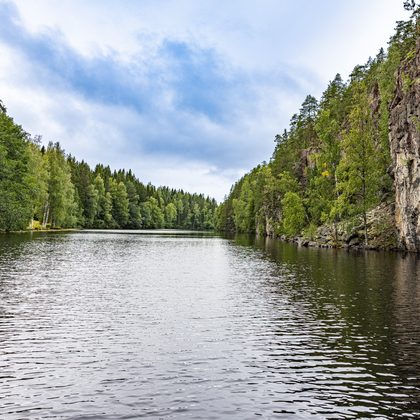
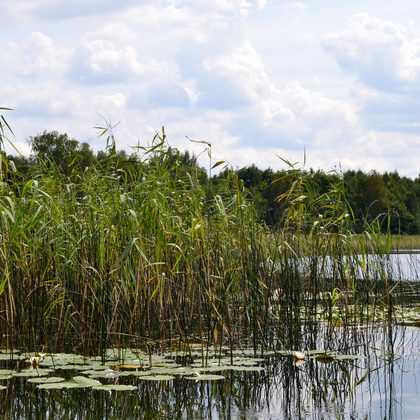
Small, sheltered fresh waters with plenty of marginal cover: reed-fringed pools, gravel pits, reservoirs, park lakes, canals and slow rivers. European birds are nearly always found on exactly this kind of water, and only rarely on large open lakes.
Where the bird is most at home, classified with EUNIS — the European standard for habitats.

Range and movements
The species ranges over North, Central and South America. In Europe it is a rare vagrant: near-annual in the Azores, with a few dozen records in Britain and Ireland, and scattered occurrences in north-west Spain and France. A famous South Wales bird paired with a Little Grebe in the 1960s and reared hybrid young, a record still quoted whenever the species comes up. Records fall mainly between late autumn and spring.
- Resident
- Breeding (summer)
- Winter
- Passage
- dark = core range, pale = thinly spread
Where and when to look
Look between October and December, after a run of Atlantic depressions, on reservoirs, gravel pits and reed-fringed fish ponds, and check every Little Grebe on such waters. Long stays are the rule, so a reported bird is usually still there the next day. Watch for the individual that hangs around the reed edge and sinks quietly out of sight instead of diving briskly.
Conservation status
Not globally threatened and widespread across the Americas, although breeding sites are lost locally where marshes are drained or cleared. In Europe the species is far too rare to manage for; the only practical concern is disturbance to long-staying birds by observers pressing too close to the bank.