All species › Tropicbirds › Tropicbirds › Red-billed tropicbird
Red-billed tropicbird | Phaethon aethereus
Roodsnavelkeerkringvogel | Rabijunco etéreo
The red-billed tropicbird belongs to warm oceans, not to Europe, which is exactly why nobody forgets one: brilliant white, with a coral-red bill and two whip-thin tail streamers trailing behind like ribbons. It is the only member of its order and its family in this guide, and when one turns up it is almost always high, alone and a long way from any other seabird.

Voice
In Europe you will almost certainly hear nothing, because a wandering bird at sea is silent. At the colony it is loud: a shrill, rattling, screeching krik-krik-krik-krik thrown out by two or three birds as they circle tightly above the cliff, streamers spread apart. From inside the nest crevice comes a lower, growling rasp.
No freely licensed recording is available for this species yet.
Identification
A white seabird the size of a sandwich tern but far more heavily built, thick-necked and heavy-headed. The plumage is satin white with a black eye-stripe that broadens behind the eye and runs onto the side of the nape, fine black barring across mantle, back and scapulars, and black outer primaries that give the wingtip a sharp dark leading edge in flight. The bill is heavy, slightly decurved and coral to orange-red. Adults carry two white tail streamers 46 to 56 cm long, thin as whipcord; at range they are the first thing you see, or else entirely absent, because they break off easily. The flight is high and direct on fast, shallow, almost pigeon-like beats broken by short glides; over a shoal the bird hangs briefly on the spot and then drops vertically with half-closed wings. On the sea it floats high with the streamers cocked. Juveniles lack streamers and show a yellow bill, a black hindneck bar and much coarser black barring above.
Confusion species
With the streamers missing, which is half the time, sandwich tern is the quickest mistake: much smaller and slimmer, with a shaggy black crown and a black bill with a yellow tip, and a looser, deeper wingbeat. Northern gannet is far larger and cigar-shaped, with black across the whole wingtip and a pointed blue-grey bill. A summer-plumaged long-tailed skua also carries two long central feathers, but it is grey-brown with a black cap and dark wings, and those feathers are flexible and blunt rather than white and whip-thin. The world's two other tropicbirds do not occur within the area covered here, so the combination of a red bill, white streamers and finely black-barred upperparts can be nothing else.
Habitat
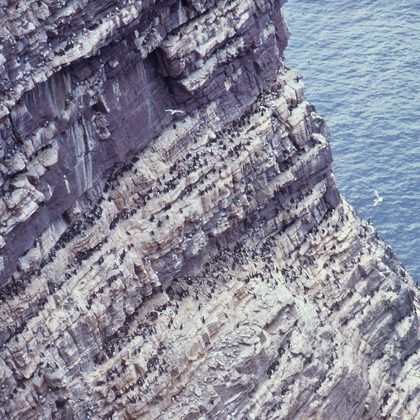
Warm, deep, nutrient-poor ocean, usually well beyond the shelf edge, where it hunts flying fish and squid alone, plunging vertically from ten to thirty metres. It comes ashore only to breed, laying a single egg in a rock crevice, under an overhang or in a cavity on a steep sea cliff of an oceanic island, with no nest material. Its legs are set so far back that it cannot walk; it shuffles in and out of the hole on its breast, which leaves it helpless on the ground.
Where the bird is most at home, classified with EUNIS — the European standard for habitats.

Range and movements
Breeds on tropical islands in the Atlantic, the Indian Ocean and the eastern Pacific. Within the area of this guide there are two separate stories. In the east the Red Sea breeding population reaches into the Gulf of Aqaba, which makes the bird a scarce but nearly annual visitor at Eilat, the southern tip of Israel and the Jordanian coast. In the west it has appeared with increasing regularity off the Azores and the Canaries since the 1990s, individuals sometimes lingering for weeks at the same cliff. On the European mainland every record is an event: Britain has a bare handful, and the species is not to be expected on the North Sea.
Where and when to look
The most reliable spot in the whole area is the head of the Gulf of Aqaba. Between March and June take a telescope to North Beach at Eilat or to the harbour wall and sweep the open gulf, ideally in the first hours after sunrise while the water is still flat and a white shape stands out at once; look high, because the bird rarely travels low. The second option is a pelagic off the Azores out of Horta or Lajes do Pico in July, August or September, and the third a boat trip along the south coast of Tenerife or around La Gomera in summer. The rule is the same everywhere: it will not come to the boat, so scan the sky rather than the wake.
Conservation status
Not globally threatened (IUCN: Least Concern), though that is a reassurance with an edge to it: the world population is put at a few thousand to somewhat over ten thousand mature birds and is falling. Every colony is on an island, and there introduced rats, cats and aggressive ants do the damage, alongside disturbance at cliff nests and drowning in fishing gear. Within this map the species amounts to a handful of birds a year; what happens to it is decided on breeding islands well outside it.