All species › Gamebirds › Pheasants and partridges › Red-legged partridge
Red-legged partridge
Alectoris rufa | Rode patrijs | Perdiz roja
The Frenchman: a plump, red-legged gamebird of dry open country, and after the Pheasant the commonest bird released into the British countryside. Every one you see at home goes back to released stock, and the wild birds of Iberia and southern France are a rather different proposition.

Voice
A rhythmic, chugging sound like an old steam engine: a run-up of separate chuk notes that turns into chuk-chuk-chukara, usually from a stone, a wall or a fence post. Also a fast ti-ti-ti-ti and a soft ko-ko-ko between birds of a covey. Most vocal from February to May, in the first and last hours of the day.
No freely licensed recording is available for this species yet.
Identification
Solid grey-brown gamebird with coral-red bill, red eye-ring and red legs. Throat and cheeks white, edged with black, but that edging breaks downwards into a broad field of black streaks and drops across the neck and upper breast. Crown warm chestnut, forehead greyish, with a narrow white supercilium carried over the bill. Flanks broadly barred in white, black and chestnut. Belly orange-buff. Flight low and fast, showing rusty tail sides.
Confusion species
Red-legged is the only one of the four whose black throat surround does not stay closed: below the white bib it breaks into a broad field of black streaks and drops over the neck and upper breast, and the flank bars carry obvious chestnut as well as black and white. Crown warm chestnut. Rock Partridge, which sits higher on the same slopes in the western Alps and the Ligurian Apennines, has a pure white bib running further onto the upper breast, an unbroken knife-sharp black line, black at the base of the bill, a blue-grey crown and nape, and broad, widely spaced flank bars. Chukar has a cream throat, a closed but slightly broader and more ragged black line, a grey-brown crown with a vinous cast, a rufous ear patch inside the black eye-stripe, and narrower, more numerous bars that read as black-and-white. Barbary Partridge has no black line at all, but a chestnut collar spotted with white around a blue-grey face. The hybrid is the live issue at home. Chukars and Chukar × Red-legged crosses were released here in quantity until it was outlawed in the early 1990s, and hybrid genes have never wholly left the rearing pens; such birds show a creamier throat, a gorget only half broken into streaks and flanks short of chestnut. Any bird on a British shooting estate that looks too clean-throated deserves a second look before it is called a Red-leg.
Habitat
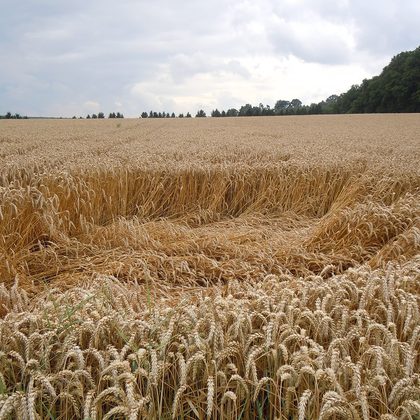
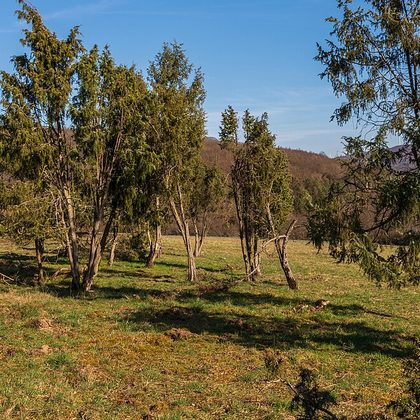
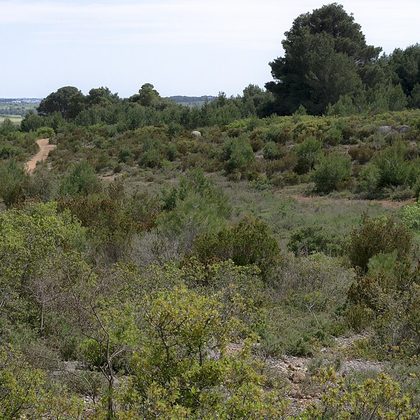
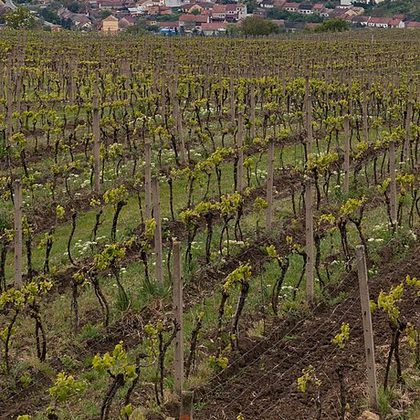
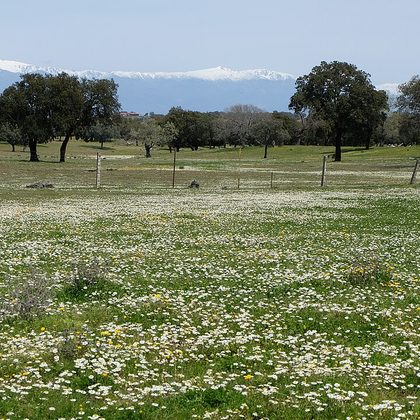
Dry open farmland: cereal and stubble, fallow, vineyards, olive groves, dehesa, and the garrigue and low scrub edges between them. It needs bare ground to work, weedy seed-rich margins, and cover within a few paces. To over two thousand metres in the Spanish mountains, where birds reach the broom fields.
Where the bird is most at home, classified with EUNIS — the European standard for habitats.
Range and movements
Naturally Iberia, southern and central France and north-west Italy. Naturalised in England and Wales, where the birds go back to releases from the late eighteenth century on a Suffolk estate, and released on the Azores, Madeira and Gran Canaria among others. In Britain the breeding total was put at around 73,000 territories in 2016, with roughly ten million reared birds released each year — a very different bird from the wild Iberian stock.
- Resident
- Breeding (summer)
- Winter
- Passage
- Migration direction
- dark = core range, pale = thinly spread
Where and when to look
At home, work farmland field edges and set-aside strips at dawn in March and April, when males call from posts and molehills. Abroad, drive the farm tracks of La Mancha, Extremadura or the Ebro valley slowly at sunrise and stop at every calling bird; later in the day they feed under the olives and in the stubble and all you see is a running back.
Conservation status
Near Threatened, with a steep decline in the native range — over forty per cent in Spain since 1998. Field enlargement, the loss of fallow and weedy margins, insect decline for the chicks and heavy hunting pressure all pull the same way, and the annual release of millions of reared birds adds chukar genes and disease to the wild stock. In Britain the trend is downwards too, at 39 per cent since 1967, but with releases on that scale the figure says more about the shooting industry than about the species.