All species › Nightjars › Nightjars › Red-necked nightjar
Red-necked nightjar
Caprimulgus ruficollis | Moorse nachtzwaluw | Chotacabras cuellirrojo
The Red-necked Nightjar is the largest nightjar of the Western Palearctic and one of the most characteristic birds of an Iberian summer night. It settles on quiet tracks and back roads, where headlights pick out its eyes as two red embers.

Voice
The song is a mechanical, repeated knocking, kutok kutok kutok, like someone chopping wood far off or bouncing a ball on stone; it runs on for minutes and swells and fades as the bird turns its head. It has nothing of the sustained churring rrrrrrrrrr of European Nightjar. In display the bird also produces a dry crack as the wings meet above the back.
Recording: Joost van Bruggen — CC BY-SA 4.0 · Wikimedia Commons
Identification
About fifteen per cent larger than European Nightjar and strikingly paler and sandier, the fine vermiculation set on a light grey ground. The clincher is the rufous collar around the nape and sides of the neck, warmer and more saturated than any tone the European species shows, together with a sharply defined white throat patch. The white spots on the three outer primaries and at the tail corners are present in both sexes, though duller and more diffusely edged on the female. Wings and tail are long, and the flight is slow, buoyant and silent.
Confusion species
European Nightjar is the only real confusion risk: smaller, greyer and darker, without the rufous collar, and with white in the primaries and tail corners only in the male — the female lacks it altogether. Voice separates the two at once: a sustained churr in European Nightjar, a repeated knocking in Red-necked. Where the two overlap in central Spain, look at the collar and at the overall tone of the plumage.
Habitat
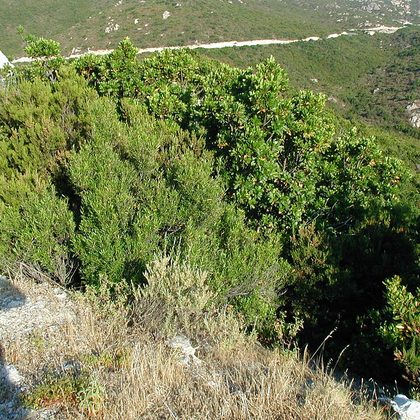
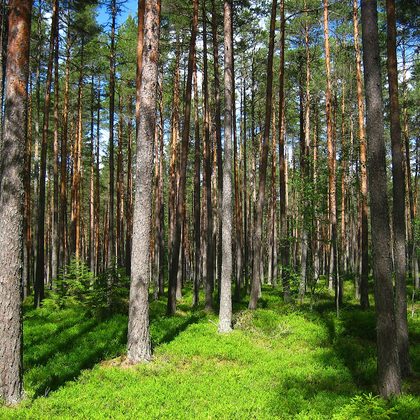
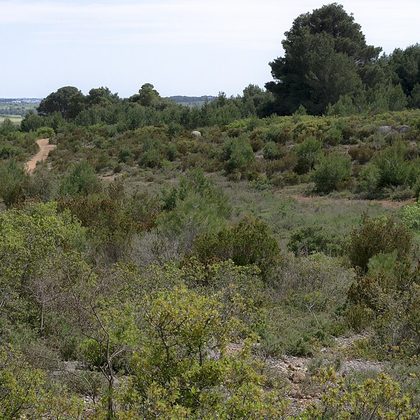
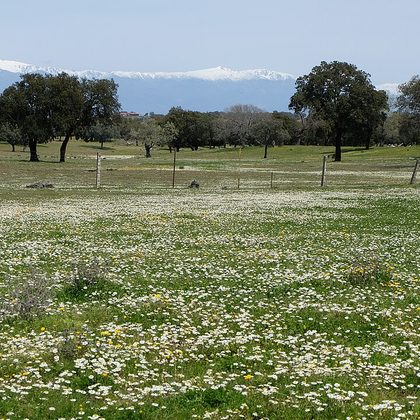
Dry, warm, level Mediterranean country: cistus, mastic and broom scrub, open pine woods on sand, garrigue, thinned dehesa, dry watercourses and stony plains, and the edges of olive and almond groves. It rests by day on the ground or along a low branch and hunts moths and beetles over clearings, firebreaks and roads, where the bare surface makes hunting easier.
Where the bird is most at home, classified with EUNIS — the European standard for habitats.

Range and movements
Breeds almost only in the Iberian Peninsula and the Maghreb. In Spain it occupies the southern and eastern half and is absent from the humid north; it arrives between late March and May and leaves between mid-August and mid-October, wintering in the Sahel zone of tropical West Africa. It has not been recorded in the Netherlands: the species withdraws southwards and hardly ever appears over north-west Europe. Only two accepted northern records exist, Northumberland in October 1856 and Denmark in 1991, both of the Iberian race.
- Breeding (summer)
- Winter
- Passage
- Migration direction
- dark = core range, pale = thinly spread
Where and when to look
Between May and July, in Doñana, the Sierra de Andújar or the plains of Extremadura, drive slowly along a sandy track or minor road from an hour after sunset: the birds sit on the still-warm surface and the headlights catch the red glow of their eyes. Then switch off the engine and listen; the male's knocking carries several hundred metres.
Conservation status
Not globally threatened (IUCN: Least Concern). In Spain numbers are slowly falling through agricultural intensification, loss of scrub and of large insects, and above all through road casualties: the habit of resting on warm tarmac makes the species very vulnerable to night traffic. Driving slowly on rural roads in summer is the simplest measure in its favour.