All species › Passerines › Swallows and martins › Red-rumped swallow
Red-rumped swallow | Cecropis rufula
Roodstuitzwaluw | Golondrina dáurica
The swallow of the southern European bridge and the mountain gorge: at range a Barn Swallow, but slower and full of long glides, and close to, a bird with a rusty collar, a rusty rump and a jet-black undertail. The bird of southern Europe, North Africa and the Near East has been treated as a separate species since 2024, apart from the Asian Eastern Red-rumped Swallow.

Voice
Softer and slower than Barn Swallow. The contact call is a nasal, sparrow-like tswee-it or djoo-eet with a slight upward curl, given in flight and from a wire. A passing falcon brings a sharp, drawn-out keeer. The song is a short, dry twitter with metallic ticks woven in, and it lacks the rattling ending with which the Barn Swallow seals its phrase.
No freely licensed recording is available for this species yet.
Identification
Slightly bulkier and broader-winged than a Barn Swallow, with the same long outer tail feathers but a steadier flight full of long glides, the tail often held closed to a point. Crown, back and wings are glossy blue-black. A rusty band runs around the neck and reaches up behind the eye, and the rump is a broad rusty to orange-brown arc — the mark the bird is named for. The underparts are pale buff with fine dark streaks and show no breast band at all. The clinching detail is underneath: the undertail coverts are jet black and stand out as a squarely cut block against the pale belly, and there is not a single white spot in the spread tail. Sexes alike; juveniles are duller, with pale feather edges on the wing and short streamers.
Confusion species
Barn Swallow is the starting point: rusty forehead and throat, a complete blue breast band, a row of white spots in the spread tail and pale undertail coverts, and no trace of a rusty rump or collar. House Martin has a pure white rump, entirely white underparts and a short tail without streamers. Crag Martin is uniformly brown-grey with no rust anywhere, and a square tail with white windows. The real problem is Eastern Red-rumped Swallow — see its own species page, where the same difference is set out from the other side: it is larger and longer-winged, with much broader and heavier streaking below and a broader, washed-out rump. Within the region place decides it: apart from a couple of British late-spring records, birds here are always Red-rumped Swallow.
Habitat
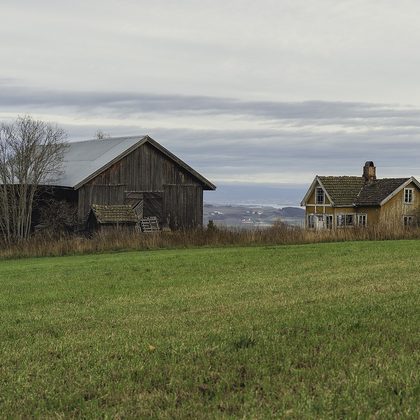
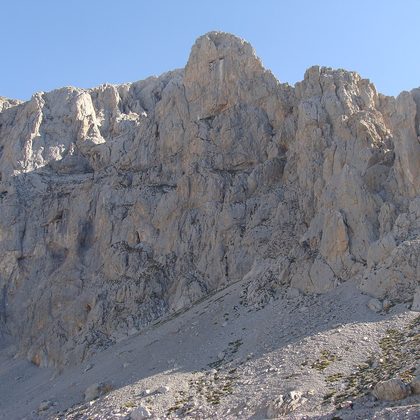
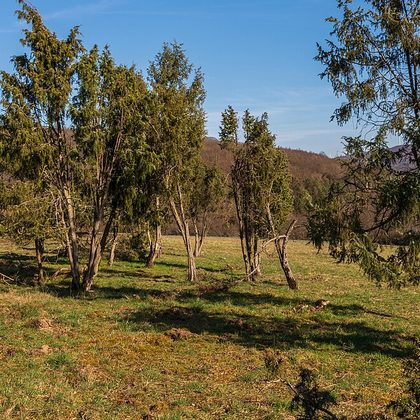
Open hilly country with rock: gorges, ravines, road cuttings and sea cliffs, and in the farmed landscape above all bridges, culverts, tunnels and isolated outbuildings. It hunts low over dry grassland, olive groves, maquis slopes and dry stream beds, seldom straying far from an overhanging vault or a rock face. The nest is a mud flask with a tunnel entrance plastered against a ceiling — a structure no other European hirundine builds, and one that stays in place for years after it is abandoned.
Where the bird is most at home, classified with EUNIS — the European standard for habitats.

Range and movements
Breeds in Iberia, southern France, Italy, the Balkans, Greece, Turkey and the Levant, across North Africa and eastwards into Central Asia. In Spain it is common and has been spreading north and east for the best part of a century, now reaching Catalonia and the Cantabrian coast, with a handful of birds wintering in the south. Most leave in September and October for the Sahel and return from March. In Britain and the Netherlands it is an annual overshoot: the Dutch list held 72 accepted records to the end of 2004, after which the species was no longer assessed because it had settled in as a scarce migrant, with a clear peak from mid-April to late May and a smaller one in September and October.
- Breeding (summer)
- Winter
- Passage
- Migration direction
- dark = core range, pale = thinly spread
Where and when to look
In Spain: drive a dry river bed in April or May and stop at every old concrete bridge. Stand under the deck and look for flask-shaped mud cups against the vault; if they are occupied the birds will glide past you and in within a couple of minutes. In north-west Europe the second half of April at a coastal migration watchpoint is the moment, in mild weather with a south-easterly: among the Barn Swallows look for a bird that flies more slowly and glides more, and that flashes a pale rusty rump as it banks away.
Conservation status
The Red List carries no separate assessment for this species yet. Since the split only the broad species Cecropis daurica is listed, as Least Concern, which leaves Red-rumped Swallow formally unassessed. In practice it is doing well: the European population is large and the species has been spreading north for decades, helped by the bridges, culverts and viaducts that now cross the Mediterranean landscape. The main pressures are the hosing off of nests during bridge maintenance and the sealing of tunnels and culverts. Leaving a nest in place costs nothing and keeps the colony where it is.