All species › Passerines › Swallows and martins › Purple martin
Purple martin | Progne subis
Purperzwaluw | Golondrina purpúrea
The largest swallow in the Americas, and in the east of that continent almost wholly dependent on people: nearly every pair breeds in a hollowed gourd or a wooden apartment house set on a pole in someone's garden. In Europe it is an extreme rarity — a single British bird, found in the Outer Hebrides in September 2004, was at the same time the first for the whole Western Palearctic.

Voice
Full, low and rich, quite unlike the thin twitter of the European hirundines. The usual call is a throaty, warm tchew-wew or choo-wew, repeated in flight, alongside a shorter choo and a harsh zwrack in alarm. Over a colony a bubbling, chortling chatter rises as dozens of birds hang above the nest pole; the male's song before dawn is a long gurgling run that carries a long way.
No freely licensed recording is available for this species yet.
Identification
Big and heavy for a hirundine, about the bulk of a Starling: broad, broad-based wings, a deep chest, a heavy head and a moderately forked tail. The old male is unique: glossy blue-black from head to tail with a purple sheen and not one pale feather — no other American swallow is wholly dark below. Females and immatures are grey-brown above, with a grey scaly collar running round the neck, a dingy grey, cloudily mottled breast and an off-white belly; the change from breast to belly is diffuse and never a clean band. Young birds take two years to reach adult plumage, so all sorts of intermediates are on the wing in autumn. The flight is slow and powerful, with long, high glides on flat wings, more like a small raptor than the nervous beat of a Barn Swallow.
Confusion species
Nothing in Europe comes near it for size: it is half again as long as a House Martin and almost twice the weight. A dark male at range suggests a Starling or a Swift rather than a swallow, but Swift is slim and scythe-winged and lacks a broad-based forked tail. Females and immatures are the real problem: they can pass for an outsized House Martin, but that bird is brilliant white below with a big white rump and a short tail, while Purple Martin has a dingy mottled breast and a uniformly dark rump. Sand Martin has a sharply drawn brown breast band and is far smaller. Anyone in Europe who sees a hirundine that looks too big and too heavy should size it against the swallows beside it and photograph head, breast and rump.
Habitat
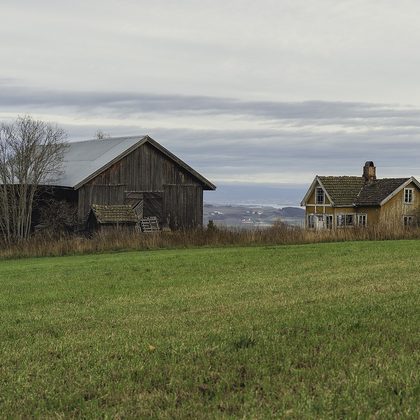
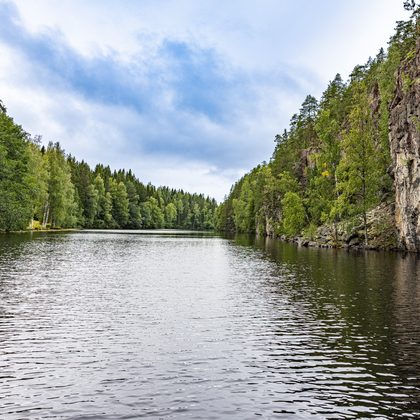
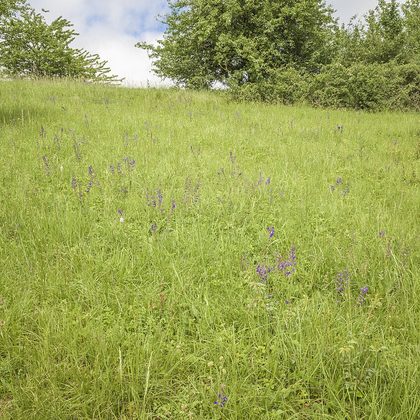
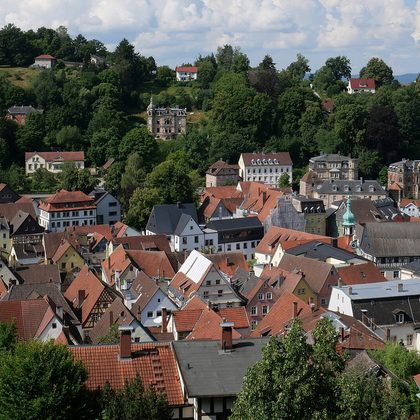
In North America a bird of open country near water: village edges, farmyards, parks, marinas and the shores of lakes and ponds, where it hunts high over open ground and open water. In the east virtually the whole population breeds in gourds and multi-compartment nest boxes put up by people on a pole, preferably free-standing a short way from a house and with a clear view all round. In the west it still uses old woodpecker holes in dead trees and in giant cacti. Outside the breeding season it gathers in enormous communal roosts in reed and trees, flocks large enough to show on weather radar.
Where the bird is most at home, classified with EUNIS — the European standard for habitats.
Range and movements
Breeds across North America from Canada to Mexico and winters in the Amazon basin of Brazil, Bolivia and Peru, so a bird in Europe has the wrong ocean entirely. The only accepted European record is a juvenile at the Butt of Lewis, Outer Hebrides, on 5 and 6 September 2004, admitted unanimously to Category A of the British List and the first for the Western Palearctic; a bird was on Flores in the Azores on 6 September of the same year, and a second followed there in 2011. There is no Dutch or Spanish record. Four nineteenth-century claims were rejected, among them a specimen said to have been obtained at Kingstown near Dublin in 1839 or 1840 and still held in Dublin.
Where and when to look
The first half of September, two to four days after a fast Atlantic depression has crossed the ocean, and then on the outer islands and headlands of Ireland, Scotland and the Azores. Do not watch the sea but the lee: over a village, a harbour or a sheltered pool where the local House and Barn Swallows are hunting. Size does the work — a bird that looks like a Starling among those swallows and glides long stretches on flat, stiff wings deserves the camera at once, with images of breast and rump.
Conservation status
Not globally threatened, but the North American population is declining in the east of its range, where the species has become wholly dependent on an army of volunteers who put up and clean out gourds and nest houses every spring. Competition for those boxes with the introduced House Sparrow and Starling is the most direct pressure; a cold, wet spell soon after arrival can wipe out whole colonies, because flying insects then simply are not there. The number of European records says nothing about any of this: it follows the weather over the Atlantic.