All species › Passerines › Swallows and martins › Eastern red-rumped swallow
Eastern red-rumped swallow | Cecropis daurica
Oostelijke roodstuitzwaluw | Golondrina dáurica oriental
The Asian counterpart of the Red-rumped Swallow, from southern Siberia and Mongolia to China and Japan. It has been treated as a separate species since 2024, and at a stroke a bird that had slipped through the net as a subspecies for a century became one of north-west Europe's rarest vagrants: Britain has two, both in late spring.

Voice
As Red-rumped Swallow, but in practice rarely of use with a vagrant. The contact call is a short, sparrow-like tswi-wit, harder and more clearly two-syllabled than the nasal note of Red-rumped Swallow; a dry tsrr is given in flight. The song is a short muttering twitter, delivered from a wire or from inside the nest tunnel.
No freely licensed recording is available for this species yet.
Identification
A large, heavy red-rumped swallow with long wings and long streamers. Structure and pattern are those of Red-rumped Swallow: glossy blue-black upperparts, a rusty collar, a rusty rump and jet-black undertail coverts, with no white in the tail. The difference lies in the markings below. Where Red-rumped Swallow has fine, thin streaks on an even buff ground, this bird is heavily and broadly streaked from the throat right onto the flanks, so that at range the underside reads as grey and lined rather than warm and plain. The rusty rump is broader but paler and often finely streaked itself, and the collar is usually broader and more complete. All of it is a matter of degree: a bird outside its range can only be nailed down on good photographs of belly, rump and tail.
Confusion species
Red-rumped Swallow is the only species that really matters — see its own page, where the same difference is set out from the other side. It is smaller and shorter-winged, with a warm buff underside on which the streaking stays fine and thin, and a narrower but deeper, more saturated rump. Beyond that pair the pitfalls are the same as for Red-rumped Swallow: Barn Swallow has a blue breast band and white tail spots and lacks both rump and collar, House Martin is white below with a white rump, and Crag Martin is uniform brown-grey with a square tail. Away from the breeding range one rule holds: photograph the underparts and the rump, because without images a claim cannot be judged.
Habitat
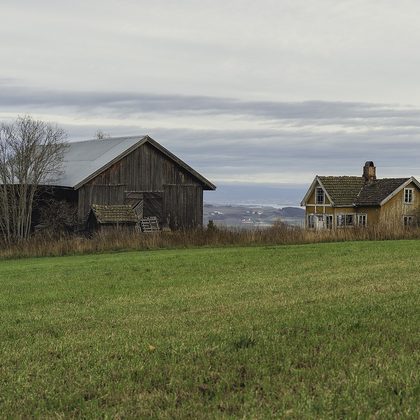
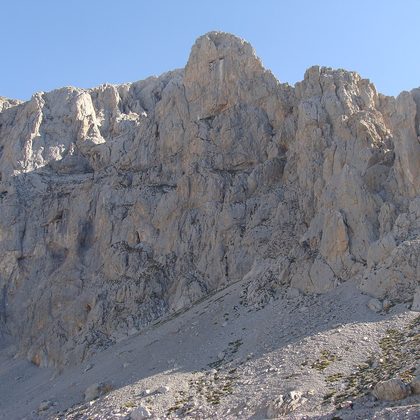
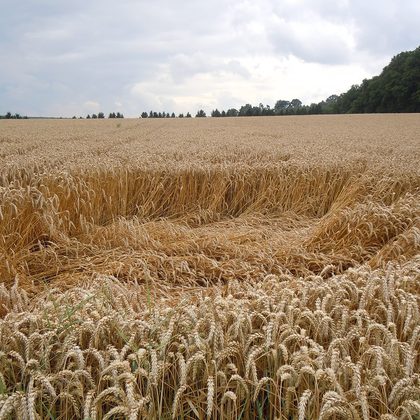
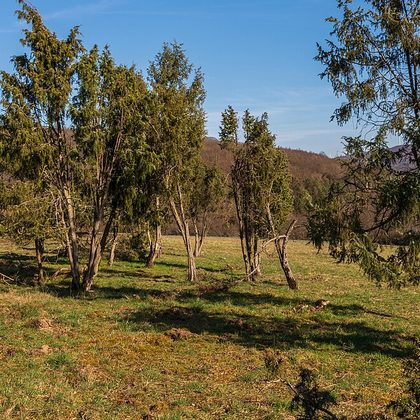
On the breeding grounds a bird of open hilly and mountainous country with cliffs, gorges and steep stream valleys, and of villages and hamlets whose bridges, temples, verandas and barns take the flask-shaped mud nest. It hunts over fields, rice paddies, dry grassland and along streams, generally lower than the swifts it shares the air with. In its South and South-East Asian winter quarters it favours open farmland and marshes.
Where the bird is most at home, classified with EUNIS — the European standard for habitats.
Range and movements
Breeds from southern Siberia, the Altai and Mongolia into northern and central China, Korea and Japan, and winters in India, South-East Asia and as far as northern Australia. That lies wholly outside the region, and European records are correspondingly exceptional. Britain has two: an adult on Sanday, Orkney on 9 June 2011, which then reappeared on Skye on 17 and 29 June, and a bird at sea east of Caithness on 26 May 2018. There is no accepted record for the Netherlands or for Spain. Because the split dates only from 2024, further records are almost certainly hidden in older sightings logged simply as Red-rumped Swallow.
Where and when to look
This is not a bird you go looking for but one you recognise. Both British records fell in the late-spring window in which ordinary Red-rumped Swallows also overshoot, late May and June, and both were on the northern isles and the north-east coast. If you meet a red-rumped swallow in those weeks, photograph it from below and from behind: heavy, broad streaking reaching onto the flanks and a broad, pale, streaked rump are what the records committee will look at. Without images there is nothing to assess.
Conservation status
Not globally threatened. The Red List still assesses the red-rumped swallow in the broad sense, under the name Cecropis daurica, and that assessment is Least Concern; it is that broad assessment which stands here, not a separate one for the eastern bird. Across Asia the species is common and locally increasing, as bridges, viaducts and concrete buildings provide nest sites where cliffs are absent. For the European list it is above all an identification question: the number of records depends on how consistently observers photograph a red-rumped swallow in late spring.