All species › Gamebirds › Pheasants and partridges › Rock ptarmigan
Rock ptarmigan
Lagopus muta | Alpensneeuwhoen | Lagópodo alpino
Britain's only true mountain-top bird, and one that changes its plumage three times a year. On the Cairngorm plateau it sits tight among the granite until you are almost on top of it, then walks away over the blockfield rather than flying.

Voice
Dry and creaking, closer to a noise than a song. The cock gives a rasping arr-arr-ka-ka-ka, like a stick drawn across a comb, usually from a boulder or during a short display flight in which he planes down on stiff wings. Flushed birds give a short kerr-kerr. On a still morning the rattle carries several hundred metres across the stones and finds the bird long before the eye does.
Recording: Lawrence Shove / British Library — CC BY-SA 4.0 · Wikimedia Commons
Identification
A small, round grouse with a notably fine, short bill and fully feathered feet. Winter birds are white with a black tail that shows only in flight; the cock adds a black loral stripe running from the bill base through the eye and a red comb above it. Summer plumage is grey-brown with dense dark vermiculation, the belly and wings staying white, and autumn plumage is a colder, plainer ash-grey. The primaries are white all year. The photograph shows a cock in summer plumage, taken in the Alps in early June.
Confusion species
The comparison that matters is with Willow Grouse, which shares the Scandinavian fells. In white winter plumage only the cock Rock Ptarmigan carries the black loral stripe; hens lack it, so its absence proves nothing. In summer Rock Ptarmigan is cold grey with fine vermiculation while Willow Grouse is warm rufous with coarser barring, the cock showing a chestnut head and neck against a still-white body. In autumn Rock Ptarmigan is uniform ash-grey and Willow Grouse warmer brown and more broadly barred. The bill settles it: small and slight on Rock Ptarmigan, clearly deeper and heavier on Willow Grouse. Red Grouse is the easy one in this group, being the only bird here that never turns white and stays red-brown all year. In Scotland the two overlap in altitude on the shoulders of the hills, where Red Grouse comes up out of the heather and Ptarmigan comes down off the plateau.
Habitat
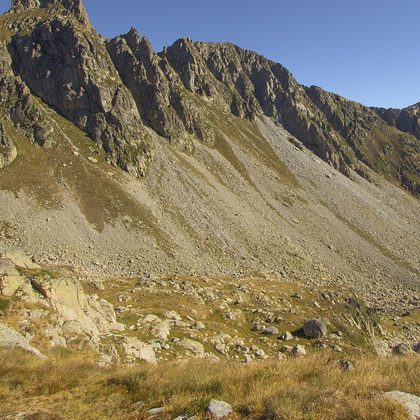
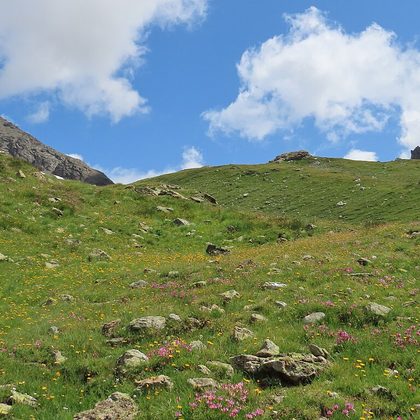
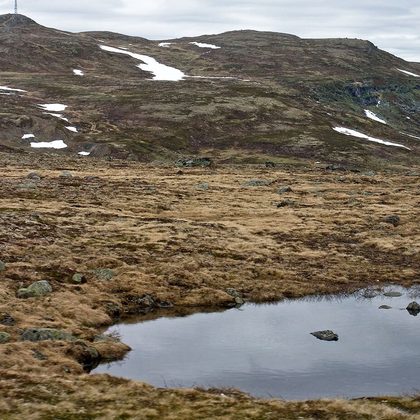
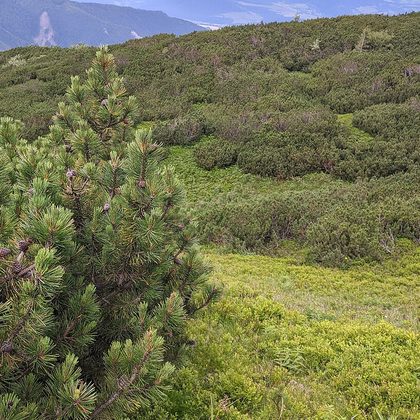
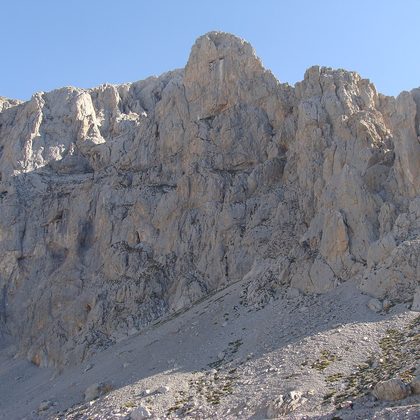
Ground above the tree line and above the heather: granite blockfields, screes, short montane sward with dwarf shrubs, and the margins of late snow beds. In Scotland this means the plateaux above roughly 700 to 900 metres, in the Alps and Pyrenees from about 1800 metres upwards. Food is buds, leaves and berries of dwarf willow, blaeberry and crowberry, taken on foot; in winter birds burrow into snow holes to roost.
Where the bird is most at home, classified with EUNIS — the European standard for habitats.
Range and movements
Iceland, the Scandinavian mountains and northern Russia, the Scottish Highlands, and isolated ranges in the Alps and the Pyrenees. The British population, subspecies millaisi, is confined to the Highlands, with the Cairngorms, Lochnagar, the Drumochter hills and the Torridon and Wester Ross tops holding the bulk of it. There are none in Ireland, in England or in Wales.
- Breeding (summer)
- Passage
- dark = core range, pale = thinly spread
Where and when to look
Take the Coire Cas path onto the Cairn Gorm plateau early on a calm summer morning, or work the Ben Macdui track once the ground opens out into boulder and moss. Listen for the croak before scanning, then glass the stones for something the wrong colour; fresh droppings on a flat slab tell you birds are working the ground. In winter and early spring keep well off ski tracks and cornice edges, and keep dogs on a lead, as the chicks crouch in the sward.
Conservation status
Not globally threatened, but the Scottish population is thought to have contracted upwards and northwards, and the counts on individual massifs swing violently between years. Skiing infrastructure fragments the ground, birds are killed on tow and fence wires, and ski touring and hill walking now push into the months when the birds are on the thinnest margins. The underlying problem is that the zone with long-lasting snow cover is shrinking, which leaves a white bird standing on brown ground.