All species › Waders, gulls and terns › Gulls and terns › Ross's gull
Ross's gull
Rhodostethia rosea | Ross' meeuw | Gaviota de Ross
A small high-Arctic gull with a wedge-shaped tail and, in summer, a rose flush across the underparts. It breeds in the marshy tundra of north-east Siberia and winters along the edge of the pack ice, which is why every European bird draws a crowd.

Voice
Silent away from the colony. On the breeding grounds a high, tern-like a-wo a-wo and a dry chattering rattle. A vagrant in western Europe is worth listening to only as it lifts off, when it may give one short, thin call.
No freely licensed recording is available for this species yet.
Identification
Compact, with long pointed wings and a tail whose central feathers project, so that a spread tail shows a clear wedge. The bill is strikingly small and black, the legs red. Summer adults have a pale grey mantle, a white head, a thin black ring round the neck and a pink wash below, with an evenly grey underwing. Winter adults lose the ring and keep a dark ear spot. First-winters carry a black W across the upperwing, with black confined to the projecting central tail feathers.
Confusion species
Little Gull and Kittiwake are the two to work through. Little Gull is smaller and blunter-winged, its tail square, and adults show a black underwing; Ross's Gull has the wedge tail, a grey underwing and a shorter, finer bill than either. Young Kittiwake shares the black W but is bigger and longer-winged and wears a broad black neck collar, where a summer Ross's Gull has only a thin black line drawn round the throat. The pink wash over breast and belly belongs to this species alone and washes out in strong light, so judge structure first and colour second.
Habitat
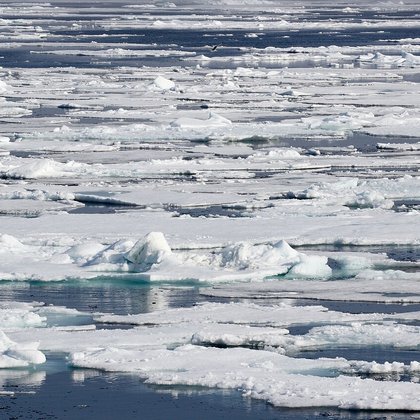
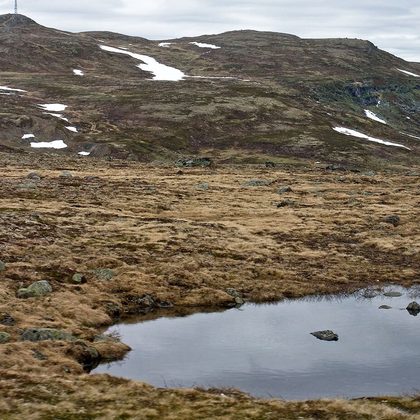
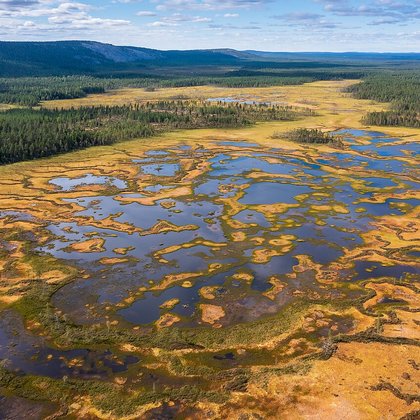
Pack ice, floe edges and the leads between them, where birds pick prey from the surface much as a phalarope does. Breeding birds use wet polygon tundra with pools and sedge, taking insects and small crustaceans. In Europe a vagrant settles wherever gulls loaf: a beach, a harbour basin, the outfall of a sluice.
Where the bird is most at home, classified with EUNIS — the European standard for habitats.

Range and movements
The core breeding range lies in north-east Siberia, with small numbers in Greenland, Arctic Canada and around Svalbard. Autumn movement is eastwards along the Siberian coast, and most of the population winters at the ice edge in the Bering Sea and the Arctic basin. European records run from Iceland and Norway south to the North Sea coasts, and very few reach Iberia.
Where and when to look
Late autumn and winter after a run of northerly winds give the best odds. Work through gull flocks on the Wadden coast or at a harbour mouth and judge flight first: buoyant and tern-like, with quick shallow beats and wings that look longer than a Little Gull's.
Conservation status
Listed as Least Concern, yet the world population runs to only some tens of thousands and is hard to count among the ice. Shrinking sea ice, growing shipping traffic and oil and gas work in Arctic waters are the main concerns, because the birds depend on the ice edge for winter food.