All species › Cranes, rails and allies › Cranes › Sandhill crane
Sandhill crane
Antigone canadensis | Canadese kraanvogel | Grulla canadiense
North America's crane, which now and then joins the wrong flock and ends up in a European crane herd. Almost every European record starts the same way: someone works through a thousand cranes, head by head.

Voice
A rolling, rattling bugle, garooo-a-a-a, lower and far more grating than the clear krooh-krooh of Common Crane. In a calling flock the difference is easier to hear than to see, so it is worth having the recordings in your head before you stand at a roost.
Recording: Jonathon Jongsma — CC BY-SA 3.0 · Wikimedia Commons
Identification
Slightly smaller and more compact than Common Crane, plain grey, often stained rusty across back and flanks from preening with iron-rich mud. The head does the work: a bare, bright red patch over forehead and lores, with a whitish-grey cheek and throat below it, and no black-and-white stripe down the neck. The drooping tertials form a smaller, tighter bustle than on Common Crane. Juveniles have a rusty-brown head and neck and no red crown.
Confusion species
In a crane flock, three things. The head: Common Crane has a black head with a broad white stripe running from behind the eye down the neck, while Sandhill has a plain grey neck and white only on cheek and throat. The red: a small red cap on the crown of Common Crane, a larger red patch running forward over the lores to the bill on Sandhill. And the size and rear end: a touch smaller, with a shorter, less woolly tertial bustle. At range it is the pale head among all the black-and-white ones that jumps out.
Habitat
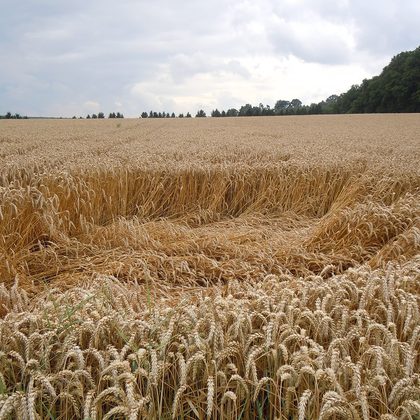
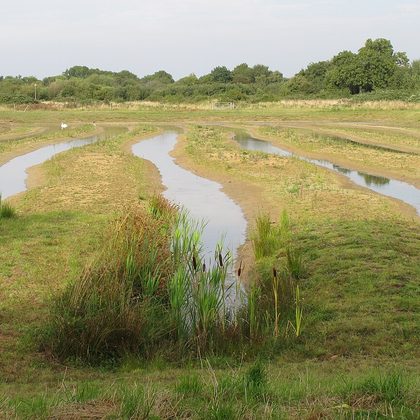
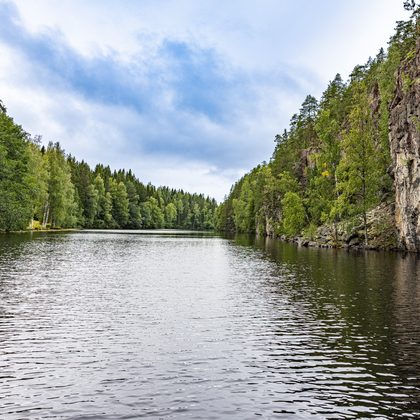
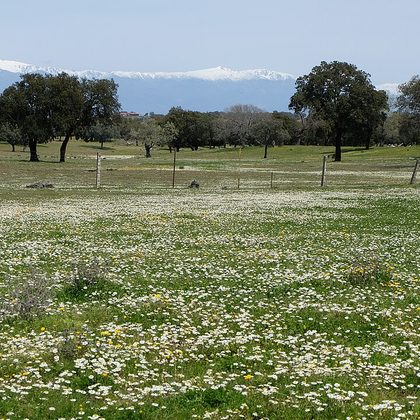
In Europe, wherever the cranes are: stubble and maize fields, wet grassland, and the edges of shallow water and sandbars where the flock roosts. On the breeding grounds, bogs, sedge fen and tundra. The bird does not pick its own site — it feeds, roosts and moves with the flock it has attached itself to.
Where the bird is most at home, classified with EUNIS — the European standard for habitats.
Range and movements
Breeds across North America, with a north-western arm into north-east Siberia. Europe has a few dozen records, concentrated in Ireland, Britain, Iceland and Scandinavia, with scattered mainland occurrences as far as France and Spain. Birds that have joined European cranes sometimes reappear on the same flyway in successive years.
- Winter
- Passage
- dark = core range, pale = thinly spread
Where and when to look
Look for the flock, not the bird. Take a staging site in north-east Germany in October or November, or Gallocanta or an Extremaduran dehesa in January, and grind through the flock with a scope while the birds feed. Work the heads, not the bodies: once you have the search image, that pale, red-masked head stands out among hundreds of black-and-white ones.
Conservation status
Abundant and increasing across its range, one of North America's conservation successes. For Europe it is purely a vagrant. Such risks as apply are the ones facing the cranes it travels with: disturbance at roosts, collisions with power lines and the loss of safe staging grounds.