All species › Passerines › Grasshopper warblers › Savi's warbler
Savi's warbler
Locustella luscinioides | Snor | Buscarla unicolor
A bird named in Dutch after its sound: a low, even purring reel that hangs over the reedbed at dusk. It is the singer of old, wet, unmown reed, and it disappears as soon as that reed dries out or is harvested.

Voice
The song is a low, even, mechanical reel on one pitch: a sustained surrrrrrrrrrrr that can run for twenty to thirty seconds and sometimes far longer. It is almost always introduced by separate ticks that accelerate until they fuse: tick … tick … tick-tick-tickticktick-surrrrrrr. Against Grasshopper Warbler it sounds lower, fuller and more even, more a purring motor than a sewing machine. Heard mainly at dusk and through the night, from mid-April into June, from a reed stem or a low bush in the reed.
Recording: Darekk2 — CC BY-SA 3.0 · Wikimedia Commons
Identification
Uniform warm red-brown above with no streaking at all, with an off-white throat and pale brown breast and flanks. The tail is long, broad and clearly rounded, with long undertail coverts that reach well down it and are faintly pale-tipped. The forehead is flat and the supercilium vague and short. Legs pink to flesh-coloured. Sexes alike; the best view is of a singing male halfway up a reed stem.
Confusion species
Grasshopper Warbler is the mirror image: olive-brown with fine dark streaks on crown and mantle, streaked undertail coverts, and a higher, drier, faster reel. Savi's is unstreaked, warmer red-brown, has plain undertail coverts, a broader and more rounded tail and a lower, slower reel. Reed Warbler is colder brown with a shorter, squarer tail and sings in short repeated motifs. Sedge Warbler shows a streaked crown, a creamy supercilium and a rusty rump.
Habitat
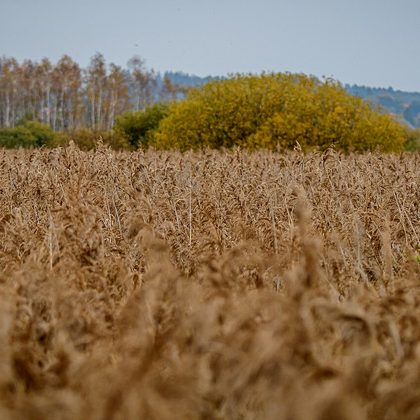
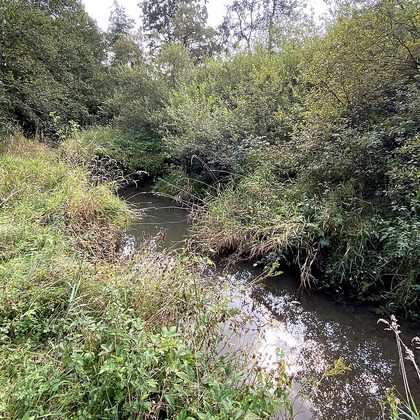
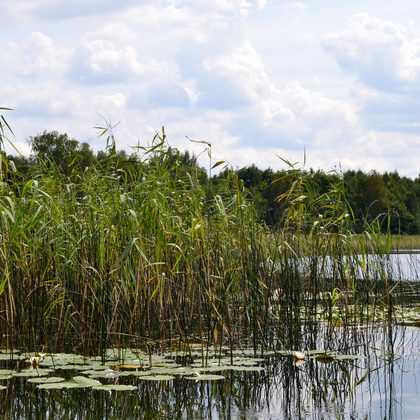
Large, old, permanently wet reedbeds with a thick layer of dead reed litter, ideally with scattered willow and elder bushes. Also standing reed in old peat cuttings, marshy fringe vegetation and infilling lakes. It avoids young, dry and annually cut reed.
Where the bird is most at home, classified with EUNIS — the European standard for habitats.
Range and movements
From Iberia and north-west Africa east to Central Asia. In the Netherlands a scarce but characteristic breeder of the great lowland peat marshes: the Weerribben and Wieden, the Nieuwkoopse Plassen, the Zouweboezem and the Oostvaardersplassen. In Spain local in the big deltas and marismas — the Ebro Delta, the Albufera of Valencia and Doñana — and thinly scattered elsewhere.
- Breeding (summer)
- Passage
- dark = core range, pale = thinly spread
Where and when to look
Mid-April to mid-May, in the last hour before dark: stand on a dyke or a boardwalk with the reedbed in front of you and wait for the reeling to start. Two or three males often sing against each other, which lets you separate them. To see the bird, look halfway up a stout reed stem; it sings with head raised and throat trembling and will stay put for minutes.
Conservation status
Not globally threatened, but in Europe it depends on a fragile habitat. Numbers in the Netherlands swing with reed quality: drying out, early or wholesale reed harvesting and the loss of the wet reed litter layer are the pinch points. Where reed marsh stays wet year-round and parts are left uncut, it recovers quickly.