All species › Passerines › Tits › Sombre tit
Sombre tit | Poecile lugubris
Rouwmees | Carbonero lúgubre
The Sombre Tit is the big, drab tit of the south-east: a bird of old open oak woodland, of wood pasture and of stony slopes with scattered trees, from Croatia and Greece deep into Turkey and the Middle East. It is the largest member of the genus Poecile and behaves like it — slow, heavy and loud, more like a small shrike than a tit.

Voice
Loud, harsh and distinctly untit-like. The call is a grating, low, broad chair-chair-chair, rattling and with a scraping undertone that suggests an angry House Sparrow or a shrike rather than a tit; it is often preceded by a few thin tsi-tsi notes. The exclamation tsi-chair is a good first clue that the species is nearby. The song is monotonous and repetitive, a run of short, slightly tinny groups — chi-chi-chuwee or chip-chip-cherr — slower and heavier than Marsh Tit's fast rattle, and loudest from March to May. The sound carries a long way across open slopes.
No freely licensed recording is available for this species yet.
Identification
Large and heavily built, with a strikingly big head, a thick neck and a stout, rather long bill; set beside a Marsh Tit the difference in bulk is immediate. The cap is dull brown-black without gloss and runs well down the nape. The bib is large and broad, sooty black, and drops as a wide triangle onto the upper breast — the single most characteristic field mark. Cheeks and neck sides are dirty white to greyish white and cover a broad area extending behind the ear coverts. Upperparts are grey-brown and dull, underparts dingy white with grey-buff flanks; there is no warm or bright colour anywhere in the plumage, which is what the name is about. The tail is proportionally long, the wing plain with at most narrow pale feather edges. The sexes look alike.
Confusion species
Marsh Tit is the only real pitfall, and the two overlap precisely in the south-east — in Bulgaria, northern Greece, Serbia and north-west Turkey they occur in the same woods. Size usually settles it: Sombre Tit is a quarter bigger, with a far heavier head and bill and a slower, lumbering way of moving. Beyond that, Marsh Tit's cap is glossy blue-black and sharply cut off, Sombre Tit's dull brown-black and longer; Marsh Tit's bib is small and neat, Sombre Tit's broad and far-spreading; and where Marsh Tit looks clean white and pale buff, Sombre Tit is dingy grey throughout. Willow Tit is absent from most of this region. At a distance a large dark tit on a stony slope can also suggest a shrike, but a shrike has a long tail and sits upright on a lookout perch.
Habitat
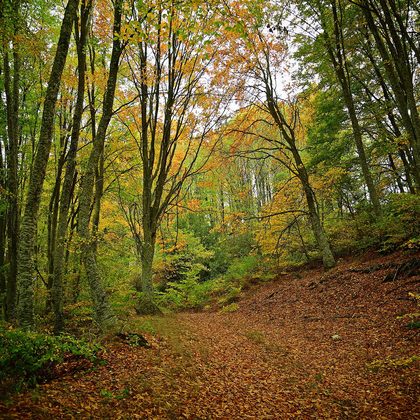
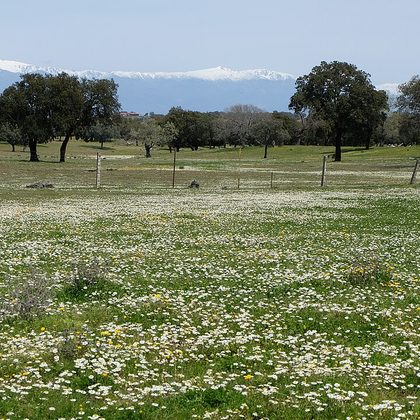
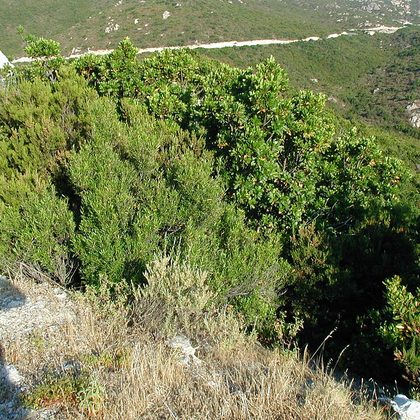
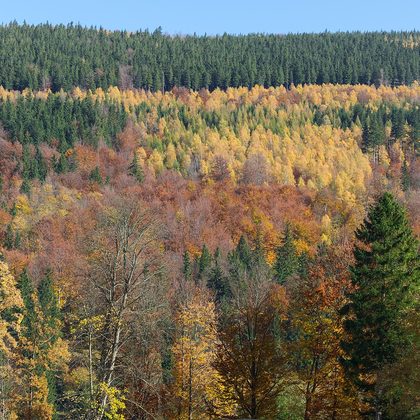
Open, old broadleaved woodland and half-open tree country on dry, stony ground: scattered mature oaks on a hillside, wood pasture grazed under the trees, abandoned orchards, tall maquis with standing trees, and old hedgebanks and tree lines along terraces. Also mixed montane and pine woodland high into the mountains, provided the canopy stays open. It avoids closed dark forest and favours edges, clearings and sunny rocky ground. It nests in existing cavities in old trees, but also in rock crevices and walls, and forages slowly and thoroughly in the upper branches and among the leaves, dealing with large insects and, in winter, with acorns and seeds by clamping them under a foot and hacking them open.
Where the bird is most at home, classified with EUNIS — the European standard for habitats.
Range and movements
From south-east Europe into the Middle East: Croatia and Bosnia south through Serbia, Montenegro, Albania, North Macedonia, Bulgaria and the whole of Greece including the larger islands, east across the whole of Turkey, the Caucasus, Syria and Lebanon, and into the mountains of north-west Iran. Its entire world range therefore falls almost wholly within the area of this guide. It is resident: it does not migrate and leaves its territory at most for a shift to lower slopes in hard winters. Birders from north-west Europe meet it on trips to Greece, Bulgaria or Turkey, where it belongs to the standard cast of a day in the hills.
- Winter
- Passage
- dark = core range, pale = thinly spread
Where and when to look
Look for it in March and April on south-facing slopes with old scattered oaks — the classic setting is a half-open hillside above a village, with stone piles, thorn scrub and a few gnarled trees. Walk slowly and above all listen: the hard chair gives it away before the eye does, because it forages slowly and hidden in the foliage. Early in the morning it often sits high and exposed on a dead branch. Greek and Bulgarian mountain districts are the easiest; in winter it sometimes visits feeding tables in villages. On every record note size and head-heaviness: in this species that is a more reliable mark than the colour of the cap.
Conservation status
Not globally threatened, and across its range still numerous and widespread. Even so the Sombre Tit is locally vulnerable, because it depends on a landscape that is going: the old wood pastures and grazed oak slopes of the Balkans are falling out of use and closing over into dense scrub, or else being cleared for arable land and building. The felling of old, cavity-rich trees around villages does not help either. In Greece and Turkey numbers are stable for now; in parts of the Balkans it is declining locally. Keeping extensively grazed, half-open oak country with old trees is the best protection it can have.