All species › Waders, gulls and terns › Gulls and terns › Sooty gull
Sooty gull | Ichthyaetus hemprichii
Hemprichs meeuw | Gaviota cejiblanca
Sooty gull is the heavier, browner twin of white-eyed gull, with a thick yellow-green bill tipped red. Of the four Red Sea birds that reach the edge of this map, it is by far the hardest: at Eilat we are talking about a handful of birds in as many decades.

Voice
A hoarse, low, nasal kaaarr, rougher and deeper than white-eyed gull, and a short barking ke-ke-ke in a squabble. Around the colonies and the fishing harbours of the Red Sea it is a familiar sound; inside this guide's map the chance of hearing it is very small, and the birds that get there are usually silent.
No freely licensed recording is available for this species yet.
Identification
A solid, deep-chested gull with a heavy head and a short, thick bill. The bill is the best feature: yellow-green with a black band near the end and a red tip, a three-colour pattern that reads at range as dark with a paler base. The hood is not black but dark chocolate-brown and runs down onto the throat; a small white crescent sits behind the eye, and a narrow white collar lies below the hood. The breast is brown and forms a clear band above the white belly. Upperparts and upperwing are dark grey-brown, the tail white, with a black terminal band on young birds; the legs are yellow-green. First-years are uniformly brown with pale feather fringes, a pale grey black-tipped bill and a dark head without the crisp collar.
Confusion species
Everything turns on white-eyed gull, which is far commoner in the Gulf of Aqaba. Sooty is larger and more heavily built, with a thicker neck and a short, deep bill, where white-eyed is slim and long-billed. The colours follow: sooty shows a brown hood, a brown breast band and brownish grey upperparts, white-eyed a black hood down onto the throat and dark slate-grey upperparts. The bill is quickest to read: yellow-green with a red tip against dark red with a black tip. The white head markings differ as well — two sharp crescents around the eye on white-eyed, one small mark behind the eye on sooty. On young birds bill shape stays the anchor, because the brown plumages are much alike at that age. A young lesser black-backed gull is bigger and more angular and has pink legs.
Habitat
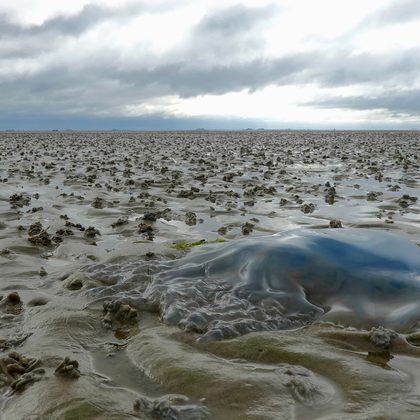
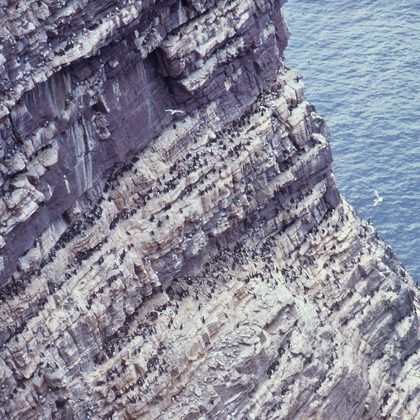
Strictly coastal and seldom more than ten kilometres beyond the reef: tidal flats, coral beaches, rocky shores, harbours and fish landings. It breeds in small colonies on coral islands, the nest a bare scrape or tucked under a bush. It eats almost anything the shore provides: fish offal, small fish, prawns, the eggs and chicks of other seabirds, and newly hatched turtles.
Where the bird is most at home, classified with EUNIS — the European standard for habitats.


Range and movements
The species breeds along the Red Sea, the Gulf of Aden, the Persian Gulf and the East African coast to Kenya and Tanzania, with a world population put at tens of thousands of pairs. Almost none of that shows inside this guide's map. The map ends at 29 degrees north and so just takes in the head of both arms of the Red Sea: the Gulf of Aqaba at Eilat and Aqaba, and the top of the Gulf of Suez at Ain Sokhna and Zaafarana. Most records come from that last corner; at Eilat there is only a handful, several of them from the spring of 1989. Further north the odd bird has turned up on the Levantine Mediterranean coast.
- Resident
- Breeding (summer)
- Passage
- Migration direction
- dark = core range, pale = thinly spread
Where and when to look
Do not count on it in Israel. Anyone wanting the species inside the region checks every brown gull on North Beach and at the fish ponds at Eilat, going first for the bill and only then for the plumage. The dependable alternative lies just off the map: the harbours of Hurghada, Safaga and Sharm el-Sheikh, where sooty gull sits on the jetty and the comparison with white-eyed gull can be made in a single view.
Conservation status
Not globally threatened; the world population is estimated at fifty to a hundred thousand pairs and the species benefits locally from fishery waste. The colonies are nonetheless sensitive to disturbance, rats and egg collecting, and to oil pollution in the narrow straits where shipping concentrates. Rapid growth of coastal tourism along the Red Sea is the pressure that will count most in the coming years.