All species › Birds of prey › Hawks, eagles and kites › Spanish eagle
Spanish eagle | Aquila adalberti
Spaanse keizerarend | Águila imperial ibérica
The Spanish Imperial Eagle breeds nowhere else in the world than in the centre and south-west of the Iberian Peninsula. It is the eagle of the Mediterranean woodland and the dehesa, and its recovery — from about forty pairs in the 1970s to more than eight hundred today — is the greatest success of Spanish conservation. Since 1996 it has been treated as a species in its own right, separate from the Eastern Imperial Eagle.

Voice
Like all large eagles it says little away from the nest, and anyone watching one soar will usually hear nothing at all. In the territory, and mainly from January to March, it gives a dry, repeated barking gwak-gwak-gwak, lower and hoarser than the call of a Golden Eagle, and sometimes a nasal kra-kra as the pair chase one another. Young beg from the nest in June and July with a harsh, monotonous whistle, and that sound betrays a nest platform long before it comes into view.
No freely licensed recording is available for this species yet.
Identification
Large and heavy, with long, broad, almost parallel-edged wings held completely flat in a soar, never in a V, and as broad next to the body as they are in the middle. Head and neck project well forward and the tail is short, square-ended and shorter than the width of the wing. The outer six primaries are deeply fingered and make a long hand; do not trust the exact number of fingers, since moult and wear alter it, but trust the silhouette. The adult is very dark blackish brown, with a pale creamy-white crown and hindneck that contrast sharply, and above all with a pure white band running along the leading edge of the inner wing from the scapulars right out to the bend of the wing: that continuous shoulder patch, visible at great range both perched and in flight, is shown by no other eagle. The tail is grey with a broad black terminal band, and cere and bill base are yellow. First-year birds are a plain rufous-buff without streaking, with dark flight feathers, a pale band across the rump and a sharp contrast between the pale body and the dark wing.
Confusion species
Golden Eagle is the commonest mistake: it soars with its wings in a shallow V, has wings pinched at the base, a long tail slightly rounded at the tip, a head that projects less and a golden nape rather than a creamy-white crown, and it never shows a white shoulder; its juvenile carries sharply defined white patches at the base of the primaries and a white tail base with a broad black terminal band, marks the young Spanish bird lacks. Eastern Imperial Eagle does not reach the peninsula: in that species the white on the shoulder is reduced to a few separate spots on the scapulars, never a continuous band out to the bend of the wing, the nape is ochre-gold rather than creamy, and the juvenile is ochre with heavy dark streaking on breast and mantle. Steppe Eagle, very rare here, has no white on the shoulder, a yellow gape line running back beyond the eye, and as a young bird a broad, clean white bar along the wing coverts. White-tailed Eagle, occasional in the north, has even broader rectangular wings and a short wedge-shaped tail. On ages: the plain rufous first-year and the full adult can be named with confidence, but between the second and fifth year the plumage breaks up into an irregular mosaic of cinnamon and dark brown, the shoulder patch appears in pieces, and many such birds can only be placed on structure, flat-winged profile and location; full adult plumage is not reached until five or six years, sometimes later.
Habitat
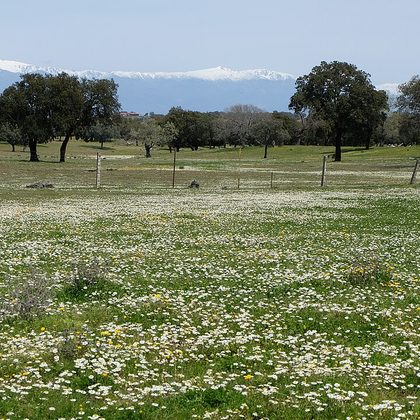
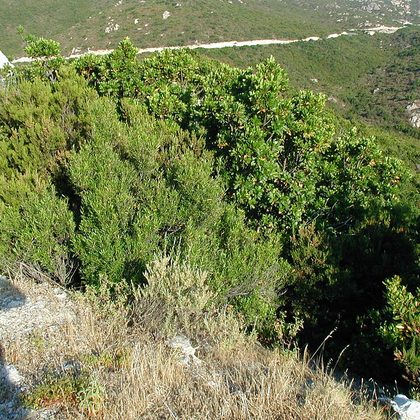
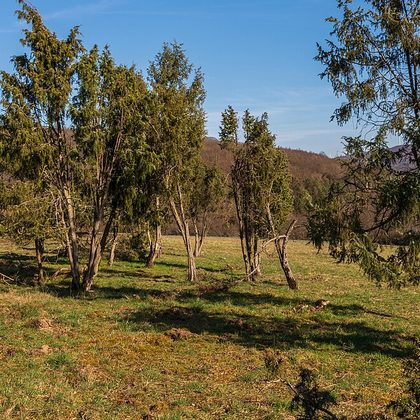
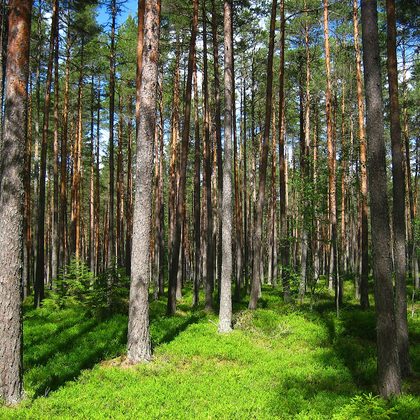
Well-developed Mediterranean woodland on plains and low sierras: holm oak and cork oak dehesa, holm oak forest and tall scrub of mastic, cistus and broom, mixed with grassland and clearings for hunting. Also the pine woods on the southern slope of the Sistema Central and, in Doñana, scrub ridges beside the marisma. It needs big trees for its platform nest, plenty of open ground and, above all, rabbits: the species depends almost entirely on wild rabbit and its density tracks the rabbit population closely.
Where the bird is most at home, classified with EUNIS — the European standard for habitats.

Range and movements
Endemic to the Iberian Peninsula. The 2022 census produced 841 breeding pairs, 821 in Spain and about 20 in Portugal, against 536 in 2017 and 39 in 1974. The bulk is in Castilla-La Mancha, holding almost half the pairs, followed by Andalusia, Castilla y León, Madrid and Extremadura, and in recent years provinces such as Granada, Cuenca and Palencia have been reoccupied. Young birds wander over the Guadalquivir valley, the cereal plains and northern Morocco before settling to breed near where they hatched. It does not reach north-western Europe.
- Resident
- Winter
- Passage
- dark = core range, pale = thinly spread
Where and when to look
Sierra de Andújar, Monfragüe, the Cabañeros area or the edge of Doñana, between January and March, mid-morning, when pairs display over their territory and the vegetation is still low. Take a high viewpoint over a dehesa valley with the sun behind you and check the emergent trees and posts first: the white shoulder shows better on a perched bird than on a flying one. The La Lancha road at Andújar and the Tiétar viewpoints in Monfragüe are the surest spots.
Conservation status
Vulnerable on the IUCN Red List, with a small population that remains dependent on continuous management. It was listed as Endangered until 2011, and its recovery rests on three fronts: making dangerous power poles safe, fighting illegal poisoning, and rebuilding rabbit numbers. Electrocution on medium-voltage pylons is still the leading unnatural cause of death, followed by poisoned baits and shooting; rabbit diseases — myxomatosis and rabbit haemorrhagic disease — periodically collapse the production of young, and the spread of energy infrastructure fragments the habitat.