All species › Birds of prey › Hawks, eagles and kites › Imperial eagle
Imperial eagle | Aquila heliaca
Keizerarend | Águila imperial oriental
The Eastern Imperial Eagle is the big eagle of the lowland steppe and farmland of south-eastern Europe, not of the mountains. It nests in a single tall tree in the middle of open country and hunts susliks, hamsters and hares. After a deep decline it has increased markedly in the Pannonian basin: Hungary now holds hundreds of pairs, and Austria regained the species after nearly two centuries.

Voice
Silent away from the nest, but in the territory clearly noisier than most eagles. From a high branch or in display it gives a deep, barking ok-ok-ok-ok or rowk-rowk, loud and far-carrying, far fuller than the thin yelping of a Golden Eagle; when excited it speeds up into a rolling kokokoko. Loudest from March to May; young beg in July with a hoarse, persistent call.
No freely licensed recording is available for this species yet.
Identification
Large and heavily built, with long, broad wings with straight leading and trailing edges held flat in a soar, or at most a trace above the horizontal; the wing does not narrow at the base. The head and long neck project clearly forward and the tail is fairly long and square-ended. The outer six primaries are deeply fingered; the exact number of fingers changes with moult and says less than the shape of the hand, which looks long and squarely cut off. The adult is blackish brown with a pale ochre to golden crown and hindneck running from the forehead well down the neck, and with small, separate white spots on the scapulars — usually one to three, sometimes hardly visible and never a continuous band. The tail is grey with a broad black terminal band. First-year birds are sandy ochre with heavy dark streaking on breast and mantle, two narrow pale bars across the wing coverts, a pale wedge on the inner primaries and a pale rump patch; the flight silhouette is then strikingly two-toned, a pale body against dark flight feathers.
Confusion species
Golden Eagle soars in a distinct shallow V, has wings pinched at the base, a longer tail slightly rounded at the tip and a head that projects less; its golden nape is confined to the hindcrown, whereas the Imperial has the whole crown and neck pale. Juveniles differ most clearly: young Golden Eagle shows sharply defined white patches at the base of the primaries and a white tail base with a broad black terminal band, while young Imperial shows a pale wedge on the inner primaries, two narrow pale wing bars, a streaked breast and no white in the tail base. Spanish Imperial Eagle is separated by the white: in that species a clean white band runs along the leading edge of the inner wing right out to the bend of the wing and the crown is creamy white, while the Eastern bird has only separate spots and an ochre nape; the juveniles differ even more, that of the Spanish bird being plain rufous and unstreaked. Steppe Eagle lacks any white on the shoulder, has a yellow gape line running back beyond the eye, often carries the hand slightly drooped, and in immature plumage shows one broad, clean white bar across the wing coverts instead of two narrow ones. Greater and Lesser Spotted Eagle are smaller, with narrower wings held bowed downwards in a glide. Naming works well for first-year birds and for full adults; between the second and fourth year the plumage is an irregular mixture of streaked juvenile and dark adult feathers, the white scapular spots only come through around the fourth or fifth year, and some of those birds have to be left unnamed in the field.
Habitat
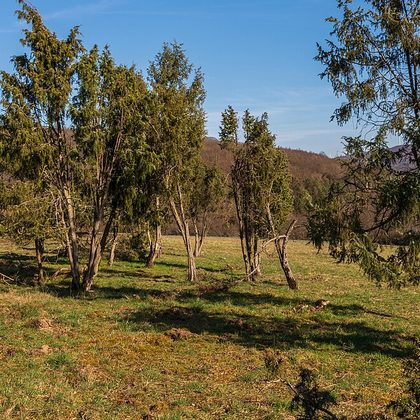
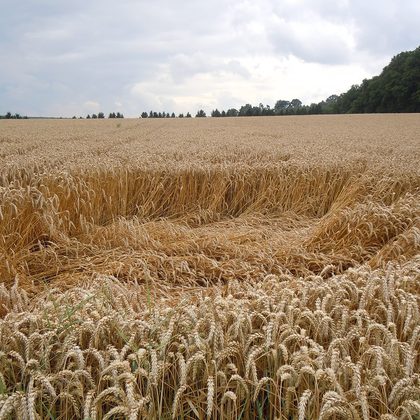
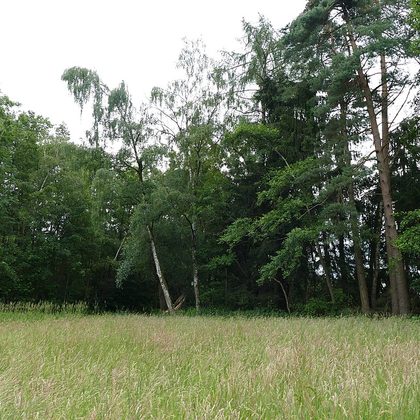
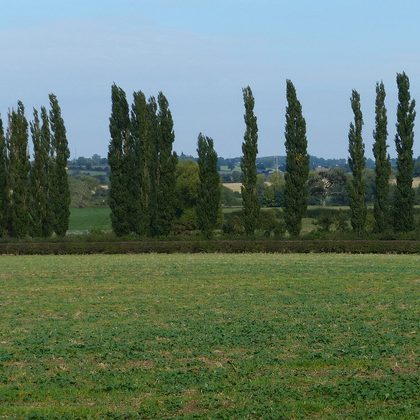
Open lowland and hill country with scattered tall trees: steppe and puszta, cereal and lucerne fields, pasture and rough field margins, and along the edges of deciduous woodland and shelterbelts. It builds a big nest high in a poplar, oak or elm, often at a wood edge or in a solitary tree out in the arable, and hunts over the surrounding open fields. Main prey are susliks, hamsters, hares, pheasants and crows, supplemented with carrion in winter.
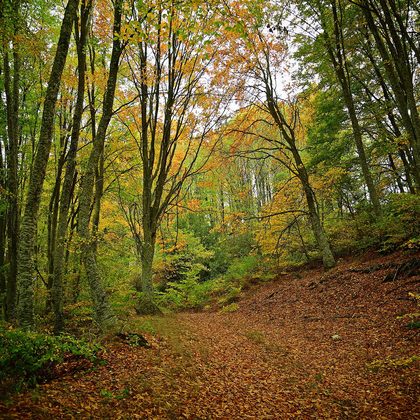
Where the bird is most at home, classified with EUNIS — the European standard for habitats.
Range and movements
From the Pannonian basin across the Balkans to Turkey, the Caucasus and southern Russia, and on eastwards into Central Asia, so only part of the range falls inside the map area. Hungary is the stronghold, where the population grew from 340–370 to 450–500 breeding pairs between 2020 and 2023; Slovakia, Austria — 42 territories in 2023 — Czechia, Serbia and Bulgaria hold smaller but growing numbers. Adults stay near the nest all year, while young birds move to the Middle East and north-east Africa. In north-western Europe it is an extreme rarity, involving wandering immatures, and every claim needs careful documentation. It is absent from Spain, where only the Spanish Imperial Eagle breeds.
- Resident
- Breeding (summer)
- Winter
- Passage
- Migration direction
- dark = core range, pale = thinly spread
Where and when to look
Hungary is the best bet: the Hortobágy, the Kiskunság and above all the loess hills at the foot of the Bükk and Zemplén ranges, in April and May between nine and twelve, as the first thermals build and pairs circle over their territory. Drive the field tracks, stop at a high point overlooking arable with scattered trees, and scan the tree tops and the pylons; a perched Imperial Eagle stands out at long range by its pale head. In Bulgaria the Sakar hills work well, in Turkey the plains around Iğdır.
Conservation status
Vulnerable on the IUCN Red List. The European population is growing thanks to nest guarding, the insulation of dangerous pylons and the investigation of poisoning cases, but it remains small and fragile. Illegal poisoning with banned agricultural chemicals in baits is the leading cause of death in central Europe, followed by electrocution on medium-voltage poles — in Bulgaria held responsible for a large share of juvenile mortality — shooting along the migration route, felling of nest trees and collisions with wind turbines. The collapse of suslik colonies as grassland is ploughed up also makes the food supply uncertain.