All species › Birds of prey › Hawks, eagles and kites › Steppe eagle
Steppe eagle | Aquila nipalensis
Steppearend | Águila esteparia
The Steppe Eagle is the migrant among the big eagles: it breeds on the open steppes of Russia and Central Asia and streams south in autumn across the Middle East and Egypt to Africa. Over Eilat and Suez you can watch it pass in flocks, although those flocks have thinned dramatically since the 1980s.

Voice
Silent, and on migration almost always mute — watch hundreds pass and you will hear none of them. At the nest and in squabbles over carrion it gives a hoarse, barking kyaf-kyaf or a raw kreh, shorter and rougher than the call of an Imperial Eagle. At rubbish tips and carcasses gathered birds produce a grunting croak as they shoulder one another aside with hackles raised.
No freely licensed recording is available for this species yet.
Identification
A large, heavy-looking eagle with long, broad wings that are widest across the secondaries and have a slightly bulging trailing edge; they are held flat in a soar, and in a glide the hand often droops a little. The outer six primaries are deeply fingered, but do not count on the number — moult and wear change the picture — and watch instead the broad, blunt hand that hardly narrows towards the body. The best mark shows at close range: the yellow gape runs back as a long yellow line to beyond the rear edge of the eye, giving the head a fierce expression; in all the related eagles that line stops level with the middle of the eye. The adult is uniform dark brown with a small rufous nape patch and no white at all on the shoulder, with strongly barred grey flight feathers and a dark trailing edge to the wing. Juveniles and immatures are paler brown and carry one broad, clean white bar across the wing coverts, above and below, with a white crescent on the rump and a white trailing edge to the wing — the most distinctive flight pattern in the whole group.
Confusion species
Golden Eagle soars in a distinct shallow V rather than flat, has wings pinched at the base, a longer tail slightly rounded at the tip, a head that projects noticeably and a golden nape; its juvenile shows sharply defined white patches at the base of the primaries and a white tail base with a broad black terminal band, while young Steppe Eagle shows that single broad white covert bar and a white trailing edge. Eastern Imperial Eagle has small white scapular spots, a pale crown and nape, a gape line reaching only to the middle of the eye and, as a young bird, two narrow pale wing bars and a streaked breast instead of one broad white band. Spanish Imperial Eagle has a continuous white band out to the bend of the wing and a creamy-white crown, and occurs only on the Iberian Peninsula. Greater Spotted Eagle is the hardest: smaller and darker, with a narrower wing held more strongly bowed in a glide, a shorter gape line, and in juveniles rows of white droplet spots on the coverts rather than one solid bar. Long-legged Buzzard is slimmer, paler-headed and has an unbarred pale tail. Naming works well for first- and second-year birds, thanks to that white wing bar, and for fully dark adults with the long gape; in between, in the third and fourth year, the white bar becomes worn and broken and many birds cannot be named with certainty at range.
Habitat
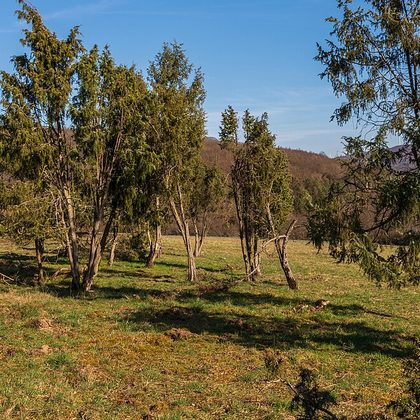
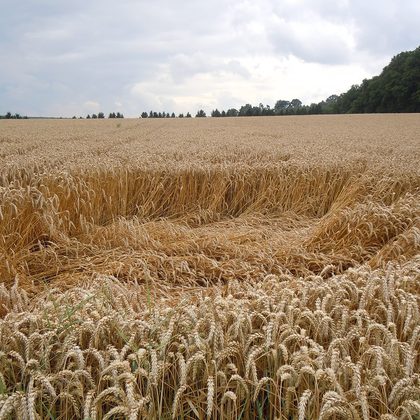
Open dry steppe and semi-desert with low herbs and bare ground, where it nests on the ground or on a low bush; on migration and in winter also cereal fields, fallow, dusty plains and above all rubbish tips and abattoir dumps, where dozens can gather at once. It hunts susliks and other rodents, but outside the breeding season lives largely on carrion and on what other raptors leave behind.
Where the bird is most at home, classified with EUNIS — the European standard for habitats.


Range and movements
Breeds from the Caspian steppes of southern Russia eastwards through Kazakhstan to Mongolia and China; only the western edge of that breeding range falls inside the map area, in the steppes north of the Caspian Sea. Within the area it is chiefly a passage migrant: in autumn birds move down the eastern side of the Mediterranean through Israel, Sinai and Suez into Africa, and back again in spring, with a second stream over Bab-el-Mandeb. Spring counts at Eilat once produced tens of thousands — an average of over seventeen thousand across the surveys between 1977 and 2000 — but the spring count there in 2007 reached only about 2900. In north-western Europe and in Spain it is an extreme rarity.
- Breeding (summer)
- Winter
- Passage
- Migration direction
- dark = core range, pale = thinly spread
Where and when to look
Eilat in March, or the hills behind Suez and Ain Sokhna in October. Stand on the shoulder of the ridge that runs parallel to the flight line, with the wind slightly behind you, and start around half past nine in the morning when the first thermals lift the birds; the eagles come over the crest in loose parties and then spiral up. Take time over birds sitting on the ground or on posts, because only then can you see the gape line. In Oman and Israel, winter rubbish tips give the closest views of all.
Conservation status
Endangered on the IUCN Red List, placed in that category in 2015. The world population has fallen by more than half within a few decades. Electrocution on badly designed medium-voltage poles across the Kazakh and Russian steppe kills large numbers every year, and beyond that the ploughing of steppe, steppe fires, the loss of suslik colonies, poisoning through baits and veterinary drugs, trampling of ground nests by livestock and shooting along the migration route all play a part. The sharp fall in the proportion of young birds in the Eilat counts suggests that breeding success has declined as well.