All species › Birds of prey › Hawks, eagles and kites › Booted eagle
Booted eagle | Hieraaetus pennatus
Dwergarend | Águila calzada
The Booted Eagle is Europe's smallest eagle, barely bigger than a Buzzard, and the only one that flies about in two clearly different colour morphs. In Spain it is an everyday sight over woodland and dehesa from March to October; in the Netherlands a rare but by now almost annual visitor.

Voice
Heard mainly around the nest from April to July: a high, penetrating pee-pee-peeee that recalls a Swift, and from both birds at the nest a rapid klee-klee-klee-kee-kee. The male also calls during his undulating display high over the wood, usually late in the morning. On migration and in winter the species is all but silent.
Recording: Bubulcus — CC BY 3.0 · Wikimedia Commons
Identification
About the size of a Buzzard — wingspan 110 to 135 against 110 to 133 centimetres — but far slimmer in build, and much smaller than Bonelli's Eagle or a Goshawk; males weigh some 700 grams, females about a kilo. It soars on flat wings with a strikingly straight trailing edge and six clearly fingered primaries; the tail is fairly long, narrow and square-cut at the tip, without a terminal band and without bars. Both morphs show a small white spot at the bend of the wing, the landing lights, and a pale band across the upperwing coverts, with a pale patch on the uppertail coverts alongside. The pale morph, by far the commoner in Spain, is white below with a rufous-washed head and breast and sharply contrasting black flight feathers, the inner primaries forming a pale wedge. The dark morph is uniform warm brown below, but shows the same pale wedge, the same landing lights and the same square tail tip. Close up the legs are feathered to the toes, which gives the bird its name.
Confusion species
Size is the first filter, but here it hardly helps: a Booted Eagle is the size of a Buzzard and far smaller than Bonelli's Eagle or a Goshawk. Buzzard has broad, rounded wings with a bulging trailing edge, a short broad tail with a dark terminal band, dark carpal patches and a pale U-shaped band across the breast, and soars in a shallow V; the Booted Eagle soars on flat wings, has a straight trailing edge, a longer, square-cut tail with no terminal band, and the white landing lights. Honey Buzzard has a smaller head on a longer neck and a longer tail with two narrow basal bars and one broad terminal band, and lacks the landing lights. Bonelli's Eagle is much larger, white below with fine streaking, a white mantle patch and a broad black terminal tail band. Goshawk is more compact, with a head projecting ahead of the wings and rounded tail corners. A dark-morph Booted Eagle suggests a Black Kite at range, but that bird is slimmer, flies loosely with a rocking action, and has an obviously forked tail.
Habitat
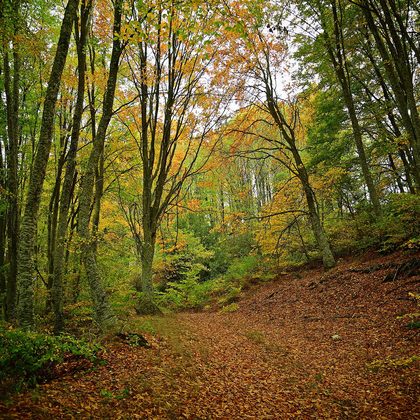
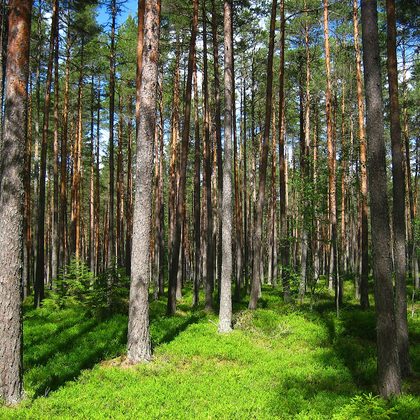
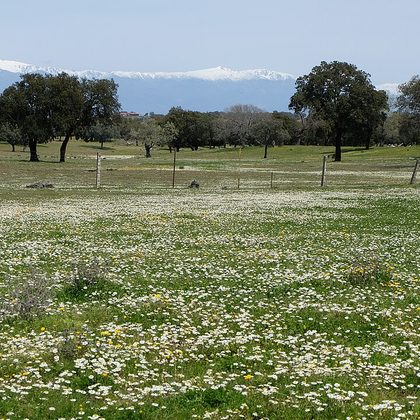
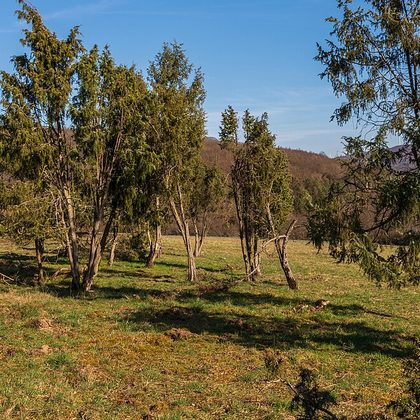
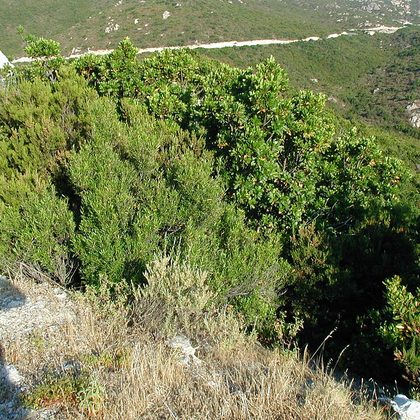
Woodland in hill and mountain country with open ground beside it: pine forest, holm oak and cork oak woods, old broadleaved stands and lines of poplars along rivers, with the nest high in a tree. It hunts over dehesa, arable land, clear-fell, scrub and dry grassland for lizards, young rabbits and above all small and medium-sized birds, seized in a steep, fast stoop from above. In the mountains up to about 2000 metres, higher still in North Africa and Asia.
Where the bird is most at home, classified with EUNIS — the European standard for habitats.
Range and movements
A breeding bird of southern Europe centred on the Iberian Peninsula, with further populations in southern France, Italy, the Balkans, Turkey and the Caucasus, and eastward across Central Asia to Mongolia; a separate population breeds in southern Africa, so the range extends well beyond the map area. European birds cross at Gibraltar and the Bosporus in September and October and winter in the Sahel and further south, though a few hundred stay through the winter in south-west Spain and Portugal. In the Netherlands over sixty records have been accepted, all since 1992, almost all between late April and mid-October, and of both the pale and the dark morph.
- Resident
- Breeding (summer)
- Winter
- Passage
- Migration direction
- dark = core range, pale = thinly spread
Where and when to look
May and June, between ten and two, when thermals lift the birds above the canopy: Monfragüe, the Sierra de Gredos and the dehesas of Extremadura then often put several birds in the air at once, along with the male's undulating display. For migration, stand at Cazalla or the Mirador del Estrecho above Tarifa from late August to early October, where the Booted Eagle is one of the commonest raptors crossing; count the proportion of dark birds while you are there, which in Iberia runs at about a quarter.
Conservation status
Not globally threatened (IUCN: Least Concern) and, with several thousand pairs, the commonest eagle in Spain. European numbers are held to be stable to slightly increasing, but locally pairs are lost through felling of old nest trees, disturbance in the breeding wood in April and May, illegal shooting, and loss of open hunting ground as fields scrub over or are farmed intensively. Electrocution and turbine collisions cost fewer birds than in Bonelli's Eagle, but count along the narrow migration corridor at Gibraltar. The species was carried for a time as Aquila pennata and is placed by most lists back in the genus Hieraaetus.