All species › Birds of prey › Hawks, eagles and kites › Lesser spotted eagle
Lesser spotted eagle | Clanga pomarina
Schreeuwarend | Águila pomerana
The Lesser Spotted Eagle is the eagle of the wet hay meadow: a medium-sized raptor that nests in old broadleaved woodland from the Baltic states to the Balkans and finds much of its food on foot in the fields alongside. Its name comes from the yapping call it delivers over its territory. Together with the Greater Spotted Eagle it forms the hardest identification puzzle among European raptors.

Voice
The call is what the Dutch and German names refer to. Over the territory comes a far-carrying, dog-like yelping tyuk … tyuk … tyuk, high and sharp, in series of three to eight with every syllable stressed; close by it sounds more like yup or yek. In the undulating display flight a long, whistled weeeek is added. Most vocal from late April into June, around the nest and over the hunting ground; on migration the species is almost entirely silent, so you can watch hundreds pass without hearing one.
No freely licensed recording is available for this species yet.
Identification
A little larger than a Common Buzzard and far slimmer than the big eagles: 55 to 67 cm long, with a wingspan of 145 to 168 cm. Females at 1300 to 2200 grams are clearly heavier than males of 1000 to 1400 grams, and in a pair that size difference is visible in the field. The wings are held flat or in a very shallow V when soaring; in a glide the hand droops noticeably so that the wing looks bowed. Watch the proportion of hand to arm: the secondaries form a narrow arm no broader than the hand, so the wing stays much the same width along its whole length, and the trailing edge runs almost straight and parallel to the leading edge, without bulging across the secondaries. Six primaries are fingered and the hand is fairly long, which makes the bird look lighter and more agile than its size suggests. Adults are pale coffee-brown, with head and upperwing coverts paler than the dark flight feathers, and a pale band across the greater coverts. Below, the contrast is the key mark: the underwing coverts are paler than the flight feathers, so the wing looks two-toned, a pale forewing against a dark rear half. At the base of the inner primaries sits a pale, rather diffuse wedge — the finger-joint patch — and together with the pale carpal area this gives the impression of two pale crescents. Above the tail a narrow whitish V or shallow U across the rump stays visible at range. Close to, the bill is relatively slender, with a small, elongated oval nostril and a yellow gape reaching about to the middle of the eye. Juveniles are darker chocolate brown with a striking ochre nape patch, a single row of small white droplet spots along the tips of the greater coverts, and a thin white trailing edge to wing and tail.
Confusion species
Greater Spotted Eagle is the only real confusion species, and the marks work only when you take them together. Build: Greater Spotted is larger and heavier, with an arm clearly broader than the hand, so the wing is widest across the secondaries and the trailing edge bulges there; in Lesser Spotted hand and arm stay much the same width and that trailing edge runs straight. The classic reversal is on the underwing: in Lesser Spotted the underwing coverts are paler than the flight feathers, in Greater Spotted darker, so that there the grey barred flight feathers remain the palest part of the wing. The pale primary patch differs in number and position: Lesser Spotted has a diffuse pale wedge at the base of the inner primaries which, with the pale carpal area, forms a double crescent, while Greater Spotted carries one sharply defined white comma at the base of the outer primaries and otherwise an unmarked hand. The white rump is a broad, clean white U in Greater Spotted, a narrower wedge or V in Lesser Spotted. Close to: the nostril of Lesser Spotted is an elongated oval, that of Greater Spotted round, and the bill of Greater Spotted is noticeably broader and heavier with a larger yellow gape. In juvenile plumage Lesser Spotted shows a warm ochre nape patch and one row of small white droplet spots on the greater coverts; young Greater Spotted is almost blackish brown, lacks that nape patch and carries several rows of large white droplet spots across coverts and scapulars. An honest caveat belongs with all this: the two cross in eastern Europe, from eastern Poland and the Baltic states to western Russia and south to the Black Sea. Mixed pairs — usually a Greater Spotted female with a Lesser Spotted male — produce fertile intermediates that sit squarely between the parents; in Estonia about eight per cent of the nestlings examined proved to be such intermediates. Some birds in the field therefore cannot be named with certainty, and that is not a failing of the observer. Beyond that: Common Buzzard is smaller and more compact with a shorter broad tail and dark carpal patches and soars with wings in a shallow V; Steppe Eagle is larger and heavier with a yellow gape running back beyond the eye; Honey Buzzard has a smaller head on a longer neck and a longer tail with two narrow basal bars and one broad terminal band.
Habitat
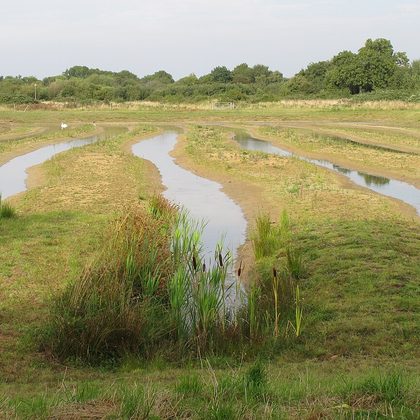
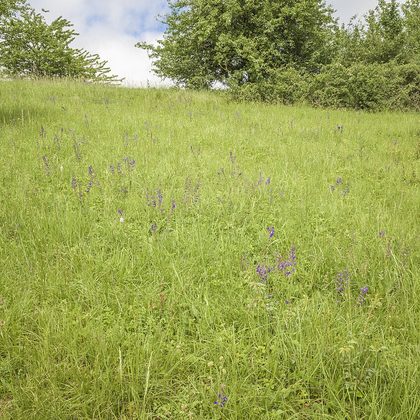
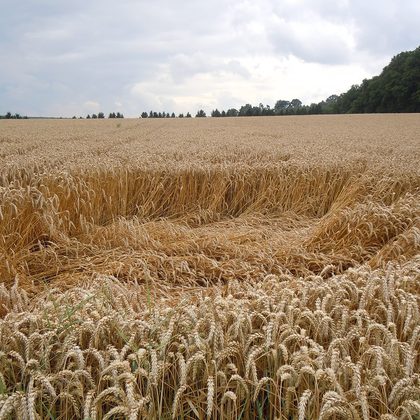
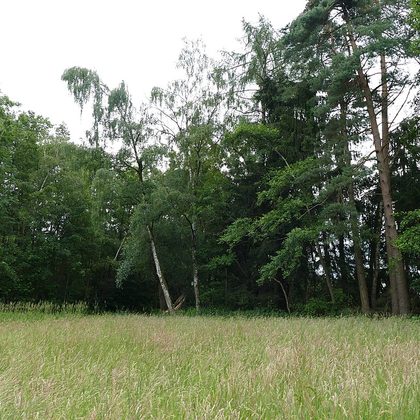
Old broadleaved and mixed lowland woodland for the nest — often a fairly small block of tall beech, oak or alder — directly bordering open, damp farmland. It forages over wet and moist grassland, hay meadow, marshy hollows, field margins and freshly mown fields, and does so remarkably often on foot: the bird walks through the grass in short steps and takes frogs, voles, moles, young birds and large insects. The combination of a quiet wood and unfertilised, herb-rich wet grassland is the key; where the meadows are drained or turned over to maize, the species leaves the wood beside them.
Where the bird is most at home, classified with EUNIS — the European standard for habitats.

Range and movements
A breeding bird of eastern Europe: from north-eastern Germany, Poland and the Baltic states east to western Russia, and south through Slovakia, Hungary and Romania to the Balkans, Turkey, the Caucasus and northern Iran. The European breeding population is put at roughly fourteen to nineteen thousand pairs, concentrated in Belarus, Latvia, Poland and Romania; the German outpost in Mecklenburg-Vorpommern and Brandenburg still holds only about a hundred pairs. Virtually the whole population moves in September over the Bosphorus and the Middle East to eastern and southern Africa; a maximum of 18,900 birds has been counted in one autumn at the Bosphorus, and well over a hundred thousand at Kefar Kassem in Israel. In the Netherlands it is a rare passage migrant with at most a few records a year, and in Spain an exceptional vagrant.
- Breeding (summer)
- Winter
- Passage
- Migration direction
- dark = core range, pale = thinly spread
Where and when to look
For a perched or hunting bird: north-eastern Poland in May or June — the Biebrza valley or the country around Białowieża — late in the morning, when the birds start circling over the hay meadows; eastern Slovakia, the Romanian Carpathians and the Latvian forests are equally reliable. For numbers you need the flyways: the Bosphorus at Istanbul in the second half of September, or Batumi on the Georgian Black Sea coast in late September and early October, where the birds are squeezed along the coast between the mountains and the sea. Take a slope there early in the morning and on every eagle check the two-toned underwing first, and size only afterwards.
Conservation status
Not globally threatened (IUCN: Least Concern), and the European population has been roughly stable over the past decade. Regionally the picture is less comfortable: the small German population is nationally listed as threatened with extinction. The main pressures are the drainage and ploughing of wet grassland, the conversion of hay meadow to maize and oilseed rape, forestry work at nest trees in spring, collisions with wind turbines on the breeding grounds and illegal shooting along the migration route. Because siblicide means a pair almost always rears just one young, losses are made good only slowly.