All species › Birds of prey › Hawks, eagles and kites › Greater spotted eagle
Greater spotted eagle | Clanga clanga
Bastaardarend | Águila moteada
The Greater Spotted Eagle is the darker and by far the rarer of the pair: a heavy, short-tailed eagle of swampy lowland woodland in eastern Europe and Russia. Fewer than a thousand pairs are left in Europe, and in the few places where it still breeds it crosses with the far commoner Lesser Spotted Eagle. Its Dutch name, which translates as bastard eagle, predates that discovery but has turned out to fit rather well.

Voice
Yapping like the Lesser Spotted Eagle, but lower, shorter and coarser: a hoarse chek or kyak, usually in threes, suggesting a small dog rather than the high, penetrating series of its relative. When the nest is disturbed the same barking comes faster and more urgently. Outside the breeding season the species is silent; wintering birds at a marsh edge or a rubbish tip give at most a short croak as they drive one another off carrion.
No freely licensed recording is available for this species yet.
Identification
Larger and more heavily built than the Lesser Spotted Eagle: 59 to 74 cm long, with a wingspan of 155 to 185 cm. Weight runs from about 1500 grams in males to 3250 grams in large females, which can therefore be almost twice as heavy as a male. The wings are long and broad and are held flat when soaring; in a glide the hand droops. The proportion of hand to arm is the best structural mark: the secondaries form a broad arm, broader than the hand, so the wing is widest across the secondaries and the trailing edge bulges evenly there rather than running straight. The hand consequently looks short and blunt, and the tail is short and almost square-ended. Adults are more or less uniform dark chocolate brown to nearly blackish brown, with no pale head and no nape patch. Below, the contrast is the reverse of the Lesser Spotted Eagle's: the underwing coverts are as dark as or darker than the flight feathers, so it is the grey barred flight feathers that remain the palest part of the wing. At the base of the outer primaries sits a single sharply defined white comma or crescent — the finger-joint mark — small but conspicuous against all that darkness; the rest of the hand is unmarked, and on the upperwing at most a faint pale patch is left in the same place. Above the tail a broad, clean white U shows across the rump. Close to, the bill is broad and heavy with a large yellow gape, and the nostril is round rather than an elongated oval. Juveniles are darker still than adults, almost black, with rows of large white droplet spots across the upperwing coverts and scapulars and white tips to secondaries and tail; this is the most strongly marked plumage the species wears. A pale morph, fulvescens, with cream body and coverts against dark flight feathers, occurs mainly in the east of the range.
Confusion species
Lesser Spotted Eagle is the only real confusion species, and the marks work only when you take them together. Build: Lesser Spotted is smaller and lighter, with hand and arm of about equal width, so the wing stays much the same width along its whole length and the trailing edge runs straight and parallel to the leading edge; in Greater Spotted the arm is broader than the hand and that trailing edge bulges noticeably. The classic reversal is on the underwing: in Greater Spotted the underwing coverts are darker than the flight feathers, in Lesser Spotted paler, so that the latter shows a two-toned wing with a pale forewing. The pale primary patch differs in number and position: Greater Spotted has one sharply defined white comma at the base of the outer primaries and nothing else, while Lesser Spotted carries a diffuse pale wedge at the base of the inner primaries which, with the pale carpal area, forms a double crescent. The white rump is a broad, clean white U in Greater Spotted, a narrower wedge or V in Lesser Spotted. Close to: the nostril of Greater Spotted is round, that of Lesser Spotted an elongated oval, and the bill of Greater Spotted is noticeably broader and heavier with a larger yellow gape. In juvenile plumage Greater Spotted is almost blackish brown with several rows of large white droplet spots over coverts and scapulars and no nape patch; young Lesser Spotted is warmer brown, has a striking ochre nape patch and only one row of small white droplets. An honest caveat belongs with all this: the two cross in eastern Europe, from eastern Poland and the Baltic states to western Russia and south to the Black Sea. Mixed pairs — usually a Greater Spotted female with a Lesser Spotted male — produce fertile intermediates that sit squarely between the parents; in Estonia about eight per cent of the nestlings examined proved to be such intermediates, and in some areas mixed pairs now outnumber pure ones. Some birds in the field therefore cannot be named with certainty, and that is not a failing of the observer. Beyond that: Steppe Eagle is larger and heavier, has a yellow gape running back beyond the eye and, as a young bird, one broad white bar across the coverts instead of rows of droplets; Eastern Imperial Eagle has small white scapular spots, a pale crown and nape and a longer tail; a dark Marsh Harrier is far slimmer and lighter, soars with wings in a distinct V and shows a pale crown and throat.
Habitat
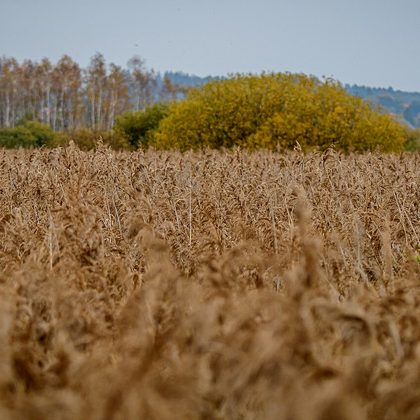
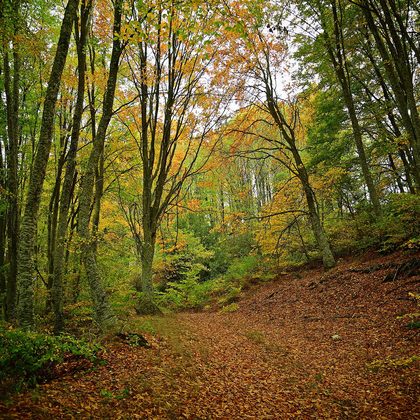
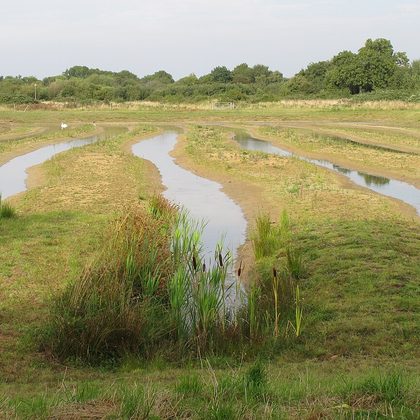
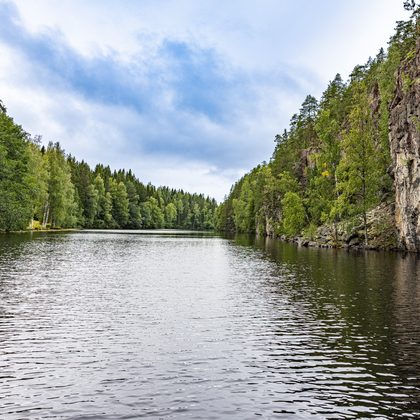
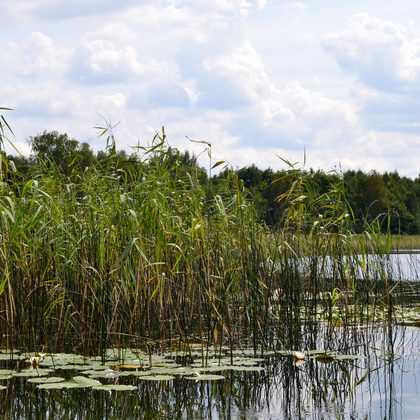
Extensive wet lowland woodland: floodplain forest along large rivers, alder carr and swamp woodland, always bordering open water and open marsh. It forages over reed and sedge beds, fen, wet grassland, shorelines and shallow lakes and flooded ground, taking voles, frogs, waterbirds, fish and young waders. Outside the breeding season it is less particular and turns up at lagoons, fish farms, reservoirs, rice fields and rubbish tips, where carrion makes up a large part of the diet.
Where the bird is most at home, classified with EUNIS — the European standard for habitats.
Range and movements
Breeds from eastern Poland, Belarus and the Baltic states east through Russia to Siberia and northern China; only the western edge of that range lies in Europe. There fewer than a thousand pairs are left: an estimated six to eight hundred in the Russian Volga region, a hundred and twenty to a hundred and sixty in Belarus, about forty in Ukraine, at most fifteen in north-eastern Poland and in Estonia no more than a handful of territories, against thirty at the end of the last century. It winters around the Mediterranean and in the Middle East — Greece, Turkey, Israel, Egypt, Iraq — and beyond that in Iran, India and South-East Asia. In the Netherlands it is a rare vagrant with a handful of accepted records, and in Spain equally exceptional.
- Breeding (summer)
- Winter
- Passage
- Migration direction
- dark = core range, pale = thinly spread
Where and when to look
The best chance in Europe is a wintering bird, and that means Greece: Lake Kerkini or the Evros Delta in December and January, where a few birds stay each winter and often perch for long spells on a dead tree or a dyke, so that bill width and nostril shape can genuinely be assessed. The Danube Delta in Romania and the Hula Valley in Israel also produce winter records. In the breeding season the Biebrza in north-eastern Poland is the classic site, but expect to be patient and expect the bird you find to turn out to be an intermediate. On migration the species passes the Bosphorus and Batumi in small numbers among thousands of Lesser Spotted Eagles; scan there patiently for the darkest bird with the broad arm.
Conservation status
Vulnerable on the IUCN Red List. The species has gone from almost all of its former western and central European range and the remaining populations are small and decreasing. The main causes are the draining of marshes and floodplain forest, the canalising of rivers, logging in breeding woodland, disturbance, illegal shooting along the migration route and poisoning through baits. On top of that comes a problem few other raptors face: crossing with the far commoner Lesser Spotted Eagle means that vacated territories are filled by mixed pairs, after which pure Greater Spotted Eagles disappear locally altogether. In Estonia that sequence has been documented step by step over sixteen years.