All species › Birds of prey › Hawks, eagles and kites › Short-toed snake-eagle
Short-toed snake-eagle | Circaetus gallicus
Slangenarend | Culebrera europea
The Short-toed Snake-eagle is the big pale raptor that hangs in the wind above a slope for minutes on end, legs dangling and head locked on the ground below. Seen head-on it suggests an owl by daylight: a broad round head with two enormous yellow eyes set forward in it. It eats almost nothing but reptiles, and so leaves Europe in September.

Voice
Fairly silent. In the territory and over the nest it gives a plaintive mew, meee-ok, and short series of musical whistles, kyo-kyo-kyo-kyeee, which carry a long way across a quiet hillside. Fledged young beg with an insistent pseee-ah well into August. On migration and in winter quarters it is hardly ever heard, and on many days in the field the species makes no sound at all.
Recording: Benoît Van Hecke — CC BY-SA 4.0 · Wikimedia Commons
Identification
A large raptor with long broad wings held flat, never in a V, and six well-spread fingers in the hand. The first thing you notice is how white it is below: belly and underwing coverts white with fine and highly variable barring, and three narrow bars across the flight feathers, with no dark carpal patches at all. Head and breast usually form a dark brown hood that cuts that white off sharply, although pale-headed birds show it only faintly. The tail is long, with three or four dark bars and no broad terminal band. The head is big and rounded, with very large yellow eyes set frontally, and the legs are bare and blue-grey, with the short toes that give the bird its scientific name. The sexes look alike; the female is somewhat larger and distinctly heavier, so the figures above cover both. Behaviour identifies it as surely as plumage: it hovers for minutes over the same point of a hillside, on slow elastic beats or simply hanging on the wind, and drops in stages before the strike.
Confusion species
A pale Common Buzzard is the everyday confusion, and size and proportions settle it: the Buzzard is clearly smaller and compact, with shorter, more rounded wings and a short broad tail, and it soars with the wings in a shallow V. The carpal patches decide the matter. A pale Buzzard shows dark carpal patches and a pale U-shaped band across the breast, while the snake-eagle has a clean white underwing without carpal patches and carries all its dark on head and breast. The Buzzard also hovers only briefly and clumsily; the snake-eagle will hang above a slope for as long as it likes. Osprey shares the white underparts and the hovering, but hunts over water, has narrow wings with a marked kink at the carpal that makes a flattened M in a glide, and shows a dark carpal patch and a dark eye-stripe across a white head rather than a full hood. Long-legged Buzzard is a size up on Common Buzzard and approaches the snake-eagle in wingspan, but soars with the wings in a pronounced V, and the adult has a plain orange-brown unbarred tail and a compact dark belly patch, the exact opposite of the snake-eagle's white belly. If you can see the face, the two huge yellow eyes staring straight forward end the argument.
Habitat
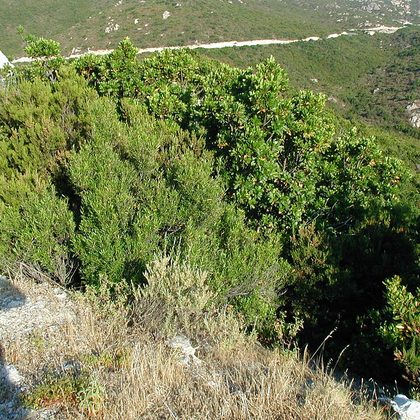
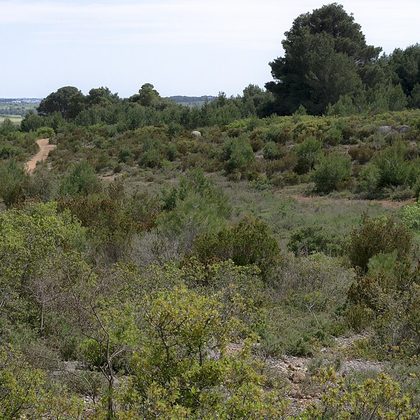
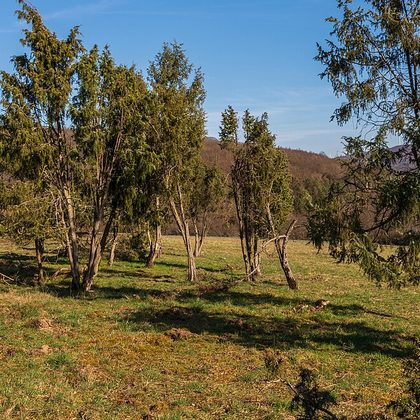
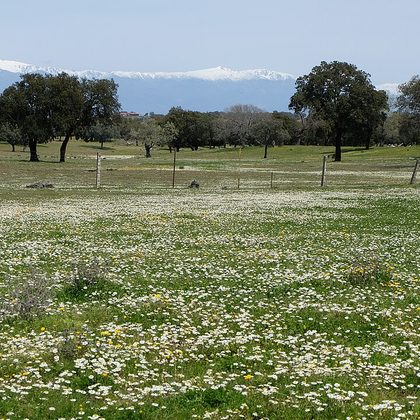
Warm open slopes and plains rich in reptiles: Mediterranean scrub and kermes oak, garrigue and rosemary heath, dry grassland and stony fallow, thinned dehesa and open pine woods with clearings, firebreaks and field edges. It needs a tree for the nest, a pine, a holm oak or a juniper carrying a small platform for a single egg, but it spends the day over open ground. It hunts snakes and lizards from a hover, swallowing the prey whole or carrying it dangling from the bill to the nest.
Where the bird is most at home, classified with EUNIS — the European standard for habitats.

Range and movements
Breeds around the whole Mediterranean and east to the Caucasus, the Middle East and Central Asia. Spain holds the largest part of the European population and the bird is a summer visitor across almost all of the peninsula, from the interior pine woods and sierras to the Mediterranean scrub of Extremadura and Andalusia, scarcer along the humid Cantabrian strip. It also breeds in France, Italy, the Balkans and southern Russia. European birds winter in the Sahel, and passage over the Strait of Gibraltar falls in September and again in March. In the Netherlands it is a rarity of only a handful of records, usually a bird flying over in late spring.
- Resident
- Breeding (summer)
- Winter
- Passage
- Migration direction
- dark = core range, pale = thinly spread
Where and when to look
Between May and July pick a sunny day, stand on a pass or a ridge line overlooking a south-facing slope, in the Sierra de Guadarrama, Gredos or Cazorla for example, and wait between eleven and three for the thermal to build over the ridge: the snake-eagle rises with it and then holds station above the slope with its legs hanging, which is the moment it names itself. A bird flying straight for the wood with a snake in its bill is carrying food to the nest and will usually repeat the trip after a while. In September the watchpoints above Tarifa give the departure for Africa, best on mornings with a light easterly.
Conservation status
Not globally threatened (IUCN: Least Concern). The European population is put at roughly 9,900 to 16,000 pairs and behaves very differently from country to country: clear increases in France and Italy, decreases in Hungary, Poland and Slovakia. Loss of scrub and dry grassland to afforestation, intensive irrigated farming and scrub encroachment costs hunting ground, while electrocution on medium-voltage lines, collisions with traffic where birds hunt road verges, and disturbance at the nest all take a toll. The last of these weighs heavily in a species that lays only one egg a year.