All species › Birds of prey › Hawks, eagles and kites › Rueppell's griffon
Rueppell's griffon | Gyps rueppelli
Rüppells gier | Buitre moteado
Rüppell's Griffon is an African vulture of the Sahel and the East African highlands, and the highest-flying bird on record: one struck an airliner at 11,300 metres. Since the 1990s it has turned up every year among the Griffon Vultures of southern Spain and Morocco, and a handful of birds now stay for years in Andalusian colonies.

Voice
Noisy only at food and at the roost; away from a carcass or the colony almost nothing is heard. At a kill birds squabble with harsh hissing sshh, grating kek-kek chattering and deep guttural grunts and squeals; a large gathering carries a long way. In Spain the few birds present join the Griffons at feeding stations and sound much the same.
No freely licensed recording is available for this species yet.
Identification
A large griffon, slightly smaller and darker than a Griffon Vulture, and unmistakable at close range: the whole body and upperwing are dark brown with broad creamy-white feather tips, giving a strongly scaled plumage that no other vulture in the region shows. Head and neck carry dirty-white down with a whitish ruff, and the bill is pale ivory to horn-yellow, not dark; the eye is amber. From below the wing is two-toned: dark coverts crossed by two narrow pale bands along the median and greater coverts, set against blackish flight feathers. Juveniles are browner and streaked rather than scaled, with a dark head and neck.
Confusion species
Griffon Vulture is the bird to eliminate, and in Spain that means picking one Rüppell's out of a wheeling flock of hundreds. Griffon has a sandy body and pale coverts contrasting strongly with black flight feathers, a bare pale neck, a white downy ruff and a short square tail; its underwing shows one broad pale band, not two narrow ones. Rüppell's is darker overall, scaled rather than streaked, with a pale ivory bill against Griffon's grey one, and it soars on flatter wings where Griffon holds a clear V. Scan for a bird that looks a shade too dark and too neatly patterned; then check the bill and the underwing bands. Beware mixed pairs: hybrids with Griffon are raised in Andalusia and show intermediate features. Cinereous Vulture is uniformly dark with no pale bands at all, with broader, straighter wings and a wedge-shaped tail.
Habitat
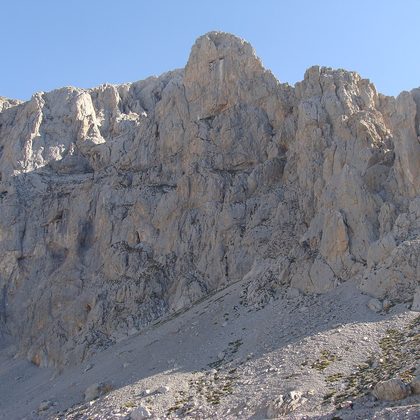
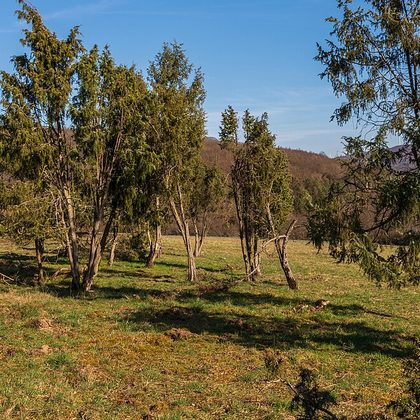
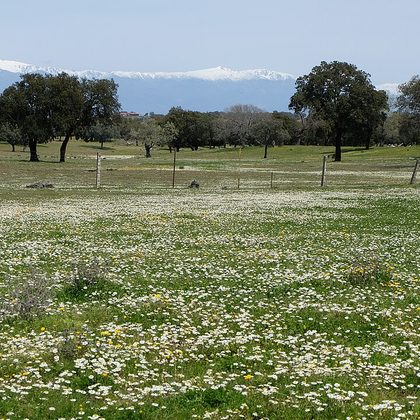
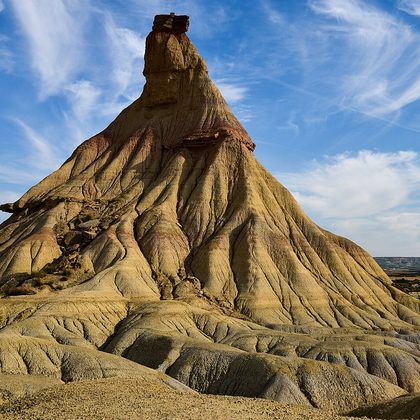
In Africa it nests colonially on cliffs, in gorges and along escarpments, and ranges enormous distances over dry savanna, thorn scrub, grassland and semi-desert, following the great herds. Birds reaching Iberia and Morocco settle into exactly the country the Griffon uses: limestone cliff colonies above dehesa, cereal steppe and rough grazing, with the supplementary feeding stations that go with extensive livestock farming.
Where the bird is most at home, classified with EUNIS — the European standard for habitats.
Range and movements
The breeding range lies in the Sahel and East Africa, from Senegal and Mali east to Ethiopia, Kenya and Tanzania, well south of this guide's map. Within the map area it is a regular visitor rather than a breeder: first recorded in Spain in 1992 and annual since 1997, with at least 29 accepted individuals to 2004 and steadily more since. Most are around the Strait of Gibraltar, in Cádiz and Málaga, with records north to Cáceres, Madrid and Segovia and regular sightings in Morocco. Some birds stay for years — one held a place in a Portuguese colony from 1999 to 2007 — and in January 2020 two adults were found paired with Griffons in Cádiz and Málaga. The first hybrid chick fledged in September 2023.
- Passage
- dark = core range, pale = thinly spread
Where and when to look
Southern Spain, and the Strait of Gibraltar above all, from March to October. Take a vulture feeding station or a mountain pass where Griffons stream through — Tarifa and the Sierra de la Plata in Cádiz, or the crag colonies of the Sierra de Grazalema — and work through the flock bird by bird between about ten and three, when the thermals bring everything up. Most records come from photographs checked afterwards, so photograph any vulture that looks out of place.
Conservation status
IUCN: Critically Endangered. The world population is put at around 22,000 birds and is falling fast throughout the range. Poisoned carcasses laid out for predators, or laced deliberately by poachers to kill the vultures that betray a carcass, are the main cause; to that are added veterinary drugs including diclofenac, killing for traditional medicine and belief-based use, electrocution and collision with power lines and wind turbines, and the loss of large wild grazing herds. The birds that reach Spain are drawn from a population that is disappearing at its core.