All species › Passerines › Chats and flycatchers › Spotted flycatcher
Spotted flycatcher
Muscicapa striata | Grauwe vliegenvanger | Papamoscas gris
Spotted Flycatcher is the least conspicuous summer bird in Europe and at the same time the easiest to name once you see it perched: bolt upright on a dead twig, a fence post or a garden chair, plucking an insect out of the air and returning to exactly the same spot. It is the last migrant back from Africa, often not until the second half of May.

Voice
Both song and call are so unobtrusive that they are routinely put down to something else. The song is a thin, halting run of five to eight sharp, unequal notes, tsee … tsri-tsi … tsree, with no rhythm or melody and silences between them; it sounds more like a Blue Tit's contact call than a song. The call is a thin, scraping tsee, often followed by a short hard tek-tek when it is anxious at the nest. Heard from late May into July, usually right above the nest site.
Recording: Alexander Kürthy — CC BY-SA 4.0 · Wikimedia Commons
Identification
Slim, long-winged and long-tailed, and utterly colourless: grey-brown above, off-white below, with no wing patch and no wing markings at all. What little pattern there is sits on the head and breast: fine dark streaks over the crown and a vague, diffuse streaking across the upper breast and throat sides that reads at distance as a greyish smudge. The eye is large and dark in a plain face, the bill broad-based. The posture is the real character: upright, wings drooped, a brief tail flick, then a short twisting sally and a return to the same lookout. Sexes alike; juveniles are scaled, with cream tips to mantle and coverts.
Confusion species
The main confusion is a juvenile Pied Flycatcher in autumn. That bird is shorter and more compact, always shows a clear white wing patch and white tail sides, lacks the crown and breast streaking, and flicks both wing and tail rather than simply sitting and waiting. A juvenile Spotted Flycatcher is scaled but never shows a white wing panel. Red-breasted Flycatcher is smaller, with a white eye-ring and a black-and-white tail held cocked. Dunnock sits low and shuffles on the ground, and Garden Warbler lacks the upright stance and the sallies.
Habitat
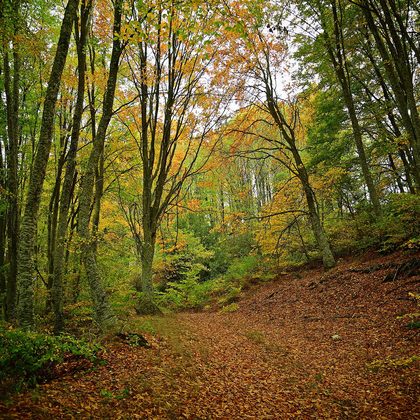
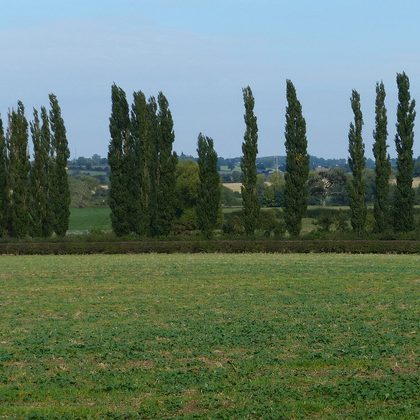
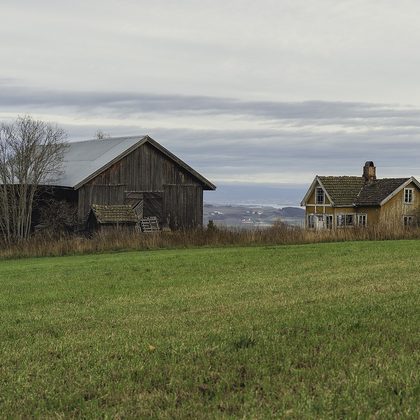
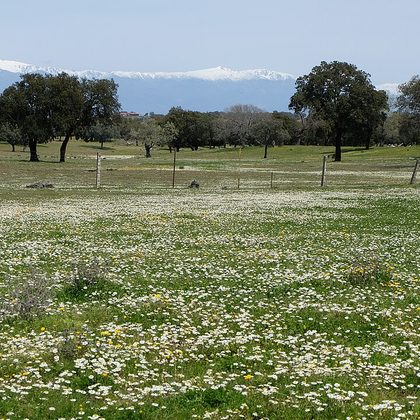
Semi-open broadleaved and mixed woodland, woodland edges, old avenues, wooded gardens, churchyards, village edges and farmyards; what it needs above all is open air space between the canopies and dead branches to hunt from. The nest sits on a ledge, in an ivy-covered wall, behind flaking bark or in an open-fronted box, often close to people.
Where the bird is most at home, classified with EUNIS — the European standard for habitats.

Range and movements
Breeds across nearly all of Europe, from Iberia to Lapland, and winters as far as southern Africa — one of the longest journeys of any of our songbirds. In the Netherlands seventeen to twenty-three thousand pairs, spread through wooded districts and old villages. In Spain it is a widespread summer visitor of dehesas, olive groves, riverine gallery woods and city parks; the Balearic form balearica is treated by some authors as a separate species.
- Breeding (summer)
- Passage
- Migration direction
- dark = core range, pale = thinly spread
Where and when to look
In June, towards evening, sit on a bench at the edge of an old garden, a churchyard or an estate wood and watch the dead branches five to eight metres up. Do not look for colour, look for movement: a bird sitting motionless and upright that suddenly sallies out with an audible snap of the bill and comes back to the same twig is almost certainly this species. In autumn they line up in coastal hawthorns, where the comparison with a juvenile Pied Flycatcher can often be made within a single field of view.
Conservation status
Still Least Concern globally, but the European trend is among the most worrying of any common woodland bird: over half the birds have gone from much of western Europe since 1980, and in the Netherlands numbers fell by more than five per cent a year from 1990 before stabilising over the last decade. The species is on the Dutch red list. The loss of large flying insects, cold wet Junes, and drought in the Sahel and the African wintering grounds are the causes most often cited.