All species › Woodpeckers and allies › Woodpeckers › Syrian woodpecker
Syrian woodpecker | Dendrocopos syriacus
Syrische bonte specht | Pico sirio
The pied woodpecker of orchards, village edges and town parks, from south-east Europe to Iran. It looks much like a Great Spotted Woodpecker and likes human company, living among walnuts, mulberries and old standard fruit trees. It does not occur in Britain or Ireland, and its westward advance has stalled far short of the North Sea.

Voice
The call is a soft, slightly muffled kyuk, less sharp and explosive than the kik! of Great Spotted, running into a rattling kwirrr when the bird is agitated. The drum roll is noticeably longer and fades away at the end, where Great Spotted stops abruptly. Males drum from January into April, often from a dead orchard branch or a roadside pole.
No freely licensed recording is available for this species yet.
Identification
The same size as Great Spotted Woodpecker, with a longer bill and a strikingly white, open face. The black moustache curves back and dies away in the white of the neck side: there is no black band running on to the nape, so cheek and neck form one unbroken white sweep. The underparts are dingy white to buff, on many birds with faint flank streaks, and the vent is dull pink rather than scarlet. The outer tail feathers show little or no white. Males have a red nape patch, females no red, juveniles a black-edged red cap.
Confusion species
Great Spotted Woodpecker is the comparison that matters: on it the black moustache runs unbroken to the nape and cuts the white face into pieces, the underparts are clean white, the vent vivid red and the outer tail clearly barred white. Middle Spotted Woodpecker has a red crown in both sexes with no black border and a salmon-pink lower belly. Lesser Spotted is sparrow-sized with a barred back. Where the two large species meet, hybrids occur; a bird with half a moustachial band is best left unnamed.
Habitat
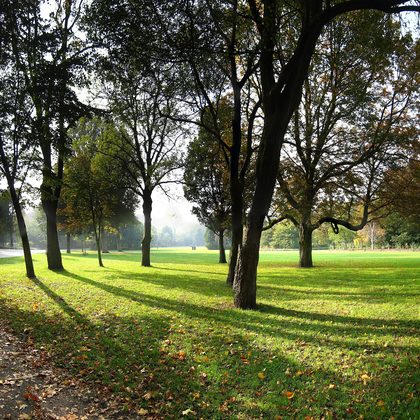
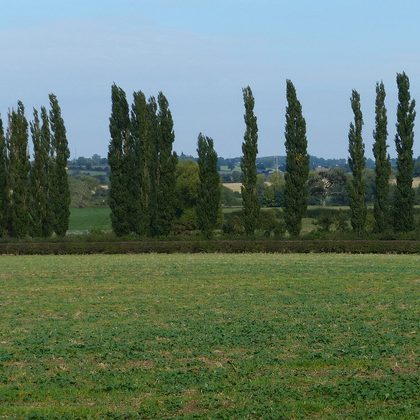
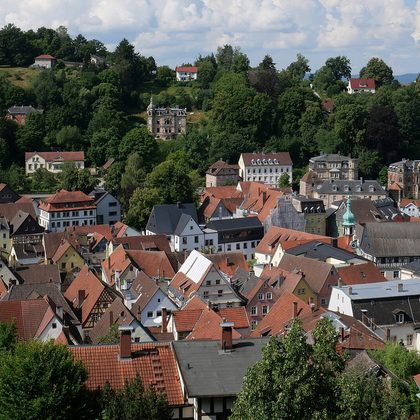
Half-open wooded farmland: standard orchards, walnut and mulberry trees along roads, gardens, cemeteries, village edges and town parks, and olive groves further south. Closed forest it avoids. It needs isolated old trees with soft, decaying wood to excavate a nest hole, and in autumn wedges nuts and stones into a regular anvil.
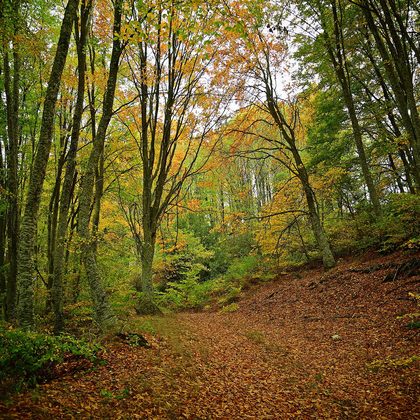
Where the bird is most at home, classified with EUNIS — the European standard for habitats.
Range and movements
From south-east Europe and Turkey through the Levant and Iraq to the Caucasus and Iran. Since the late nineteenth century the range has shifted far to the north-west, across the Balkans, Hungary, Slovakia, Austria and Poland; since about 2000 that western front has been more or less static in western Poland, Czechia, eastern Austria and Slovenia. Britain lies well outside it, and there is no sign of that changing.
- Resident
- Breeding (summer)
- Winter
- Passage
- Migration direction
- dark = core range, pale = thinly spread
Where and when to look
Look for it in the village, not the wood. In Hungary, Serbia, Romania or Bulgaria, spend a March morning walking a street of old walnut trees, the edge of an orchard or a cemetery, and listen for the soft kyuk and a drum roll that runs on a shade too long. When a pied woodpecker appears, check the side of the neck first, then the vent.
Conservation status
Not threatened (IUCN: Least Concern) and common over most of its range. At the western front the spread has stalled since the turn of the century and numbers are falling locally, most likely because old standard orchards and solitary walnut trees are disappearing. Keeping old fruit and nut trees in and around villages is the simplest measure.