All species › Passerines › Larks › Thekla's lark
Thekla's lark | Galerida theklae
Theklaleeuwerik | Cogujada montesina
The crested lark of the stony hillside. In Europe it lives only in Iberia and the Balearics, with a second stronghold in north-west Africa, and for most northern birders it is the bird you are never quite sure you saw on a Spanish holiday. It is perfectly doable, provided you look at three things at once: bill, breast and terrain.

Voice
Usually the clinching evidence. The song is longer, faster and more musical than a Crested Lark's: a continuous, chattering, jangling run of short motifs, rich in imitations of other birds, that may go on for half a minute or more. It sings from a boulder, a wall or the top of a bush, and also in a wide circling song flight that can hang over the slope for minutes on end — something Crested Lark rarely does. The call is drier, harder and more nasal than the Crested Lark's liquid whistle, often a short, slightly tinny dree-dree-dree or chree-choo. The season runs from January into June, with most song in February and March.
No freely licensed recording is available for this species yet.
Identification
Slightly smaller and more compact than Crested Lark, with a proportionally larger, rounder head and a shorter, deeper-based bill whose culmen is clearly convex and whose tip is dark; the base of the lower mandible is greyish blue rather than pink. The crest is shorter and fan-shaped, so that separate feather tips can be made out, and is often held half lowered. The upperparts are colder and greyer brown than a Crested Lark's, with crisper markings. The decisive picture is on the breast: sharply defined, almost black drop-shaped streaks on a clean white ground, running onto the flanks. The undertail coverts are pale cream to off-white and the underwing greyish buff. In flight the greyer rump stands out, contrasting with rusty tail sides, whereas on Crested Lark rump and tail flow into one another. It perches on rocks, walls and bush tops far more readily than Crested Lark does.
Confusion species
It all turns on Crested Lark — see its species page, where the same difference is set out from the other side. Crested Lark is bigger and coarser, with a longer, more tapering bill with an almost straight lower edge, a longer and spikier crest carried as one point, vague blurred brown breast streaks on off-white, warm ochre undertail coverts, warm rusty-orange underwing coverts and a rusty rump that merges into the tail. No single one of those marks is watertight; three or four on the same bird are. Habitat counts almost as heavily as plumage here: rocky slopes, stony fallow, garrigue and open dehesa belong to Thekla's Lark, while flat arable land, verges, docks and industrial estates belong to Crested. And the song decides it: Thekla's is longer, more musical and full of mimicry, Crested's shorter and purely whistled. Short-toed and Mediterranean Short-toed Larks are smaller, crestless and short-billed; Woodlark has a very short tail and a black-and-white block at the bend of the wing.
Habitat
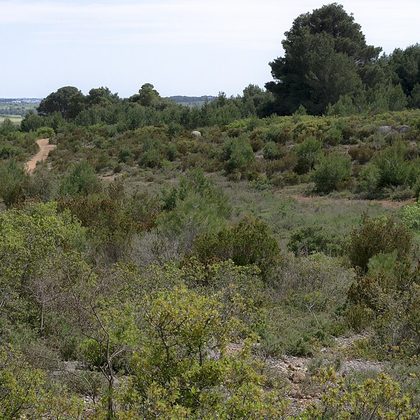
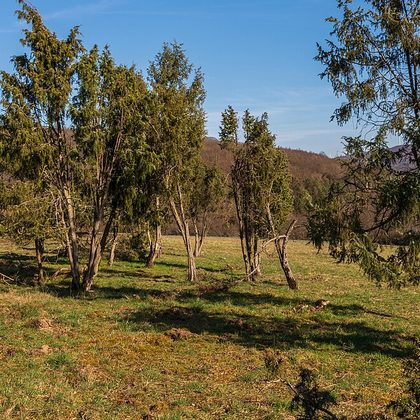
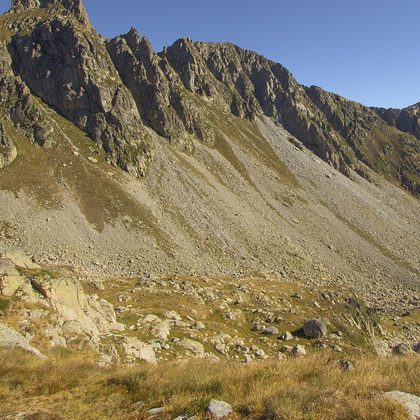
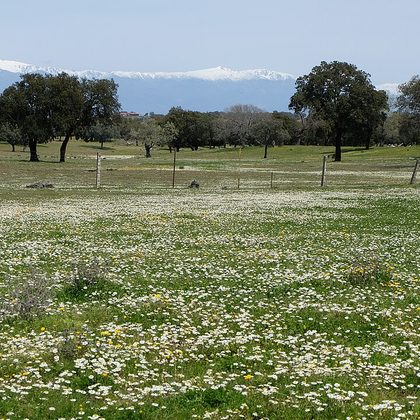
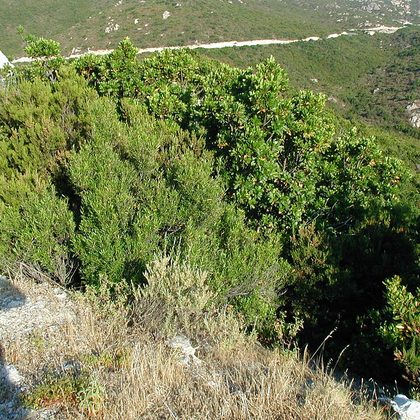
Stony, warm, nutrient-poor slopes with a low and open shrub layer: garrigue and thyme scrub, thorny bushes, abandoned terraces, stony fallow, scree slopes, badlands and the edges of rocky plateaux. Also thin dehesa with bare patches, olive groves on stony ground and coastal cliff tops. It feeds on foot between the bushes on open stony soil, and uses boulders and bush tops as lookouts and song posts. In southern Spain it reaches well over two thousand metres in the Sierra Nevada. Flat, intensive arable land and hard surfacing it leaves to the Crested Lark.
Where the bird is most at home, classified with EUNIS — the European standard for habitats.
Range and movements
The Iberian Peninsula, the Balearics and north-west Africa from Morocco to Libya; nowhere else in Europe. In Spain it is widespread in the south, east and centre — Andalusia, Murcia, Valencia, Aragón, La Mancha, Extremadura — and scarcer in the wet north. In Portugal it is mainly a bird of the south and the Algarve coast. It is resident, moving at most from the higher sierras down to milder slopes in winter.
- Resident
- Winter
- Passage
- dark = core range, pale = thinly spread
Where and when to look
Choose the terrain, not the bird. In March or April walk up a stony, thyme-and-broom slope above an Andalusian or Aragonese village, stand still and wait for the song. Almost any Galerida singing there from a boulder or a bush top, or hanging over the slope in a circling song flight, is a Thekla's Lark. Then check the short, convex bill and the crisp black drops on the white breast. Down on the plain, along the road and on the arable, think Crested Lark instead. Visiting both in one day — slope first, valley afterwards — is the quickest way to fix the difference for good.
Conservation status
Not globally threatened (LC) and still widespread in Iberia and the Maghreb, but it is a bird of a habitat that is quietly disappearing. Where sheep and goat grazing stops, open garrigue closes into tall scrub and the lark goes; where open scrub is planted with pines or turned into intensive orchards and large solar farms, the same happens. Fire, oddly, works in its favour in the short term, by returning the scrub to a low, open state. Spanish common bird monitoring has pointed to a gradual decline since the turn of the century. Keeping stony, lightly grazed slopes with low scrub is the heart of its conservation.