All species › Passerines › Starlings › Vinous-breasted myna
Vinous-breasted myna | Acridotheres leucocephalus
Wijnborstmaina | Miná vinoso
Israel's second myna, and a good deal scarcer than the first. Where the common myna is everywhere, the vinous-breasted myna sits in a handful of parks and avenues on the coastal plain, usually in small parties and often in the company of its abundant cousin. It comes from much further away — Myanmar, Thailand and Indochina — and here goes back to escaped cage birds. It is a strikingly handsome bird: pale head, orange bill, vinous belly.

Voice
Harsh and jangling, pitched much like common myna but with a shorter repertoire and fewer clear fluted motifs, so that the whole sounds more monotonous and more plaintive. Runs of hard chek and chaar notes, punctuated by a nasal, slightly bleating kweh. It calls mainly from a bare branch high in a tree and as birds drop into the roost. Heard all year, most in the early morning and the last hour of light.
No freely licensed recording is available for this species yet.
Identification
As large as common myna but slimmer and more elegant, with a slightly longer tail. The head is creamy to dirty white, with a sharply drawn black mask running from the base of the bill through the eye and back; the bill is orange-red with a pale tip and the legs are orange. Neck, breast and belly are pale pinkish to vinous buff, the mantle grey-brown, and the wings black with a large white panel at the base of the primaries. The tail is black with broad white tips, giving a chequered black-and-white trailing edge as the bird lifts. The sexes are alike; young birds have a greyer head and a duller mask.
Confusion species
Common myna is usually standing right next to it, and then the difference is large: that bird is chocolate-brown with a glossy black head and a bare yellow triangle behind the eye, and a yellow bill. Vinous-breasted myna has a pale head, a black mask and an orange bill, and looks slimmer thanks to its paler underparts and longer tail. In flight the two are more alike — both flash a white primary panel — but vinous-breasted also shows a broad white tail band. On a distant bird against the light, use the head: on common myna it is the darkest part of the bird, on vinous-breasted the palest.
Habitat
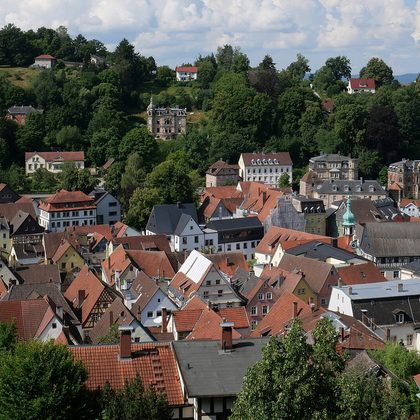
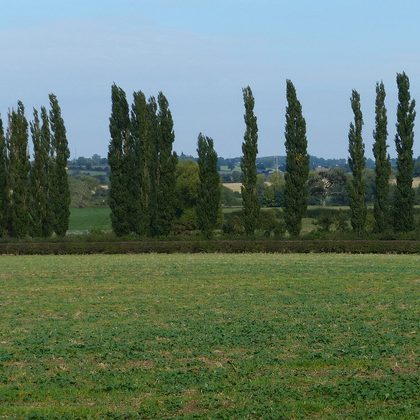
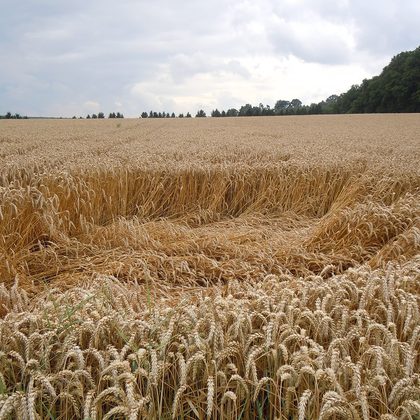
City parks with old, tall trees, wide avenues, playing fields with watered turf, cemeteries, university grounds and the green strips along the coastal highway. It nests in cavities high in trees — often in old or enlarged woodpecker holes in eucalyptus, fig and washingtonia palm — and sometimes in openings in buildings. It feeds on foot over short grass and under trees, taking insects, fruit and nectar, and outside the breeding season gathers in small parties at one regular spot.
Where the bird is most at home, classified with EUNIS — the European standard for habitats.

Range and movements
Native to south-east Asia: Myanmar, Thailand, Laos, Cambodia and Vietnam. Within this region it is essentially confined to Israel, and there to the coastal plain between roughly Rishon LeZion and Netanya, centred on Tel Aviv and the Yarkon valley; single birds have turned up further north and south, with a few records on the West Bank. The population runs to hundreds rather than the tens of thousands of common myna, and the spread is slow but steady. Nowhere else in this region is the species established.
- Resident
- Passage
- dark = core range, pale = thinly spread
Where and when to look
The Yarkon parks in northern Tel Aviv, early on a spring morning. Work along the broad lawns and check the trees at the edge that carry a hole in the trunk; the birds sit high and quiet there and usually give themselves away with a run of hard calls before they show. If a party of mynas is out on the grass, scan the whole group: one pale head among the brown ones is enough, and it stands out at a hundred metres.
Conservation status
Not globally threatened (IUCN: Least Concern); the species is common in south-east Asia, although bird markets there trap it in quantity. In Israel it is a naturalised introduction founded on escaped cage birds, with the first breeding records around the turn of the century. Numbers are still too small for damage to be demonstrated as it has been for common myna, but the concern is the same: another large, aggressive hole-nester in a country where tree cavities are scarce and native hoopoes, woodpeckers, rollers and owls depend on them. Israel therefore keeps the colony under watch. Mixed pairing with common myna is known from elsewhere in the world and could arise here too; so far it has not been shown.