All species › Passerines › Dippers › White-throated dipper
White-throated dipper | Cinclus cinclus
Waterspreeuw | Mirlo acuático europeo
The only songbird in Europe that walks underwater. It stands bobbing on a boulder in a rocky stream, steps in without hesitation, vanishes, and surfaces ten metres upstream with a caddis larva in its bill. On a Welsh, Pennine, Highland or Irish river it is one of the great sights of a winter morning, and it will be singing while the frost is still on the bank.

Voice
The song is a long, sustained rambling warble in which clear notes and grating ones run together, with a creaking, almost electric quality — chee-chrit-churr-chee — pitched exactly where it will carry over the roar of the water. Both sexes sing, and unlike most songbirds they sing right through the year, including on frozen January days, because territories are held all winter. The call is a short, hard zit or dzik, usually given in flight, and usually the first thing you notice: a bullet-shaped shadow shooting low over the water with a sharp zit-zit attached.
Recording: Terje Kolaas — CC BY 4.0 · xeno-canto
Identification
Squat, short-tailed and dark, about the length of a Starling but far rounder and heavier-looking. Head and nape are warm chocolate-brown, the back and wings slate-grey with fine dark scalloping, and throat and breast carry a large, sharply cut white bib. Below it, British, Irish and continental birds show a chestnut band running into a blackish-brown belly. The stubby tail is cocked like a Wren's, the legs are heavy and the toes long, with strong claws. The bird is almost never still: a constant deep bobbing at the knees, punctuated by a flash of white eyelid that carries across the noise of the water. The plumage is exceptionally dense and greasy — about half as many feathers again as a Blackbird — and the preen gland above the tail is huge; the bird works its oil through the feathers for long spells and keeps them waterproof. Underwater a flap closes the nostrils, a transparent third eyelid slides across the eye, and a heavy skeleton with little air in the bones holds it down on the bed.
Confusion species
Nothing else in Europe is really in the running: no other songbird dives. At a distance a Blackbird or Starling on a midstream rock can pass for a moment, but neither bobs and neither shows white. Common sandpiper works the same boulders but is long-legged, pale below, and teeters from the rear end rather than at the knee; Grey Wagtail shares the stream but is slim and yellow. The genuine pitfalls are within the species. Juveniles are dull slate-grey with a dingy white throat lacking a clean border, finely scaled underparts, and no chestnut at all. The races differ too: British birds (gularis) and continental birds (aquaticus) show the chestnut band under the bib, Irish and north-west Scottish birds (hibernicus) are darker and duller with a narrower chestnut zone, and Scandinavian birds (nominate cinclus) are black-bellied with no chestnut whatever. Black-bellied birds are the ones that turn up on the east coast and in the Low Countries in hard winters.
Habitat
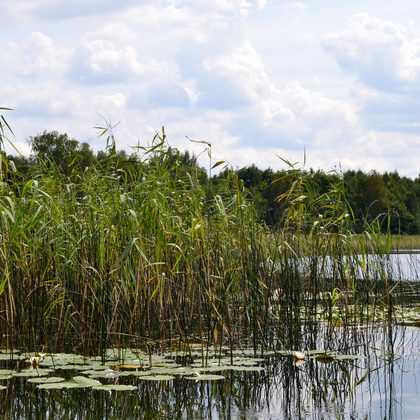
Fast, clean, well-oxygenated water over gravel and boulders: trout streams, upland rivers, the becks of the Pennines and the Lake District, Welsh and Devon rivers, Highland burns and Irish limestone streams. Rapids, shallow riffles and rocks that break the surface are what matter; still water, a silted bed or a straightened, dredged channel are of no use. It feeds by walking on the bottom, into the current with its head down so the flow presses it against the gravel, prising caddis, mayfly and stonefly larvae and freshwater shrimps out from under the stones; large birds take small fish too. Built structures count: weirs, mill leats, sluices and bridge arches are part of the daily round. The nest is a domed ball of moss with a side entrance, set behind a waterfall, in a bank wall, under a bridge or against a weir, often where the bird can only reach it through the spray. It breeds early — the first eggs are laid in March, sometimes late February.
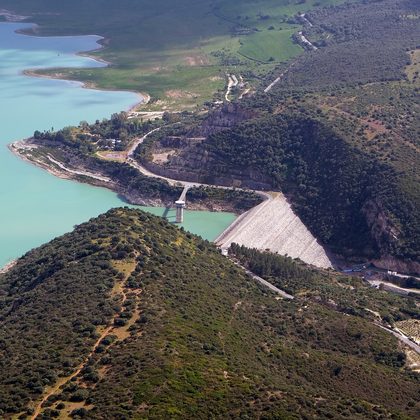
Where the bird is most at home, classified with EUNIS — the European standard for habitats.

Range and movements
From Ireland and Scotland through Scandinavia, the Ardennes, the Eifel, the Black Forest, the Alps and the Carpathians to the Balkans; south into the Pyrenees, the Cantabrian mountains, the Spanish Central System and the Atlas of Morocco; eastwards the range runs well beyond the edge of this map, through the Caucasus and Iran into Central Asia and the Himalaya. In Britain and Ireland it is a resident of the north and west, with about 6,900 pairs in the UK, and it is essentially absent as a breeder from the flat, slow-flowing English lowlands east and south of a line through the Midlands. Birds are highly sedentary, most staying within a few kilometres of where they hatched, though Scandinavian birds move south and west in autumn and reach the Netherlands, Belgium and eastern England.
- Resident
- Breeding (summer)
- Winter
- Passage
- dark = core range, pale = thinly spread
Where and when to look
Go in winter, between November and March: the water runs clear, the banks are bare and the birds are already in song. Pick a fast stream with boulders and a weir or an old mill leat, walk it slowly downstream and watch for two things — a short hard zit low over the water, and a white spot on a midstream rock that will not keep still but bobs. Then sit down and wait. A Dipper works a fixed circuit of rocks and will be back within a quarter of an hour, often to within ten metres. Bridges are the reliable places: stand on one, look at the underside of the next one downstream. From March to June keep away from bridges, weirs and waterfalls where a nest may be tucked in.
Conservation status
Not globally threatened, but everywhere a measure of the stream it lives on. It disappears where water is polluted, acidified, straightened or drawn off for small hydro schemes; acidification in Wales and southern Scandinavia showed how fast that happens, because caddis, mayflies and stoneflies drop out of acid water and there is then nothing to take. In the UK it has been moved to the Amber list after a fall of just over half between 1995 and 2024. Liming of catchments and cleaner rivers have brought birds back in places, and nest ledges built into bridges and weirs are readily used — this is a species that responds quickly to work done on the river itself.