All species › Passerines › Thrushes › Mistle thrush
Mistle thrush
Turdus viscivorus | Grote lijster | Zorzal charlo
Mistle Thrush is the largest and the most undaunted of the European thrushes: it sings from the topmost spire of the wood while the wind roars and the rain lashes the branches. The old English name stormcock sums it up better than any field description.

Voice
The song is a series of short, loud, melancholy fluty phrases, like a Blackbird's but simpler, more repetitive and coarser, with long silences between them, thrown out from high up as though shouting against the weather. It keeps singing precisely in storm, rain and dull light, from mid-December into May, and it is the first songbird of the year. The call is its trademark: a dry, wooden rattle, trrrrt, like a football rattle or a riffled pack of cards, given in flight and in alarm.
Recording: Benoît Van Hecke — CC BY-SA 4.0 · Wikimedia Commons
Identification
Big, long-legged and strikingly long-tailed, standing bolt upright on the ground. Upperparts cold greyish-brown with no warm tone; underparts white to off-white with large, round, irregularly scattered black spots, densest along the flanks. Two things stand out in flight: a bright white underwing, and white tips to the outer tail feathers that flash briefly on landing. The flight is deeply undulating, with the wings closed against the body between bursts. Sexes alike.
Confusion species
Fieldfare shares the white underwing and is the main pitfall in flight, but has a blue-grey head and rump, a chestnut mantle and a black tail without white tips; it also chatters rather than rattles. Song Thrush is clearly smaller, warmer brown, shorter-tailed, with small arrowhead spots and a buff underwing. On coastal or mountain passage a distant Mistle Thrush can pass for a Sparrowhawk or a small raptor thanks to that undulating action.
Habitat
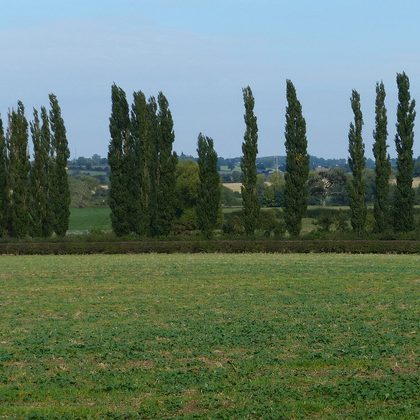
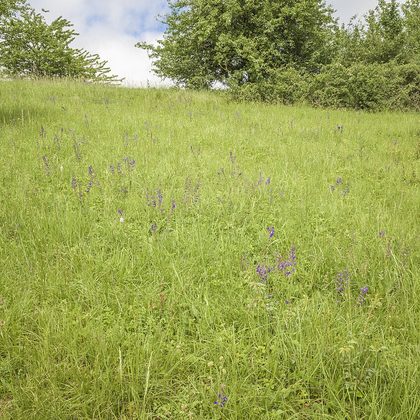
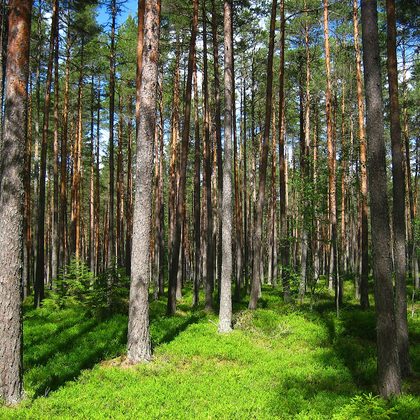
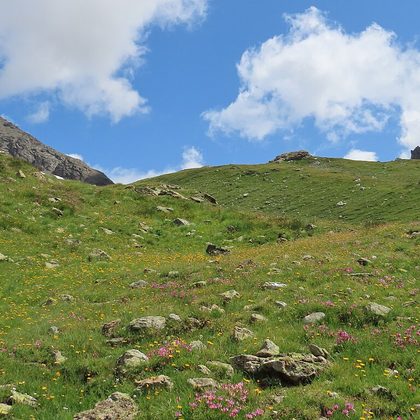
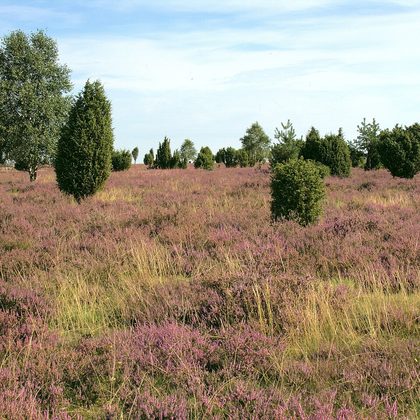
Semi-open country with tall free-standing trees next to short grassland: parkland woods, woodland edges, avenues, orchards, heaths with scattered pines, cemeteries and golf courses. In southern Europe up into the mountains, in pine forest and on alpine pasture; in winter in loose flocks on grassland and at mistletoe and juniper berries.
Where the bird is most at home, classified with EUNIS — the European standard for habitats.
Range and movements
From Ireland and Iberia to Siberia, and south into the high mountains of North Africa. In the Netherlands a scarce to fairly scarce breeder of wooded sandy soils, with eight to ten thousand pairs, plus passage migrants and winter visitors in variable numbers. In Spain it is widespread and numerous in hill and mountain country, from the Cantabrian woods to the pinewoods of the Sierra Nevada.
- Resident
- Breeding (summer)
- Winter
- Passage
- Migration direction
- dark = core range, pale = thinly spread
Where and when to look
Go to an old avenue or a beech woodland edge on a grey, windy day in February and listen for the slow fluty phrases coming from above — it is often the only bird singing. In late summer and early autumn work a grassland beside a wood: family parties feed there ten metres apart, and as they lift you get the white underwing and the white tail corners in a single view.
Conservation status
Least Concern worldwide, but clearly faring worse in western Europe. In the Netherlands it has fallen sharply since a peak around 1995 and has been listed as Vulnerable nationally since 2017, with whole districts in the south now empty. Loss of short herb-rich grassland, fewer large insects and earthworms through intensification and drying-out, and the removal of old free-standing trees are the main pressures. In the mountains of southern Europe the species is holding up better.