All species › Passerines › Thrushes › Ring ouzel
Ring ouzel
Turdus torquatus | Beflijster | Mirlo capiblanco
Ring Ouzel is Europe's mountain blackbird: a shy, hard-flying thrush of scree slopes, alpine pasture and juniper scrub above the treeline. In the lowlands you get two short windows a year, when passage birds drop into bare dune slacks and heaths.

Voice
The song is startlingly simple for a thrush: three or four clear, far-carrying, faintly melancholy whistles on the same pitch, tyuu … tyuu … tyuu, with long silences between them, rounded off by a soft grating chatter audible only at close range. In the high mountains that whistle carries the length of a valley, delivered from a boulder or a lone larch, above all at sunrise. The call is a hard, wooden tak-tak-tak, faster and drier than Blackbird's, plus a harsh chrrr.
Recording: Anthony Wetherhill — CC BY-SA 4.0 · Wikimedia Commons
Identification
The size and shape of a Blackbird but slimmer, longer-winged and faster, more driven in flight. The male is sooty black with a broad, crisply defined white crescent across the breast. On the female that gorget is narrower, off-white to buff, and the plumage browner. The character that works at range is the wing: pale feather fringes make the wing panel look distinctly silvery-grey and scaly, much paler than the rest of the bird, even when the gorget is hidden. Bill yellow with a dark tip. First-autumn birds have almost no gorget but already show that pale wing panel and heavily scaled underparts.
Confusion species
Blackbird is the only real confusion species. A Blackbird is uniformly black with an evenly dark wing, an orange-yellow bill and eye-ring and a calm, low, direct flight; Ring Ouzel always has a paler wing panel, scaly underparts and a harder, more Sparrowhawk-like flight action. Beware Blackbirds with a white breast patch — those patches are irregular in shape, usually accompanied by white elsewhere, and the wing stays uniformly dark. Fieldfare has a grey head and a white underwing.
Habitat
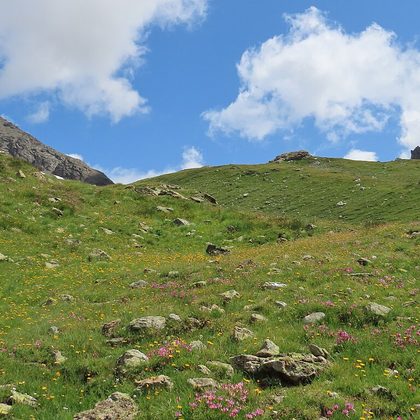
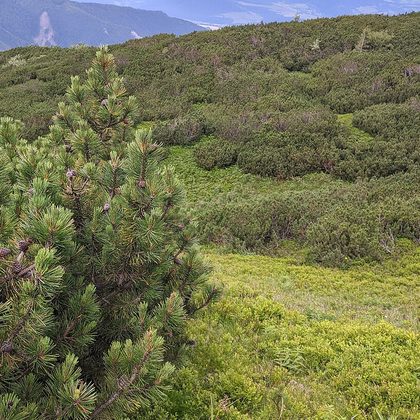
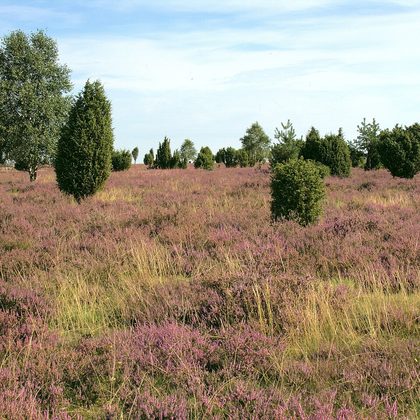
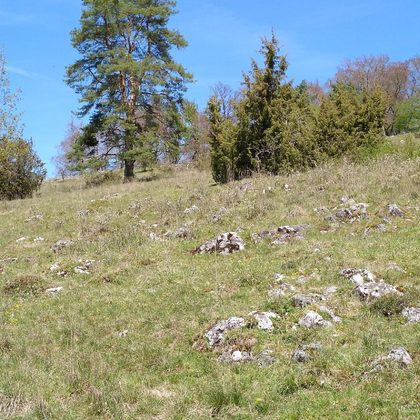
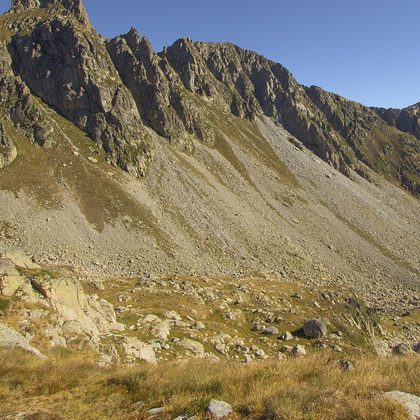
Breeds above the treeline and at the upper forest edge: alpine pasture with boulders, juniper and alpenrose scrub, scattered larches and steep stream gullies; in Britain and Scandinavia also on low-lying moorland and in rocky heather valleys. On migration in bare dune slacks, short heath, field margins and grassland with open sand — always where it can feed off bare ground.
Where the bird is most at home, classified with EUNIS — the European standard for habitats.
Range and movements
Three forms: a northern one in Scandinavia and Britain, an alpine one in the Alps, Pyrenees and Carpathians, and a third in the Caucasus. The Low Countries lie on the flyway: a scarce passage migrant in April and again from mid-September to early November, with dunes and heaths the best places. In Spain it breeds in the Pyrenees and the Cantabrian mountains and winters in the juniper woods of the Iberian plateaux and the Sierra Nevada, where the berries are its staple.
- Resident
- Breeding (summer)
- Winter
- Passage
- Migration direction
- dark = core range, pale = thinly spread
Where and when to look
The last ten days of April, early morning, in a bare dune slack or a freshly cut heath: walk the open sandy patches and watch for a Blackbird that flushes too early and flies too far. Then look at the wing — the silvery panel shows against the light — rather than hunting for the gorget, because females and first-years barely have one. In the Alps, sit above the treeline at sunrise in June and wait for those slow whistles.
Conservation status
Least Concern globally, but declining in Europe and retreating upwards in altitude and northwards in range. Britain lost more than half its breeding birds within a few decades; in the Alps the lower limit keeps climbing. Climate change shifting the snowline and the vegetation belts, loss of short alpine turf to rank growth, and the failure of juniper berry crops in the wintering areas are the prime suspects.