All species › Waterfowl › Ducks, geese and swans › White-headed duck
White-headed duck
Oxyura leucocephala | Witkopeend | Malvasía cabeciblanca
A squat diving duck with a heavy blue bill, swollen at the base, and a stiff tail often carried cocked. The drake has a white head with nothing but a black cap on it. Its survival in Europe rests almost entirely on Spain, and the main threat to it came from Britain.

Voice
Effectively silent outside display; a whole day at a lagoon full of them yields nothing. Displaying drakes swing the head, tap the bill against the inflated neck and give a low rolling prrrt that barely carries across water. Disturbed females give a short hoarse kek. April to June is the only time worth listening, and then only at close range.
No freely licensed recording is available for this species yet.
Identification
Small and thickset, with a bull neck, a large head and a pointed tail held at an angle or straight up. The drake has a white head with a black crown that stops above the eye, a narrow black neck ring and a pale blue bill whose base is swollen high with a concave upper edge; the body is warm chestnut with a finely stippled greyish back and rufous undertail coverts. In winter the bill fades to grey-blue but keeps its shape. Females and immatures are dull brown with a dark crown, a pale cheek and a single dark stripe across it; the swollen bill base shows on them too. Sits low, dives almost continuously, and flies rarely, low and fast on a plain dark wing without a speculum.
Confusion species
Everything turns on Ruddy Duck Oxyura jamaicensis. On the drake of that species the black cap runs down below the eye, so the white cheek is a bounded patch rather than a white head; the bill base is far less swollen and the undertail coverts are white, not rufous. Hybrids are the real difficulty and have turned up repeatedly in Spain: dark smudging running across the cheek, a bill shape between the two, and a greyish cast to head and body. On females it comes down to the cheek stripe, which is narrow, straight and clean-cut on Ruddy Duck but broader and more diffuse on White-headed Duck, with the bill profile the most reliable character. A female whose bill you cannot see properly is a bird to leave unrecorded.
Habitat
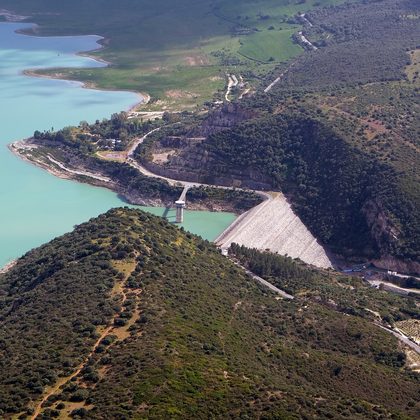
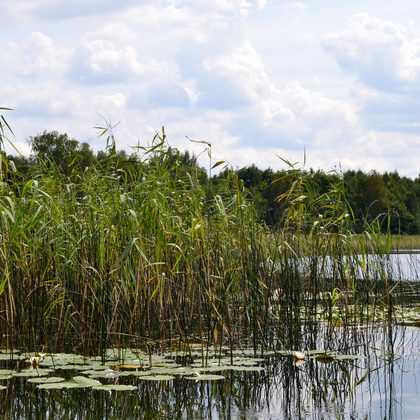
Deep, permanent lagoons and lakes with clear fresh to slightly brackish water and a broad fringe of reed and reedmace. Dives in the open middle for midge larvae, crustaceans and the seeds of aquatic plants, and edges in against the reed during the day. In Spain it uses man-made waters just as readily: reservoirs, disused saltpans and the settlement lagoons at El Hondo. Shallow pools that dry out in summer are of no use to a bird that needs water it can dive in.
Where the bird is most at home, classified with EUNIS — the European standard for habitats.


Range and movements
Two separate populations: a migratory eastern one from Kazakhstan and southern Russia to Iran and Pakistan, and a largely sedentary western one in Spain and north-west Africa. Spain holds the European stronghold, in the lagoons of Córdoba, the lower Guadalquivir, Castilla-La Mancha, Murcia and Alicante. Elsewhere in Europe it is a genuine rarity. Britain keeps the species in Category D, meaning there is reasonable doubt that any bird here has arrived in a natural state, and collections have bred it freely since the 1980s; the Netherlands has around twenty accepted records, almost all female-type or immature birds, with every adult drake proving to be an escape. Any northern claim is weighed against that background.
- Resident
- Winter
- Passage
- dark = core range, pale = thinly spread
Where and when to look
Fly to Alicante and work El Hondo near Elche from the southern hides at first light, scanning the open water immediately in front of the reed. The lagoons at Córdoba and the Clot de Galvany near Alicante are equally reliable. Look for a small dark duck riding low with the tail cocked, staying under for ten to twenty seconds at a time. Check the cheek and bill shape on every bird: the Spanish recovery programme runs on reports of odd-looking heads.
Conservation status
Endangered on the world list. The Spanish population fell to 22 birds on a single lagoon near Córdoba in 1977; once shooting there was stopped and the waters protected it climbed to over two thousand birds across thirteen provinces. Drought, aquifer depletion, lead and heavy metals in the sediment, and loss of reed fringe remain the pressures. The other is Ruddy Duck, which goes back to birds that escaped from British wildfowl collections in the 1950s and reached Spain in the 1980s. Britain reduced its own Ruddy Duck population from about 4,400 in 2005 to some 200 by 2010, and every Ruddy Duck or hybrid found near Spanish White-headed Duck waters is removed.