All species › Cassowaries and emu › Emu and cassowaries
Emu and cassowaries | Casuariidae
Kasuarissen en emoe | Emú y casuarios
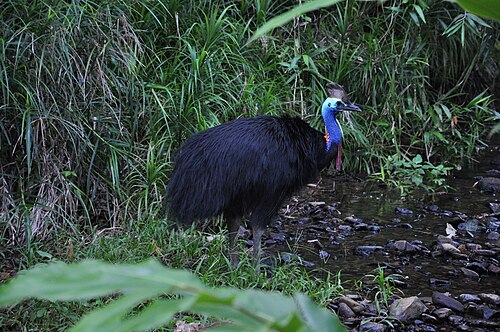
The cassowary carries a helmet of horn over spongy bone on its head, whose function is still unsettled: a role in pushing branches aside has been suggested, a role in shedding heat, and a role in carrying the very low boom with which the birds find each other in dense forest. The inner toe bears a straight ten-centimetre claw with which a cornered bird kicks forward. Both species in this family are fruit-eaters that swallow large seeds whole and pass them undamaged kilometres away; for a range of rainforest trees that is the only way the seed travels. The Emu lives on seeds, shoots and insects and follows the rain through the interior, sometimes for hundreds of kilometres. In both species the female lays a clutch of large green eggs and then departs; the male incubates for eight weeks, barely rising in that time and eating and drinking almost nothing.
Native species 2 species
Species that occur here by nature: breeding birds, winter visitors and passage migrants. They are arranged by genus, in the sequence of the list.
Casuarius 1 species