All species › Cassowaries and emu › Emu and cassowaries › Southern Cassowary
Southern Cassowary | Casuarius casuarius
Helmkasuaris | Casuario austral
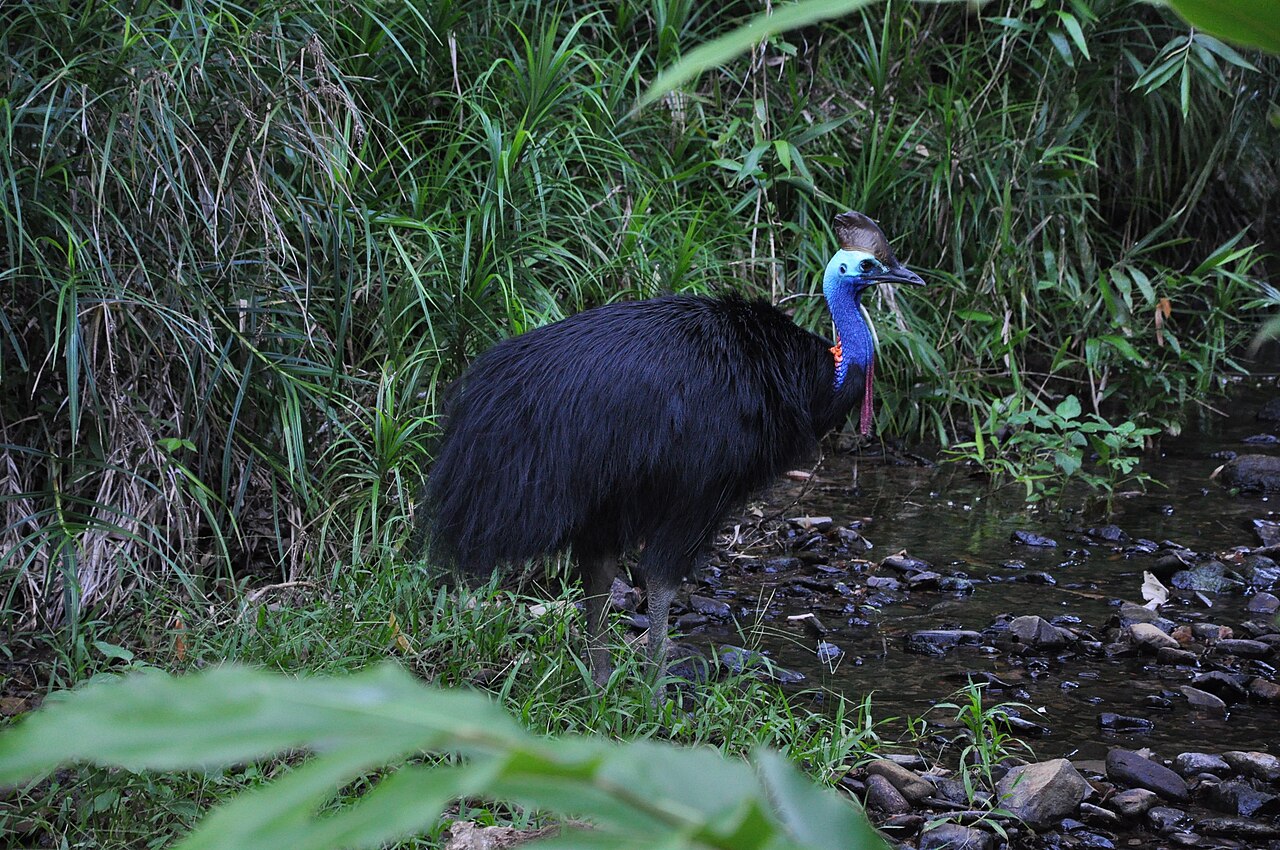
The Southern Cassowary is Australia's heaviest bird and the only one that lives inside the closed rainforest of the tropical north-east: a jet-black ratite of one and a half to two metres, with a horny helmet on the head, a blue neck carrying two red wattles, and a dagger-shaped claw on each inner toe. It disperses the seeds of hundreds of rainforest plants, and it is the only Australian bird with its own roadside warning signs.
Voice
The most distinctive sound is a deep rumble felt in the chest rather than heard: in this species it has been measured down to 32 hertz, just above the limit of human hearing, and it is exactly those low notes that carry through dense forest where higher ones fail. It comes as a series of slow, unplaceable boom ... boom pulses. Beyond that the bird grunts, growls and hisses; when threatened it gives a long drawn-out hiss with the feathers raised and the neck stretched. Chicks give a thin, persistent peeping behind their father.
Recording: Phil Gregory — CC BY-NC-SA 3.0 · Cassowary House, Kuranda, Queensland, Australia, Australia · xeno-canto
Identification
A ratite of 150 to 200 centimetres, clothed in glossy black, hair-like feathers that hang loose and separate over the body. The head and fore-neck are bare and bright blue, the hind-neck red, and two red wattles hang from the throat. On the head stands a tall grey-brown horny helmet, the casque; it is taller in the female, and the female is also larger and more brightly coloured. The legs are heavy and three-toed, each inner toe carrying a straight claw up to twelve centimetres long. Chicks are cream with black lengthwise stripes; immatures are plain brown with a low casque and a dull neck.
Confusion species
Emu (Dromaius novaehollandiae) is the only bird of comparable size, but it is grey-brown rather than black, lacks casque and wattles, and lives in savanna, mulga (acacia scrub of the dry interior, dominated by Acacia aneura) and dry woodland — not in closed rainforest. An immature cassowary is brown and can briefly suggest an Emu; then use the forest type, the heavier build and the beginnings of the casque. Australian Brushturkey (Alectura lathami) forages in the same forest and also has red and yellow neck skin, but it is barely a quarter the size and holds its tail upright and flattened sideways.
Habitat
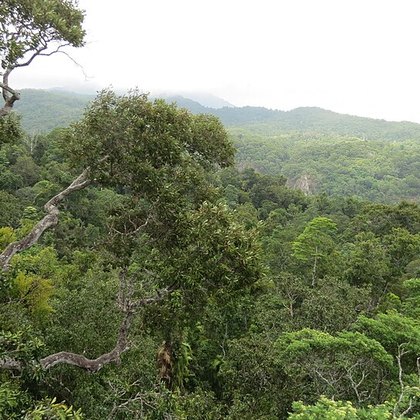
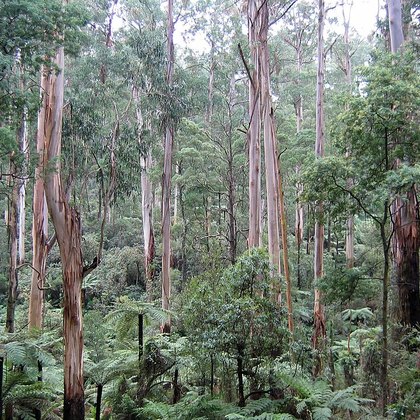
Tropical rainforest from lowland to montane forest is the core, from flat rainforest just behind the beach to over a thousand metres. It also uses adjoining wet eucalypt forest, monsoon forest and vine thicket, melaleuca swamp forest and the fruiting margins of gardens and plantations. It needs bearing trees all year round, and a territory must be able to supply that succession; where the forest has been cut into pieces it walks across roads and yards from one patch to the next.
Where the bird is most often found, arranged by main group and formation.


Range and movements
Within the guide area only north-eastern Queensland, in two separate areas: the Wet Tropics between roughly Cooktown and Paluma, with Mission Beach, Etty Bay, the Daintree and Cape Tribulation the best-known places, and the rainforest of Cape York around Iron Range and the McIlwraith Range. A gap lies between them. Outside Australia it occurs in New Guinea and the Moluccas. Australian estimates range from roughly fifteen hundred to well over four thousand birds.
- Resident
- dark = core range, pale = thinly spread
Where and when to look
Etty Bay near Innisfail and the roads around Mission Beach give the best chance: drive slowly — the yellow cassowary signs are there for a reason — and work the forest edge and the beach accesses early in the morning or late in the afternoon. Watch the ground for fresh droppings, a fist-sized pile full of whole seeds, which shows a bird passed recently. Never approach a bird with chicks, do not feed it, and if threatened put a tree trunk between yourself and the bird rather than running.
Conservation
Least Concern (LC) globally, because the bulk of the range lies in New Guinea. For Australia the judgement is bleaker: the Wet Tropics population is listed federally as Endangered, the Cape York one as Vulnerable. Vehicle strikes are the leading cause of death, followed by roaming dogs; roads and housing also fragment the rainforest, and a severe cyclone can strip the fruit supply for a season, as after Larry in 2006 and Yasi in 2011. Feeding is actively discouraged, because it brings the birds onto the road.
Scientific name
Casuarius casuarius | (Linnaeus, 1758)
Linnaeus described the species in 1758 as Struthio casuarius, among the ostriches; because it later moved to another genus, author and year take parentheses. The genus Casuarius is credited to Brisson, 1760: Linnaeus had used the name in 1748 but dropped it in 1758, and 1758 is the starting point of zoological nomenclature. The name itself comes from Malay kasuari. The type locality is Seram in the Moluccas; Australian birds are sometimes separated as the subspecies johnsonii.