All species › Cassowaries and emu › Emu and cassowaries › Emu
Emu | Dromaius novaehollandiae
Emoe | Emú
The Emu is the second largest bird in the world and the only one that occupies the Australian interior from coast to coast: a runner of nearly two metres, its double-shafted feathers hanging over the body like a coarse pelt. It wanders hundreds of kilometres after rain, and it is the male that incubates and raises the chicks.

Voice
The female produces a deep, resonant booming from an inflatable neck sac that carries two kilometres in still air: oomp ... oomp, with long gaps between notes. The male grunts and snorts instead, a soft pig-like grr-grr audible only at close range. Chicks give a sharp, persistent whistle that often betrays a family walking through tall grass.
Recording: Marc Anderson — CC BY-NC-SA 3.0 · Helensburgh, NSW, Australia · xeno-canto
Identification
A grey-brown, shaggy runner of 1.6 to 1.9 metres, with a long neck, three toes and no visible wing. Head and neck are largely bare and blue-black, most strongly so in birds in good condition; females average larger and show a darker face when breeding. The plumage hangs loose and separated, so the animal reads more as a walking bale of hay than as a bird. Chicks are cream with dark brown lengthwise stripes, a pattern they lose at about three months.
Confusion species
In the rainforest of northeastern Queensland the Southern Cassowary (Casuarius casuarius) is the only real confusion: black, with a tall horny casque and a red and blue neck, and always in closed forest. Feral Ostriches (Struthio camelus) hold on around Port Augusta in South Australia; they stand taller, have two toes and a bare pink neck. At distance in heat haze an Emu can pass for a kangaroo or a grazing beast, but the even, high-stepping gait with the head pumping gives it away.
Habitat
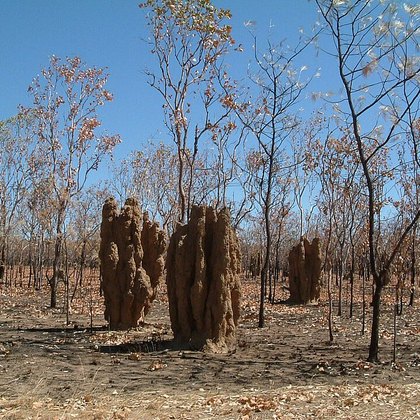
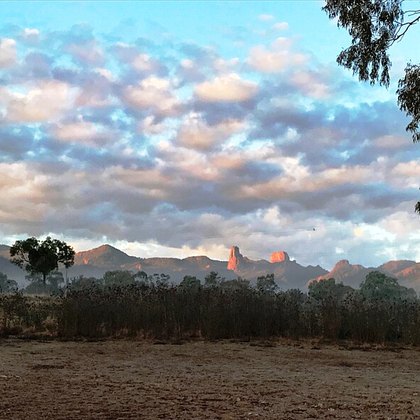
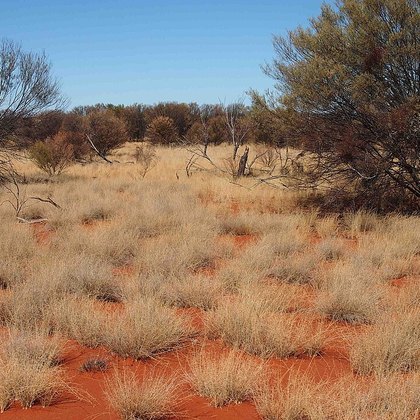
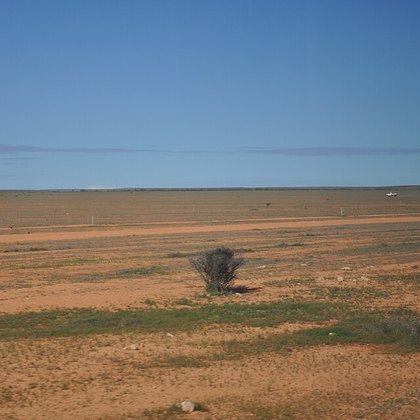
Savanna woodland, dry eucalypt forest, mulga (acacia scrub of the dry interior, dominated by Acacia aneura) and spinifex (spiny, hummock-forming desert grass of the interior) country: anywhere grass, seed, fruit and insects are to be had and water is not too far off. It avoids closed rainforest and the driest sand deserts, but walks freely across grain paddocks and grazed rangeland. In the southwest it follows the summer flowering and seeding of the wheatbelt.
Where the bird is most often found, arranged by main group and formation.

Range and movements
Across virtually all of mainland Australia, from the coast to above the treeline in the Australian Alps, densest in the semi-arid interior. It was exterminated on Tasmania soon after European settlement, and the small forms of King Island and Kangaroo Island are gone as well. It does not migrate but it does wander: tracked Emus cover hundreds of kilometres, up to twenty-five a day, moving towards country where rain has fallen.
- Resident
- dark = core range, pale = thinly spread
Where and when to look
Look for it early in the morning along a gravel road through mulga or savanna, where it stands against the light as a dark hump above the grass. From December to February groups walk in to water; sit at a stock dam and wait, because Emus arrive at set times and from the same direction.
Conservation
Least Concern (LC). On the mainland it is numerous — estimates run to six or seven hundred thousand adult birds — and it profits from stock dams and from the thinning of dense cover. Locally, fencing, road deaths and the conversion of rangeland to cropping press the numbers down; the coastal population of New South Wales has shrunk sharply as a result.
Scientific name
Dromaius novaehollandiae | (Latham, 1790)
Latham described the bird in 1790 as Casuarius novaehollandiae, among the cassowaries; because it was later moved to another genus, author and year stand in parentheses. The genus Dromaius was introduced by Vieillot in 1816, after Greek dromaios, 'running'. novaehollandiae means 'of New Holland', the old name for Australia. The type came from New Holland; Mathews restricted the type locality to Sydney, New South Wales, in 1910.