All species › Pigeons and doves › Doves and pigeons › African Collared Dove
African Collared Dove | Streptopelia roseogrisea
Barbarijse tortel | Paloma de collar africana
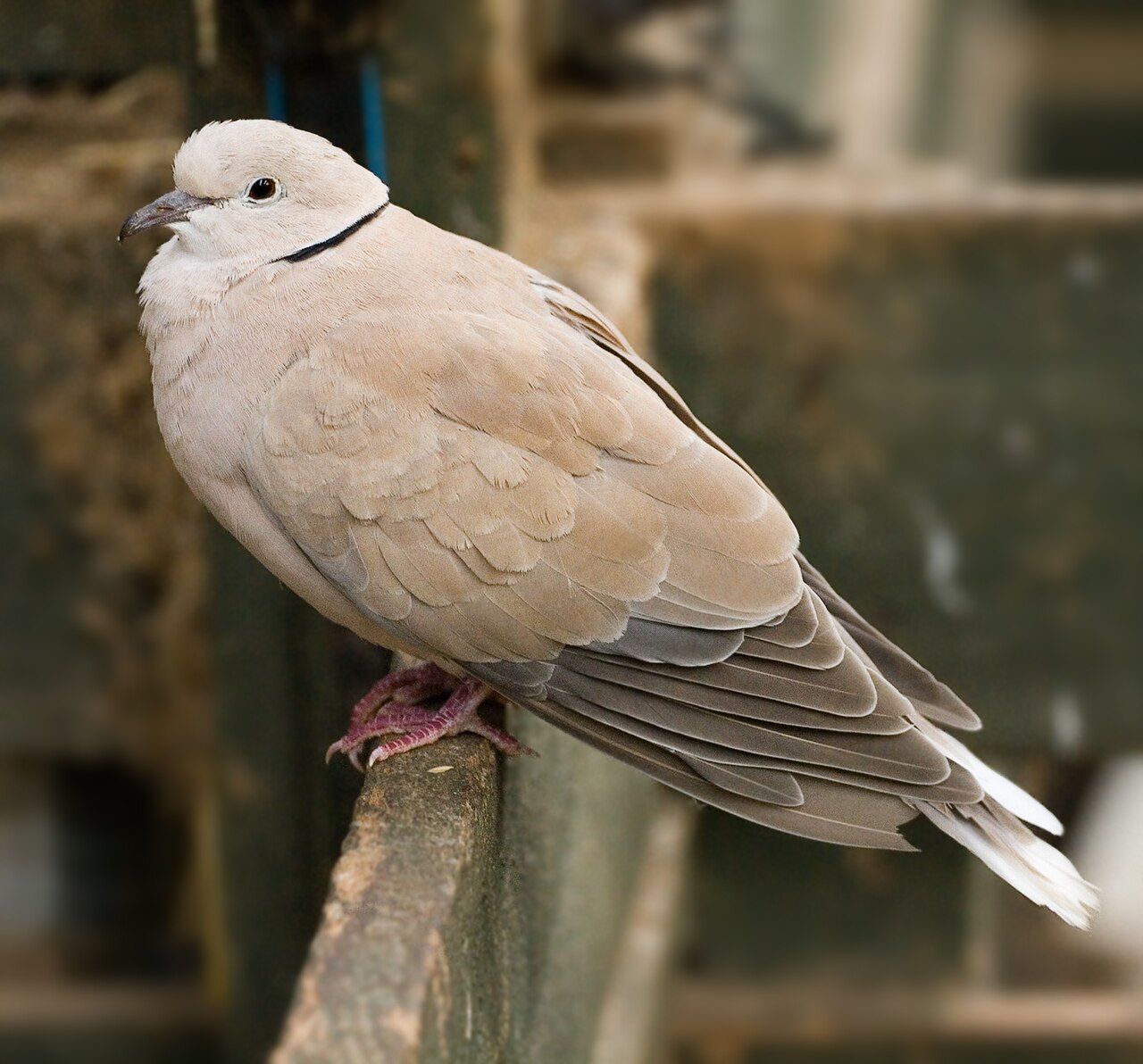
The African Collared Dove is not a bird of the bush but of the back garden: the feral form of the tame ring dove, sandy to creamy white, with a narrow black half-collar and a dark red eye. Wherever people kept or keep cage birds, small colonies of escapees hang on — in New Zealand around Northland, Auckland, the Waikato and Hastings, in Australia around Alice Springs, Darwin and Adelaide. Its soft cooing sounds exactly like an aviary heard out of doors.
Voice
A soft, melodious two-note coo, repeated over and over: coo crrooo, the second note drawn out and rolling. There is also a rapid, excited heh-heh-heh that sounds like a jeering little laugh, usually when a pair greets or a bird lands. Both sounds are familiar to many people from the aviary, and they give the species away in a suburb at once.
No freely licensed recording has been found for this species yet; what to listen for is described below.
Identification
A dove of 28 to 30 centimetres and about 140 grams. The plumage is pale sandy to creamy buff, palest on head and neck, with a narrow black half-collar on the hindneck edged white above. The undertail is white-tipped, the iris dark red and the legs deep pink; immatures are duller, with a yellow-brown eye and grey-brown legs. Because the stock is a domesticated cage bird, pure white, pink-tinged and mottled brown individuals also occur, and some lack the collar altogether — a suburban dove that 'isn't in any book' is usually this one.
Confusion species
Spotted Dove (Spilopelia chinensis) is bigger and darker and has a black nape patch spotted white rather than a plain half-bar. Laughing Dove (Spilopelia senegalensis) is smaller and pinker and carries its chequered rufous patch on the side of the neck. Rock Dove (Columba livia) is heavier built and shorter tailed and varies just as much in colour, but never shows a half-collar. The species that causes most confusion worldwide, Eurasian Collared Dove (Streptopelia decaocto), does not occur in Australia or New Zealand — which saves a great deal of trouble here.
Habitat
Gardens, parks, street trees, hedges, farmyards and the edges of towns and cities: always within reach of people. It feeds on the ground on spilled grain, seed and food put out for birds. It does not enter native forest or intact scrub; anyone seeing it far from buildings should first think of an escaped bird.
Where the bird is most often found, arranged by main group and formation.


Range and movements
In New Zealand established in Northland (Kerikeri, Whangārei), Auckland, the central Waikato and around Hastings in Hawke's Bay, with strays elsewhere including Wellington and Christchurch; in the 1999–2004 bird atlas it was found in only 2.3 per cent of squares. In Australia established at Alice Springs and Darwin, with a small but self-sustaining group in the suburbs of Adelaide — 110 birds across twelve suburbs were counted in 2009, with breeding confirmed — plus scattered breeding attempts in Melbourne and Perth that have each been trapped out, occasional records in New South Wales since 1946 and reports from Karratha. Every population traces back to escaped or released aviary birds. The original wild range lies in the Sahel, the northern Horn of Africa and south-western Arabia.
- Resident
- dark = core range, pale = thinly spread
Where and when to look
Listening works better than searching: the soft two-note coo from a street tree in a New Zealand suburb, or from a caravan park in Alice Springs, is nearly always this dove. Then check the hindneck for the narrow black bar and the eye for dark red. A dove that is white or piebald and hardly bothers to fly off fits as well.
Conservation
Least Concern (LC) worldwide, both for the wild African stock and — as a domestic animal — for the feral birds; the question here is therefore not protection but control. South Australia forbids release under the Landscape South Australia Act 2019, and Western Australia rates the species a 'serious threat', the second-highest risk class: the climate suits it, it could compete with native doves, take cereal crops and become a nuisance in town through noise and fouling. Australian states clear new colonies as soon as they find them; in New Zealand it counts simply as an introduced and naturalised bird, with no control effort.
Scientific name
Streptopelia roseogrisea | (Sundevall, 1857)
Sundevall described the wild African bird in 1857, in another genus, so author and year stand in parentheses; the type came from north-eastern Africa. roseogrisea is Latin, from roseus, 'rose-coloured', and griseus, 'grey', for the pinkish-grey plumage. The genus Streptopelia was introduced by Bonaparte in 1855, from Greek streptos, 'collar, twisted chain', and peleia, 'dove'. The tame ring dove, long known as Streptopelia risoria (Linnaeus, 1758) — risorius, 'laughing' — is a domesticated form of this species; the International Commission on Zoological Nomenclature settled the matter in 2008 (Opinion 2215) in favour of roseogrisea for the wild bird. The Dutch name recalls Barbary, the old name for the North African coast.