All species › Cranes, rails and allies › Cranes › Sarus Crane
Sarus Crane | Antigone antigone
Saruskraanvogel | Grulla sarus
The Sarus Crane is the tallest flying bird in the world and, in this region, the second crane alongside the Brolga: pale grey, with a bare bright red head and upper neck whose red runs well down the neck, and pink to coral-red legs. In Australia it occurs only in the far north of Queensland — a small, isolated tip of a range that otherwise lies in Asia.

Voice
The call is a loud, high-pitched trumpeting that carries far, a tone higher than the Brolga's; the windpipe is elongated and coiled in the sternum, which explains the volume. Pairs call in unison duet with the bill raised, the female giving two notes to every note of the male. On take-off comes a short, hard bark, and young birds beg with a high peeping.
No freely licensed recording has been found for this species yet; what to listen for is described below.
Identification
A crane about a metre and a half long, standing well over a metre and a half, with a wingspan of two to two and a half metres. The plumage is pale ash-grey with black primaries. The crown is bare and grey, but head, throat and upper neck are bare and bright red, and that red continues well down the neck — the mark everything turns on. The bill is long, straight and grey-green, the legs pink to coral-red. Young birds have a fully feathered brown-grey head with no red. Australian birds (subspecies gillae) are smaller and lighter than the Asian ones.
Confusion species
Brolga (Antigone rubicunda) is the only real confusion and stands on exactly the same stubble fields in north Queensland. On it the red stops at the back of the head, a black-bristled dewlap hangs beneath the chin, and the legs are grey-black; it also calls a tone lower. The Sarus Crane has no dewlap, red far down the neck, and pink legs. Note that the two interbreed. These hybrids, called 'sarolga' in Queensland, make up just over two per cent of birds if you go by sight, but genetic work on shed feathers shows it happens ten times as often — so a bird with intermediate features cannot be named with certainty. At a distance herons pull the neck in; cranes hold it straight.
Habitat
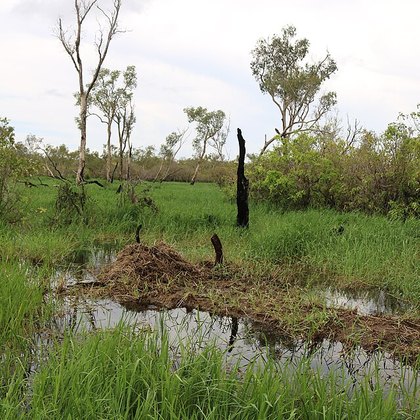
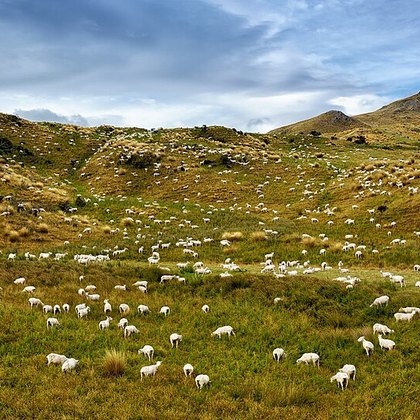
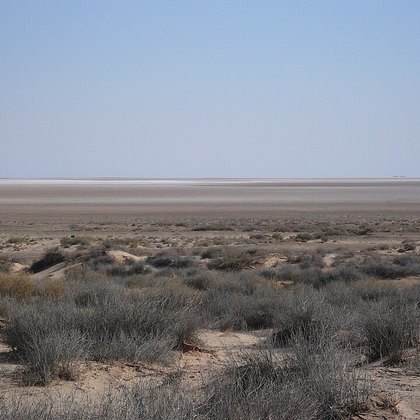
Shallow freshwater swamps and floodplains of the Gulf country for breeding, with the nest in or beside shallow water. In the dry season the flocks stand on harvested fields — maize, peanuts and grain — on pasture and on Mitchell grassland, and roost standing in shallow water out on an open plain. Deep water, closed forest and steep ground it avoids.
Where the bird is most often found, arranged by main group and formation.


Range and movements
Within this guide's map, only the far north of Queensland. The breeding grounds lie on the Gulf Plains around the Mitchell, Gilbert and Flinders rivers; in the dry season the birds gather five hundred kilometres away on the Atherton Tableland. Beyond that there are scattered birds on Cape York and very few in the Northern Territory. This is a small, isolated part of a range that otherwise lies in India, Nepal and South-East Asia; genetic work indicates the Australian birds have been separated from those for tens of thousands of years. The species was only formally recorded for Australia in 1966, though Aboriginal languages knew it long before.
- Resident
- dark = core range, pale = thinly spread
Where and when to look
From July to October go at sunrise to a swamp or stubble field on the Atherton Tableland — Bromfield Swamp, Hasties Swamp and the fields around Atherton and Mareeba — and wait for the flocks to come off the roost. Then work through the heads with a scope: red carrying past the nape and down the neck, plus pink legs, picks out the Sarus among the Brolgas, and against the light the legs alone will often do it.
Conservation
Vulnerable (VU). The world population is put at thirteen to a little over twenty thousand birds, of which five to ten thousand are in Australia; the dry-season flocks on the Atherton Tableland together hold between eight hundred and some three thousand birds, with no detected trend. Draining and conversion of wetland, altered water management and collision with powerlines and fences weigh heaviest — at over two metres of wingspan a wire in the dark is lethal. Add feral pigs trampling nests, and over the longer term the question of what hybridisation with the Brolga does to both species.
Scientific name
Antigone antigone | (Linnaeus, 1758)
Linnaeus described the species in 1758 as Ardea antigone, among the herons, with India as the type locality; it now sits in Antigone, so author and year stay in parentheses. The genus Antigone was introduced by Reichenbach in 1853. The species name goes back to Greek story: Linnaeus chose Antigone, the daughter of the Trojan king Laomedon, who was turned into a bird, and ran that tale together with the one about Gerana, queen of the pygmies, who became a crane for the same reason. The Australian subspecies gillae was named only in 1988, by Schodde.