All species › Owls › Owls › Australian Boobook
Australian Boobook | Ninox boobook
Australische boeboekuil | Nínox papú
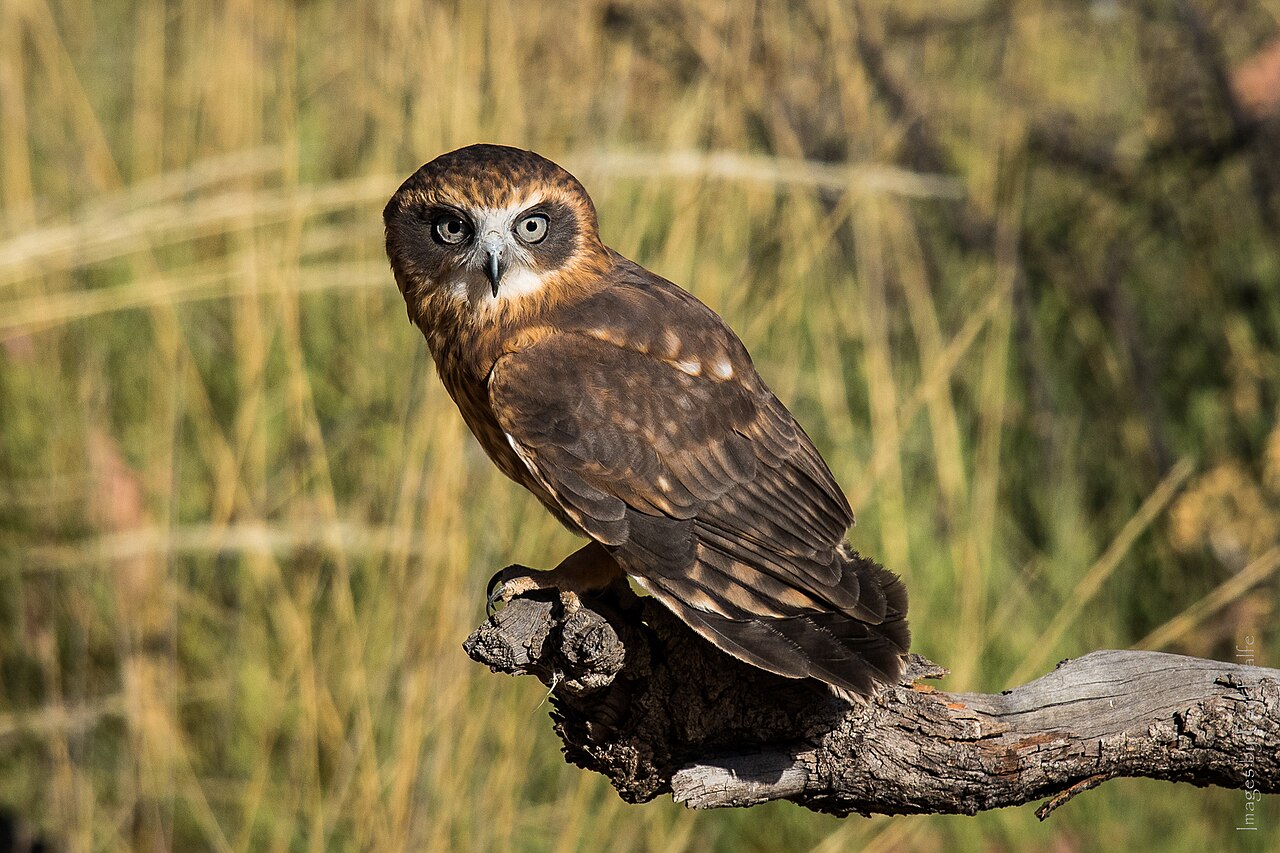
The Australian Boobook is the smallest and by far the commonest owl in Australia, and the bird behind the sound that fills the continent at night: a clear two-note boo-book. It is barely bigger than a Wood Pigeon, dark brown with pale spotting, and sits as readily in a suburban garden as in mulga or mallee.
Voice
The feature that fixes it everywhere is the call: a clear, two-part boo-book with the second syllable lower than the first, repeated in series and audible up to about a kilometre away. The male calls far more often than the female; a pair answers in duet, the female's higher voice cutting across the male's. There is also a cat-like rising kreeow, a soft rattling murmur at the nest, and a hoarse hiss from begging young.
No freely licensed recording has been found for this species yet; what to listen for is described below.
Identification
A small, compact owl of around thirty centimetres, without ear tufts and without a true facial disc — the head is round and the brown face runs into the neck with no sharp border. The upperparts are dark chocolate brown with white spots on shoulder and wing, the underparts rufous brown, heavily streaked and spotted with white. The large eyes are greenish yellow and sit in a darker mask that works like a pair of spectacles. The tail is long and barred; the flight is fast and direct with short glides, more like a sparrowhawk than a barn owl. Weight runs from about 145 to 360 grams. Desert birds (ocellata) are pale and sandy, Cape York rainforest birds (lurida) small and dark rufous.
Confusion species
Barking Owl (Ninox connivens) is clearly larger (35–45 against 25–33 cm), greyer, with a plain grey-brown head and no mask, streaked rather than spotted below, and a barking rather than a booking call. Powerful Owl (Ninox strenua) at half a metre is another class altogether and carries coarse V-shaped chevrons below. Rufous Owl (Ninox rufa) is large, reddish brown and finely barred, and stays in the tropical north. The Morepork of New Zealand (Ninox novaeseelandiae) was lumped with this species until 1999; it is darker and less rufous and does not reach mainland Australia, so geography settles it — only Norfolk Island holds a mixed population. Barn owls (Tyto) differ at a glance: pale heart-shaped facial disc, dark eyes, long legs.
Habitat
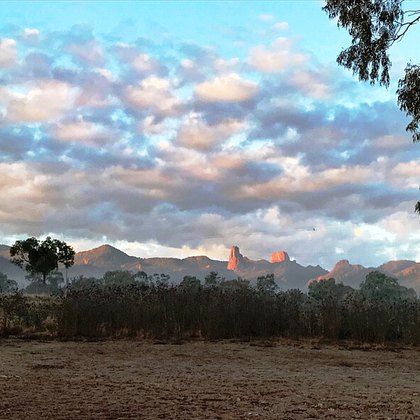
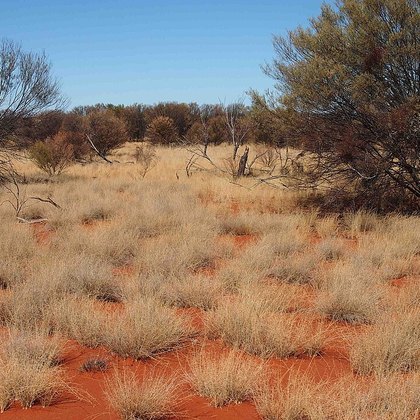
Almost any country with trees: dry eucalypt forest and woodland, riverine forest along creeks, mallee, mulga and acacia scrub, and beyond that gardens, parks and street trees into the centre of the big cities. What it needs is a tree hollow to breed in and an opening or a light to hunt over; the rest is detail. It is absent from the heart of the sand deserts, but present again along every wooded creek inside them.
Where the bird is most often found, arranged by main group and formation.




Range and movements
Across the whole Australian mainland, from the Kimberley and Cape York to the southwest corner, including Tasmania and many coastal islands; only in the cores of the sand deserts is it scarce. Beyond the map window the species continues into southern New Guinea, Timor and the Lesser Sundas. On Norfolk Island two Australian males were released in 1987 so that the last female of the island form could still breed; the owls flying there now are hybrids. It is sedentary and holds the same territory year after year.
- Resident
- dark = core range, pale = thinly spread
Where and when to look
Stand still on a track or a driveway after sunset and wait; the boo-book comes from almost anywhere and travels well, and a weak torch catches the orange-red eyeshine. By day a knot of furiously scolding honeyeaters or Grey Butcherbirds often gives away a roosting boobook deep in a dense crown. Insects around street lighting draw it in: check the arm of a lamp at the edge of a town for a small, squat silhouette, or the wire beside it.
Conservation
Not threatened (LC): the range is enormous, numbers are stable, and as one of the few Australian owls it has actually gained from people, since gardens, orchards and street lighting produce food. The weak point is the one all hollow-nesters share — big old trees with a usable hollow are lost faster than new ones are made. Locally poisoning matters: a decline around Perth has been linked to second-generation rodenticides reaching the owl through poisoned mice.
Scientific name
Ninox boobook | (Latham, 1801)
Latham described the species in 1801 as Strix Boobook, from a painting by Thomas Watling made at Sydney; because it was later moved to Ninox, author and year stand in parentheses. The genus Ninox was introduced by Hodgson in 1837 and combines Nisus, the sparrowhawk, with noctua, the night owl. The epithet boobook is not Latin but a loanword: around 1790 William Dawes recorded bōkbōk for 'owl' in the Dharug of the Sydney district, a name formed from the call. The type locality is New Holland, that is New South Wales. Until volume five of the Handbook of the Birds of the World in 1999 the bird ranked as a subspecies of the New Zealand Morepork.