All species › Owls › Owls › Barking Owl
Barking Owl | Ninox connivens
Blafuil | Ninox ladrador
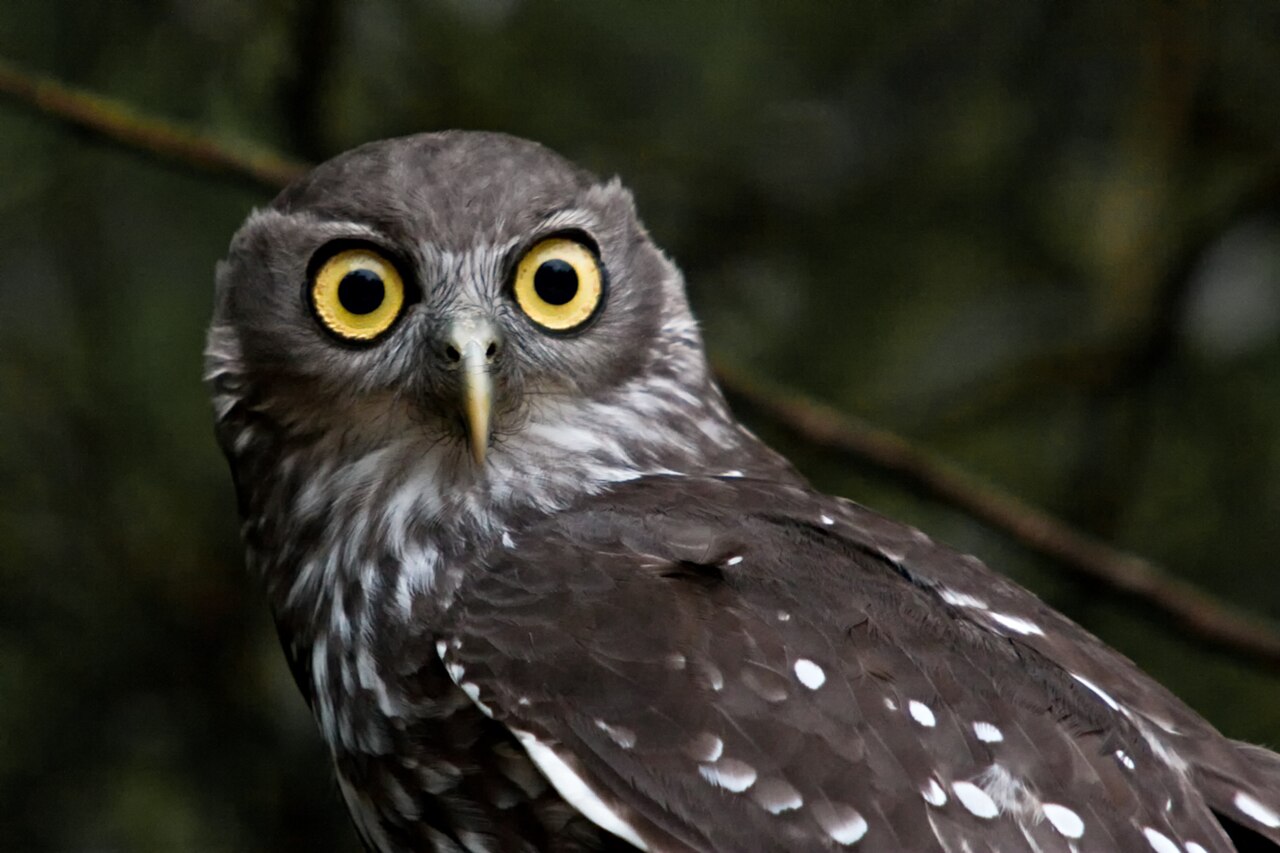
The Barking Owl is the mid-sized Ninox of open eucalypt woodland, and the only owl in the world that sounds like a dog. Its double wook-wook carries across whole paddocks, but it keeps a second repertoire that earned it the inland name 'screaming-woman bird': a shrill, wavering scream that seems to come from a person.
Voice
The usual call is a clear two-note bark, wook-wook, with a short gap between the notes and repeated in series; the pair often calls together, the female the higher of the two. The sound is loud and clipped and has nothing of the drawn-out hoot of other owls. Much more rarely comes a rising, quavering scream that slides up and down in pitch and sounds so human that in the nineteenth century it was repeatedly taken for murder — hence 'screaming-woman bird'. At the nest there is a soft, throaty growl.
No freely licensed recording has been found for this species yet; what to listen for is described below.
Identification
A slim, long-bodied owl of about forty centimetres with no facial disc, a strikingly large round head and big, piercing yellow eyes. The upperparts are plain grey-brown with rows of white spots on the scapulars and wing coverts; the underparts are off-white with broad grey-brown streaks — streaked, that is, not spotted or barred. The head is almost entirely grey-brown, without the dark mask of the boobooks, which gives it an open, startled expression. The flight is easy and hawk-like with long glides. Young birds are more faintly streaked and show mottled white and grey-brown on the hindneck.
Confusion species
Australian Boobook (Ninox boobook) is markedly smaller (25–33 cm), warmer brown, with a dark mask around the eyes and spotted rather than streaked underparts, and calls boo-book. Powerful Owl (Ninox strenua) is far heavier, darker grey-brown, and carries coarse V-shaped chevrons below instead of straight streaks. Rufous Owl (Ninox rufa) overlaps in the north but is reddish brown and finely barred right across the underparts. The barn owls (Tyto) have dark eyes and a heart-shaped disc. Anyone going by voice will rarely go wrong: the short doglike bark is unique.
Habitat
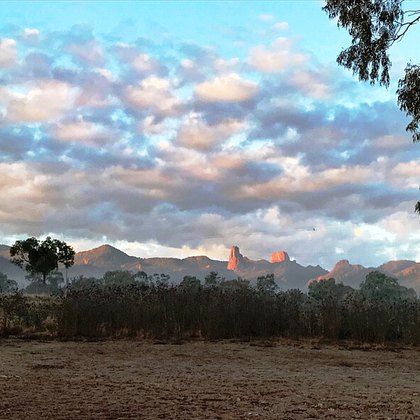
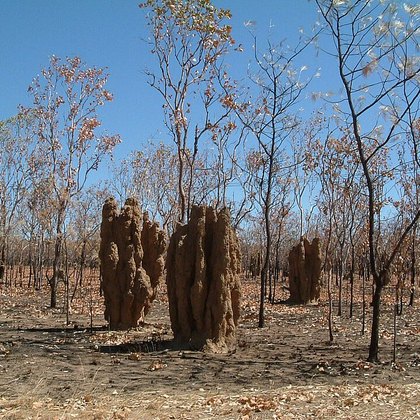
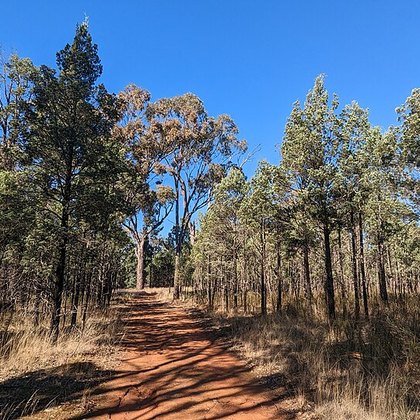
Open eucalypt forest and woodland, forest edges and lines of trees along cropland and pasture, almost always where plenty of big hollow-bearing trees stand. Roosts lie strikingly often close to water: a creek, a dam or a swampy corner, in the dense crown of a river oak or paperbark. It avoids closed rainforest and equally the bare inland plains; this is the bird of the half-open, mixed country.
Where the bird is most often found, arranged by main group and formation.

Range and movements
Widely spread over Australia but absent from the central deserts, with an eastern and southwestern population (connivens) and a northern one (peninsularis) in the Kimberley, the Northern Territory and far north Queensland. It does not occur in New Zealand. In the southeast it has declined sharply in places, and in southwestern Western Australia only a handful of pairs remain. It is sedentary; a pair holds a large territory, often more than a thousand hectares.
- Resident
- dark = core range, pale = thinly spread
Where and when to look
Drive a woodland edge beside pasture in the early evening, or in the last hour before sunrise, and stop at every dead tree: the Barking Owl hunts from an exposed high branch and shows well there against the sky. Listen in August and September, when the pair is marking its territory and the barking is at its most frequent. By day search a dense crown close to water; a pair often keeps the same roost branch for years, with a heap of whitewash beneath it.
Conservation
Not threatened globally (LC), but that hides a sharp split within Australia: the species is listed as vulnerable in New South Wales and threatened in Victoria, and in southwestern Western Australia only a small remnant is left. Two causes work together. Clearing and thinning of old eucalypt woodland removes the large hollows it breeds in, and the loss of medium-sized ground mammals — bandicoots, bettongs, rabbits after control — cuts into the prey base precisely in the south, where the owl depends on them more than it does in the north.
Scientific name
Ninox connivens | (Latham, 1801)
Latham described the species in 1801 as Falco connivens — he took the figure for a falcon — and because it later moved to Ninox, author and year stand in parentheses. The epithet connivens is the Latin participle of conniveo, 'to close the eyes, to blink', after the half-shut eyes in the drawing Latham worked from. The genus Ninox was introduced by Hodgson in 1837, from Nisus (sparrowhawk) and noctua (night owl). The type locality is New Holland, in practice New South Wales. Genetic work points to the Australian Boobook as the closest relative.