All species › Owls › Owls › Tasmanian Boobook
Tasmanian Boobook | Ninox leucopsis
Tasmaanse boeboekuil | Nínox tasmano
The Tasmanian boobook is the third piece of a knot that occupied taxonomy for more than a century. Mainland Australia, New Zealand and Tasmania long shared a single boobook; in 1999 the Australian bird was split off, and in 2022 the Tasmanian one followed. What is left is a dark, rufous, densely spotted little owl with golden-yellow eyes, calling two syllables down out of the wet eucalypt forest at night — faster and higher than its mainland neighbour, and with a coarse, almost frog-like edge.

Voice
The call is the classic two-note boo-book, the second note lower than the first, repeated at intervals of a few seconds and sometimes kept up for half the night. Against the mainland Australian boobook the Tasmanian version sounds distinctly higher in pitch, faster in tempo and coarser in timbre — recordings are often described as frog-like, as if the note cracks slightly. That difference is more usable in the field than any plumage mark. Lower growling and chattering notes are given at the nest and when disturbed.
No freely licensed recording has been found for this species yet; what to listen for is described below.
Identification
A compact, round-headed owl without ear tufts, about the size of the New Zealand morepork but proportionally short-tailed and heavy-bodied. The upperparts are dark rufous brown, darker and warmer than in the mainland Australian bird, and strewn with bright, crisply defined white spots that stand out most on the wing coverts. The underparts are streaked and blotched brown over a ground colour with a yellow-brown wash. The facial discs are dark and merge into the head without a sharp rim; between them sits a short, strongly hooked bill. The eyes are golden yellow, warmer and yellower than the grey-green to yellow-green of the mainland bird. The legs are feathered down to pinkish grey toes.
Confusion species
Within Tasmania there is really only one competitor: the much larger, long-tailed, finely barred masked owl (Tyto novaehollandiae), which has a sharply outlined heart-shaped facial veil and dark eyes where this species shows round, yellow-eyed dark discs without a rim. The mainland Australian boobook (Ninox boobook) is the closest relative with a real risk of confusion: it is paler and cooler brown, less densely and less brightly spotted, and has grey-green to yellow-green eyes, with a lower and slower call. The two do not normally overlap, since Bass Strait separates them, but there are scattered records of Tasmanian birds in southern Victoria, one in New South Wales and even a specimen from Lord Howe, so a winter boobook in southern Victoria is worth a note. The New Zealand morepork (Ninox novaeseelandiae), which has its own page in this guide, was counted as one species with this bird until 2022 and looks very like it, but occurs only in New Zealand and on Norfolk; those ranges nowhere meet, so here too the island decides.
Habitat
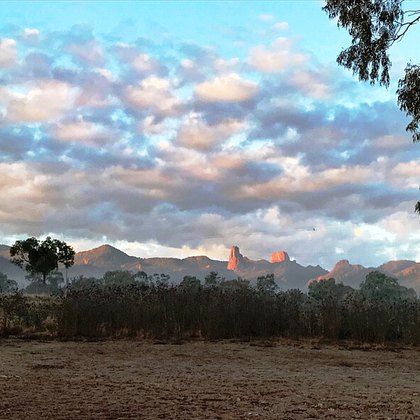
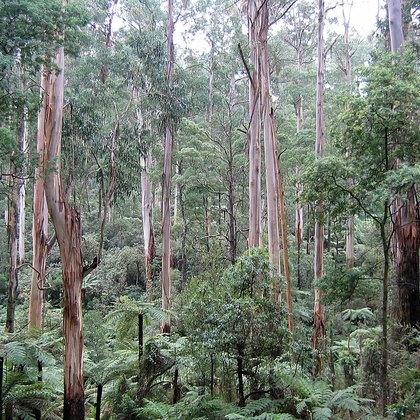
Forest, in almost any Tasmanian form. The centre of gravity is dry eucalypt forest and woodland, but the species is equally at home in wet eucalypt forest with dense understorey and in the moist Nothofagus forests of the west and north-west. It asks two things above all: old trees with hollows to roost and nest in, and open space or a forest edge to hunt over. The latter makes it a common bird at village edges and in wooded gardens and parks, where streetlights provide a reliable supply of moths and beetles.
Where the bird is most often found, arranged by main group and formation.


Range and movements
Resident in Tasmania and the Bass Strait islands, including King Island; measurements for this guide give ten qualifying years out of ten with 3,112 records and one measured resident unit, coinciding with Tasmania itself. It is spread across the whole island from sea level into the mountain forests, at varying density but nowhere genuinely scarce. Outside Tasmania it is a vagrant: a handful of reports from southern Victoria, one from New South Wales and one specimen from Lord Howe. Here too this is a recent split not yet carried through in GBIF's backbone taxonomy, so the figures had to be measured separately at subspecies level.
- Resident
- dark = core range, pale = thinly spread
Where and when to look
Find it with your ears, not your eyes, and do it in the first two hours after sunset along a forest edge or from a pull-off inside the forest. Listen not just for the two syllables but for the tempo: if the phrase runs briskly and high and the note sounds slightly rough, you have the right bird. A torch aimed at the direction of the call often picks up two orange eyeshine dots on a branch just below the canopy.
Conservation
The IUCN lists the species as Least Concern and there is no sign of a steep decline; it is spread across all of Tasmania and tolerates modified and used forest well. The vulnerability is in the detail: as a hollow nester it depends on old trees, and logging that removes large hollow eucalypts impoverishes an area even when the forest itself remains. Like all nocturnal rodent hunters it is also exposed to secondary poisoning by second-generation rodenticides around farms and settlements. As a recently split species whose entire range sits on one island, it deserves to be monitored in its own right rather than counted in with the mainland bird.
Scientific name
Ninox leucopsis | (Gould, 1838)
Leucopsis is Greek for 'white-faced', from leukos 'white' and opsis 'face, appearance' — a slightly unfortunate name, since the pale facial disc is less conspicuous in this dark form than in many relatives, and the name probably goes back to one individual skin. The Dutch name follows the guide and places the island before the group name, as with the New Zealand morepork. The word boobook itself is onomatopoeic and reaches English from an Aboriginal language of New South Wales; the Australian synonym mopoke is the very same call, heard differently.