All species › Owls › Owls › Morepork
Morepork | Ninox novaeseelandiae
Boeboekuil | Nínox maorí
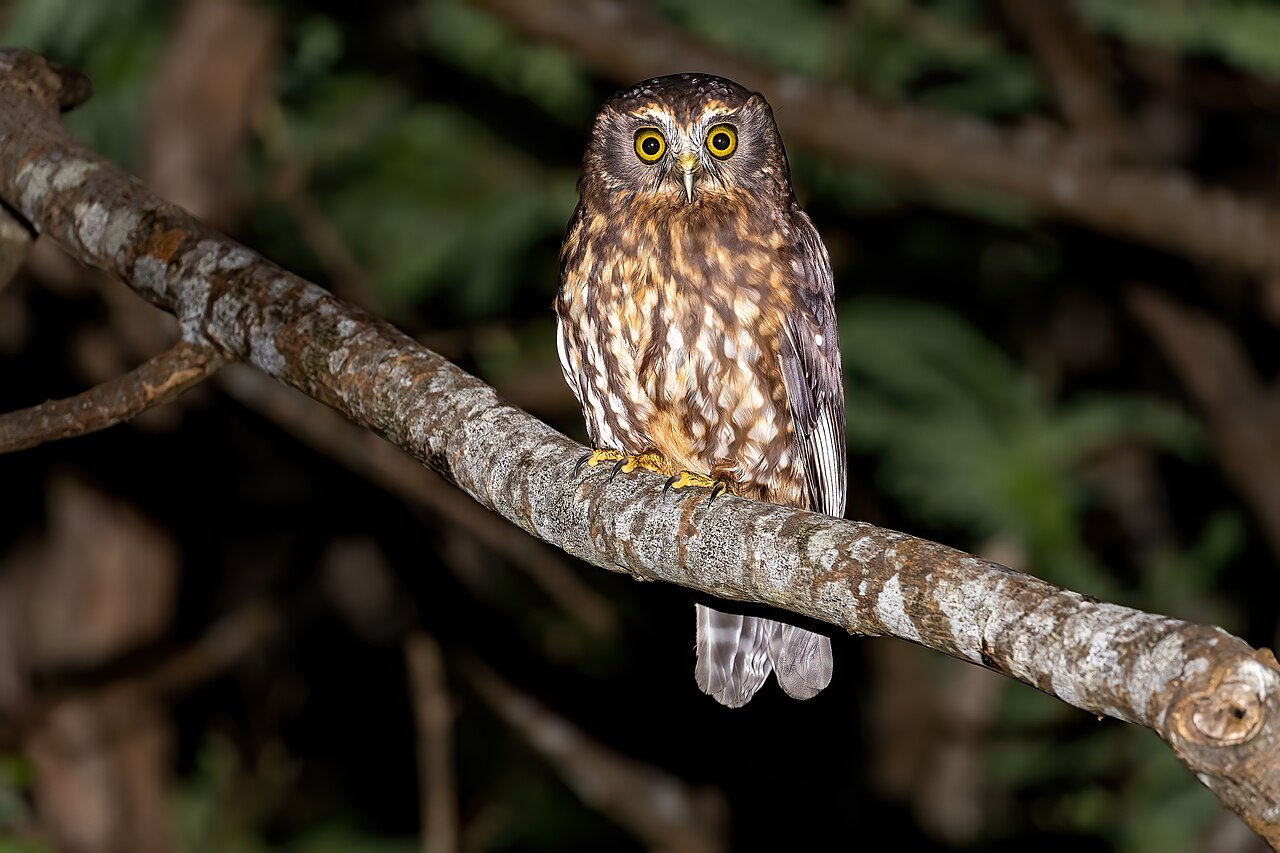
The Morepork, ruru in Maori, is the only owl New Zealand has left, and its two-note call is among the best known night sounds in the country. It is a small dark brown owl with bright yellow eyes, at home in untouched podocarp forest and in a Wellington city park alike. Since 1999 it has ranked as a species in its own right, separate from the Australian Boobook.
Voice
The call it is named for is a clear two-part more-pork or ru-ru, the second syllable lower, repeated in series from a set branch and mostly in the first hours after dark. The repertoire also holds a rattling quork-quork, a rising thin quee that is surprisingly often taken for a kiwi, and a yelping note much like a Little Owl's. At the nest there is a soft murmur, and begging young give a sustained hoarse squeak. Anyone who spends a night in New Zealand forest will almost certainly hear it.
No freely licensed recording has been found for this species yet; what to listen for is described below.
Identification
A compact owl of 29 centimetres and about 175 grams, with no ear tufts. The upperparts are dark brown with sparse off-white spots, the breast streaked dark brown over a cream and rufous ground. The facial disks are dark and fade away without a sharp rim; between them sits a short, strongly hooked bill. The eyes are yellow to yellowish green — the quickest separation from the barn owls, which have dark eyes. The legs are feathered to the yellow feet. Flight is silent, fast and agile, with short glides between close-set trunks.
Confusion species
Little Owl (Athene noctua), introduced and confined to the South Island, is the only real confusion within New Zealand: smaller and far paler grey-brown, with a flatter head, a shorter tail, white brow bands above the yellow eyes, and it sits in open farmland rather than forest. Australian Boobook (Ninox boobook) is the same size but more rufous and more lightly spotted; the two were counted as one species until 1999 and overlap only on Norfolk Island, where a mixed population flies. Eastern Barn Owl (Tyto javanica), established in Northland since 2008, is larger, golden brown and pure white below, with a heart-shaped facial disc and dark eyes.
Habitat
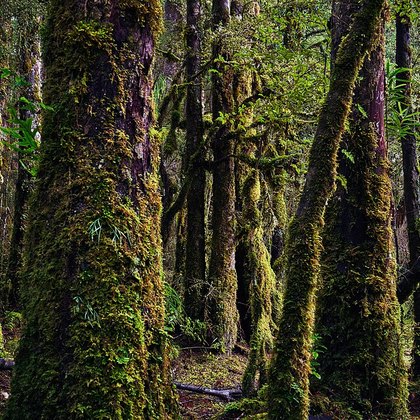
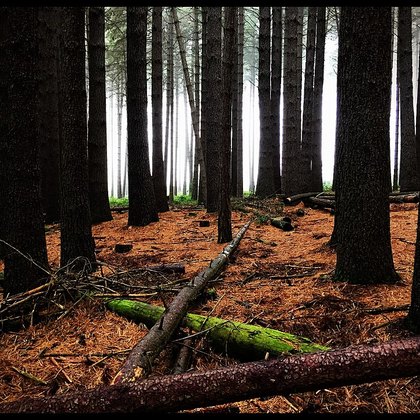
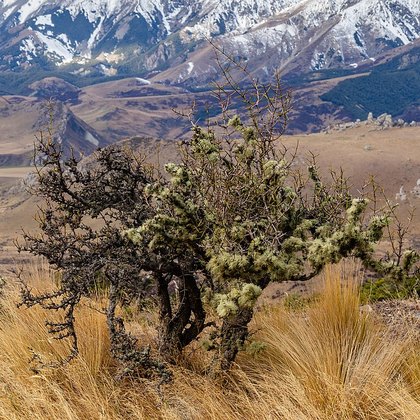
Native and planted forest alike: podocarp-broadleaf forest, southern beech and kauri forest, but equally pine plantations, manuka scrub, city parks, gardens and sparsely treed farmland. By day it roosts on a branch or in the crown of a tree fern under heavy leaf cover, sometimes in a tree hollow or a derelict shed. It breeds in a cavity, a crevice in a rock face or a nest of dense epiphytic growth; on predator-free islands it will even nest on the ground.
Where the bird is most often found, arranged by main group and formation.



Range and movements
Throughout New Zealand on both main islands, but clearly scarcer in the dry east of the South Island south of Christchurch, where forest is missing. Beyond that on almost every forested offshore island, from the Three Kings in the north to the muttonbird islands off Stewart Island. Norfolk Island holds the descendants of the island form undulata, whose last female was paired in 1987 with two imported Australian males; the Lord Howe form (albaria) is extinct. It does not occur on mainland Australia.
- Resident
- Breeding (summer)
- dark = core range, pale = thinly spread
Where and when to look
Stand at a forest edge half an hour after sunset and let the dark come down; the call usually starts within the first hour and comes year after year from the same corner of the territory. By day walk slowly under tree ferns and look for a dark upright lump against a trunk — a roosting ruru will sit tight if you do not stare straight at it. The shrill scolding of Tui or fantails in broad daylight often points the roost out for you.
Conservation
Not threatened (LC), and classed in New Zealand as Not Threatened: of the two native owls this is the one that made it, since the Laughing Owl (Ninox albifacies) died out around 1914. Introduced predators do press on it, though: cats, possums, rats and mustelids take eggs and young from the cavities, and on islands where it nests on the ground pigs and hedgehogs do the same. A second, subtler problem comes on top: in pest control operations using brodifacoum the owl can be poisoned secondarily through poisoned rats and mice.
Scientific name
Ninox novaeseelandiae | (Gmelin, 1788)
Gmelin described the species in 1788 as Strix novae Seelandiae, after Latham's account; because it later moved to Ninox, author and year stand in parentheses. The type locality is Queen Charlotte Sound on the South Island, where the bird was collected on Cook's voyages. The epithet simply means 'of New Zealand'. The genus Ninox was introduced by Hodgson in 1837, from Nisus (sparrowhawk) and noctua (night owl). Both the English name Morepork and the Maori name ruru are formed from the call. Until volume five of the Handbook of the Birds of the World in 1999 the Australian and New Zealand birds went under this single name; since then New Zealand keeps novaeseelandiae and the Australian bird is Ninox boobook.