All species › Owls › Owls › Rufous Owl
Rufous Owl | Ninox rufa
Rosse boeboekuil | Nínox rojizo
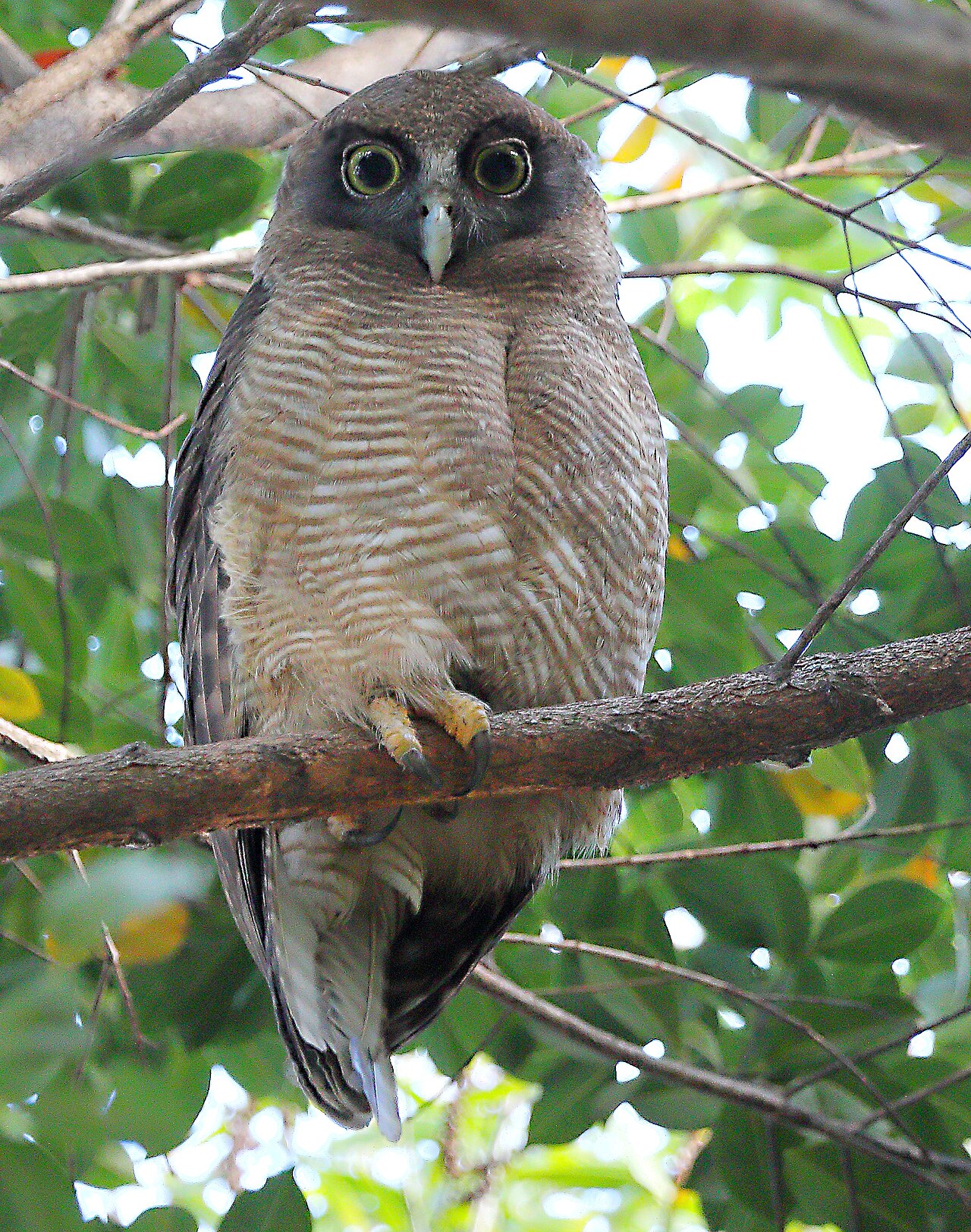
The Rufous Owl is the large owl of tropical Australia: dark reddish brown, finely barred, with a black mask around greenish yellow eyes. It hunts possums, flying-foxes and birds up to the size of a scrubfowl in rainforest and along wooded creeks. Unlike almost every other bird of prey, the male here is the bigger of the pair.
Voice
The call is a soft, low and very even double note, woo-hoo, with a short gap and sometimes repeated for minutes on end without changing pitch. Male and female call together and can then be told apart by pitch: the female's voice is the higher. At the nest there is a hoarse rasp, and begging young give a thin, sustained whistle. The sound carries less far than the size of the bird suggests and is easily lost in the noise of a creek.
No freely licensed recording has been found for this species yet; what to listen for is described below.
Identification
A heavy, long-bodied owl without a facial disc, with a small round head and a long tail. The upperparts are dark reddish brown with narrow light brown and off-white bars, the underparts off-white with close rufous-brown barring that runs down onto the belly. The mask is blackish brown and stands out sharply against the greenish yellow eyes; the legs are feathered to the toes. The male weighs about 1050 to 1300 grams and the female 700 to 1050, the reverse of nearly every other raptor. Young birds have an entirely downy white head, neck and underparts, which leaves the dark mask sitting on the face like a pair of spectacles.
Confusion species
Powerful Owl (Ninox strenua) is as large but greyer and cooler in tone, with coarse V-shaped markings below instead of fine bars, and it belongs to the southeast where this species does not occur. Barking Owl (Ninox connivens) does overlap, but is much smaller, streaked rather than barred, and gives a two-note barking wook-wook. Australian Boobook (Ninox boobook) is smaller again and spotted. Barn owls separate at a glance by the heart-shaped face and dark eyes.
Habitat
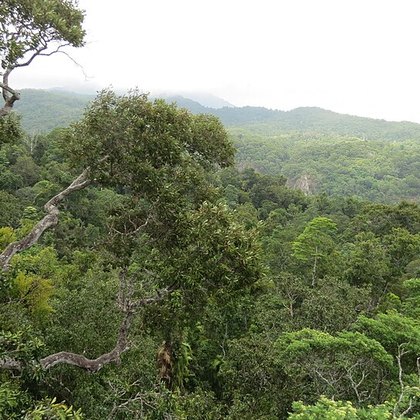
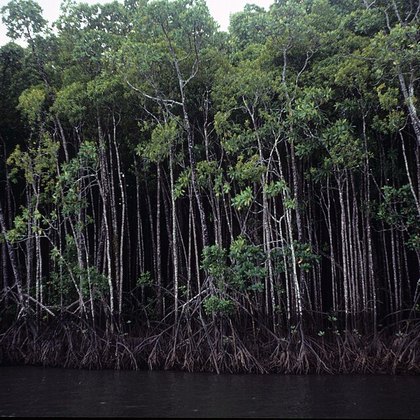
Rainforest and its margins, monsoon forest and vine thicket, and above all gallery forest of paperbark and other trees along creeks that hold water all year. Mangrove and heavier eucalypt forest are used as well, always where big trees with hollows stand. By day it roosts close to the trunk in a dark, densely leafed crown, often on the same branch for years.
Where the bird is most often found, arranged by main group and formation.


Range and movements
Confined to the coast and the belt behind it in the north and northeast, with a broken distribution from the Kimberley across Arnhem Land and Cape York to mid-eastern Queensland about the latitude of Mackay. Beyond Australia it occurs in New Guinea and the Aru Islands. It is sedentary and does not migrate; a pair holds the same territory for years. With the loss of lowland rainforest and gallery forest the distribution between the core areas has become more broken still.
- Resident
- dark = core range, pale = thinly spread
Where and when to look
Walk a paperbark creek in the early evening in the dry season and listen for the slow double hoot; the pair often calls from a fixed branch close to the previous nest hollow. By day, look under big trees for whitewash and for pellets holding the bones of flying-foxes. An owl flushed in broad daylight leaves a roost it may not take up again.
Conservation
Not threatened (LC) and spread across the whole north, but everywhere at low density: a pair needs a large territory. The limiting factor is the same as for the other large owls — big old trees with a hollow wide enough to take them. Clearing, and above all too-frequent burning of lowland forest, hits those trees hardest, and in the northeast the conversion of coastal rainforest to sugarcane presses on numbers.
Scientific name
Ninox rufa | (Gould, 1846)
Gould described the species in 1846 as Athene rufa; because it was later moved to another genus, author and year stand in parentheses. The genus Ninox was introduced by Hodgson in 1837 and combines Nisus, the sparrowhawk, with noctua, the night owl, after the hawk-like head and long tail of these owls. The epithet rufa means rufous. The type locality is Port Essington, the short-lived British settlement on the Cobourg Peninsula in the Northern Territory, from which Gould described many of his northern species.