All species › Owls › Owls › Powerful Owl
Powerful Owl | Ninox strenua
Grote boeboekuil | Nínox robusto
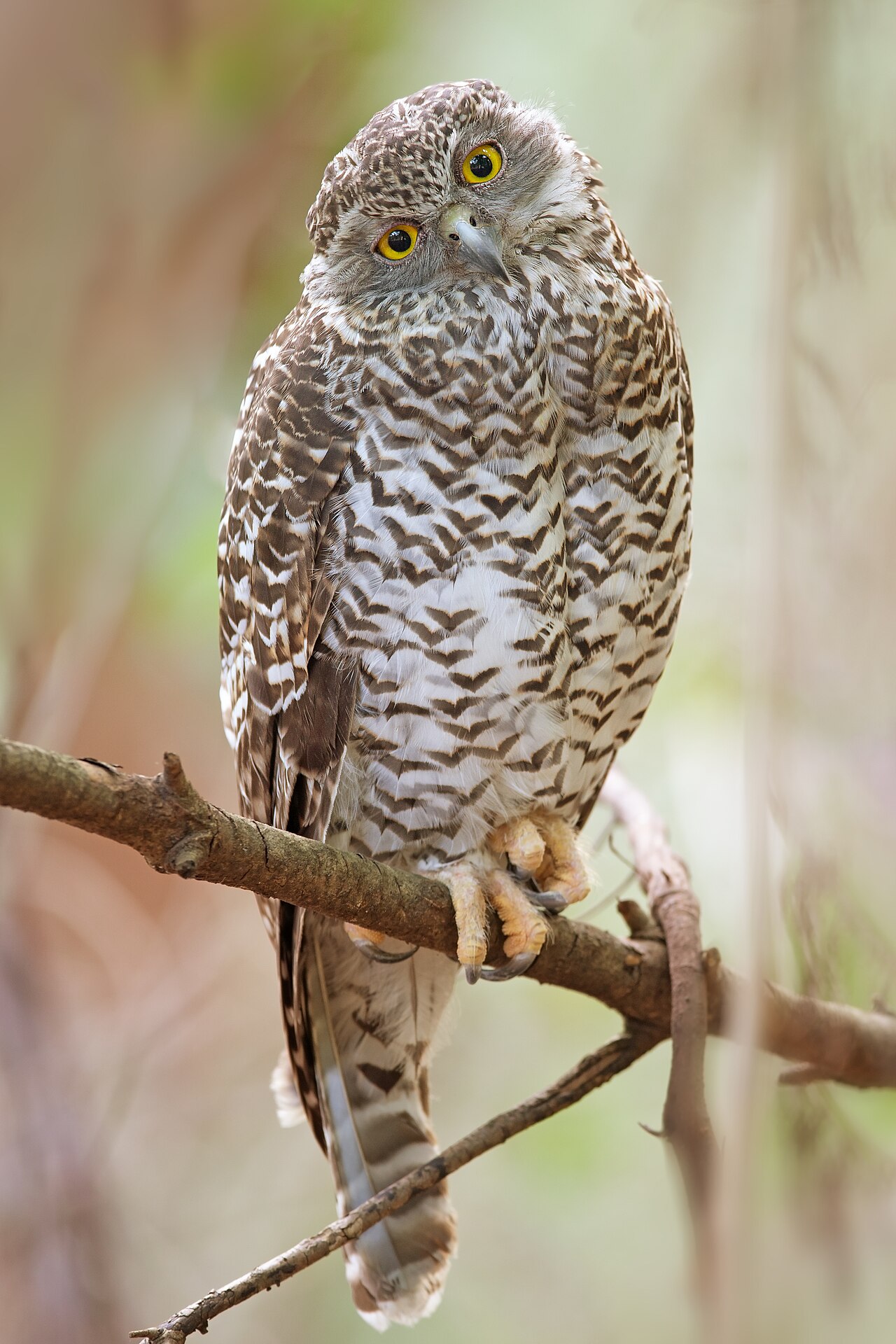
The Powerful Owl is the largest owl in Australia and the heaviest nocturnal hunter on the continent: well over half a metre long, with yellow eyes in a dark mask and huge yellow-orange feet with which it plucks Common Ringtail Possums and Greater Gliders out of the canopy. By day it hangs motionless in a gully, often with the remains of last night's kill still clamped in one foot.
Voice
The call is a deep, slow, soft double note, woo-hoo, with a clear gap between the two and repeated at irregular intervals. It sounds muffled rather than loud, but the low pitch carries unusually far down a wooded valley and is heard most in winter, the territorial season. The pair calls in duet, the female higher and a little harsher. Young beg with a sustained trilling whistle that comes from the same gully every night for weeks, and a hoarse rasp follows any disturbance.
No freely licensed recording has been found for this species yet; what to listen for is described below.
Identification
A huge, long-bodied owl with no facial disc, a head strikingly small for its bulk and a long broad tail. The upperparts are dark grey to dark grey-brown with white barring, the underparts off-white with coarse dark V-shaped chevrons laid like inverted points across breast and belly — the clearest mark of the species. The eyes are yellow and set in a dark mask; the legs are feathered and end in heavy yellow to orange toes with long talons. Unlike almost every other raptor the male is the larger: about one and a half kilograms against a good kilogram. Young birds have a downy white head and underparts.
Confusion species
Rufous Owl (Ninox rufa) is as large but warm reddish brown and finely barred right across the underparts instead of coarsely chevroned, and lives in the tropical north where this species does not occur. Barking Owl (Ninox connivens) overlaps fully, but is a third smaller, greyer and plainly streaked, and barks. Australian Boobook (Ninox boobook) is half the size and spotted. Greater Sooty Owl (Tyto tenebricosa) hunts the same marsupials in the same gully forest, but has dark eyes, a large round facial disc, and is dark both above and below.
Habitat
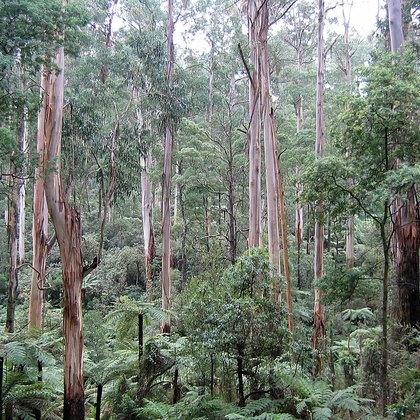
Open eucalypt forest and woodland, and above all the sheltered gullies of wet forest with a dense understorey, usually along a watercourse. Two things must come together: big old trees with a vertical hollow sometimes a metre deep to breed in, and a patch of forest carrying enough arboreal marsupials. By day it roosts in a dense, dark crown in the gully, on the same branch for years. In the cities of the east coast it has reached parks and old gardens, where ringtail possums are plentiful.
Where the bird is most often found, arranged by main group and formation.


Range and movements
Endemic to eastern and southeastern Australia, almost entirely on the eastern side of the Great Dividing Range, from southeastern Queensland through New South Wales and Victoria into southeastern South Australia. It does not occur in Tasmania, in the west, or in New Zealand. It is strongly sedentary: a pair holds a territory of a few hundred to more than a thousand hectares for life. In Sydney, Brisbane and Melbourne a remarkable urban population breeds in old park trees.
- Resident
- dark = core range, pale = thinly spread
Where and when to look
Walk into a wooded gully in the first hour after sunset in winter, between May and August, and listen for the slow woo-hoo; that is the season when the pair calls most. Then search the forest floor by day under dense crowns for whitewash, pellets and ringtail possum bones — they give away a roost branch that is often in use for decades. Check city parks with old figs and eucalypts too: in Sydney the species can be found a couple of hundred metres from a busy street.
Conservation
Not threatened globally (LC), but listed as vulnerable in New South Wales and Victoria, with the Australian population put at a few thousand pairs. The bottleneck is the tree: a hollow big enough only forms in a eucalypt of a hundred and fifty years or more, and such trees have grown scarce through logging, clearing and too-frequent fire. The severe bushfires of 2019–2020 burnt a substantial part of the southeastern habitat. On top of that comes the loss of prey: where the Common Ringtail Possum and the Greater Glider decline, the pair cannot hold its territory.
Scientific name
Ninox strenua | (Gould, 1838)
Gould described the species in 1838 as Athene ? strenua — the question mark is his own, since he doubted the genus — and because it later moved to Ninox, author and year stand in parentheses. The epithet strenua is Latin for 'vigorous, brisk, untiring' and refers to the build of the bird; the English name Powerful Owl translates it. The genus Ninox was introduced by Hodgson in 1837, from Nisus (sparrowhawk) and noctua (night owl). The type locality is New South Wales.