All species › Parrots › Old World parrots › Australian King Parrot
Australian King Parrot | Alisterus scapularis
Australische koningsparkiet | Papagayo australiano
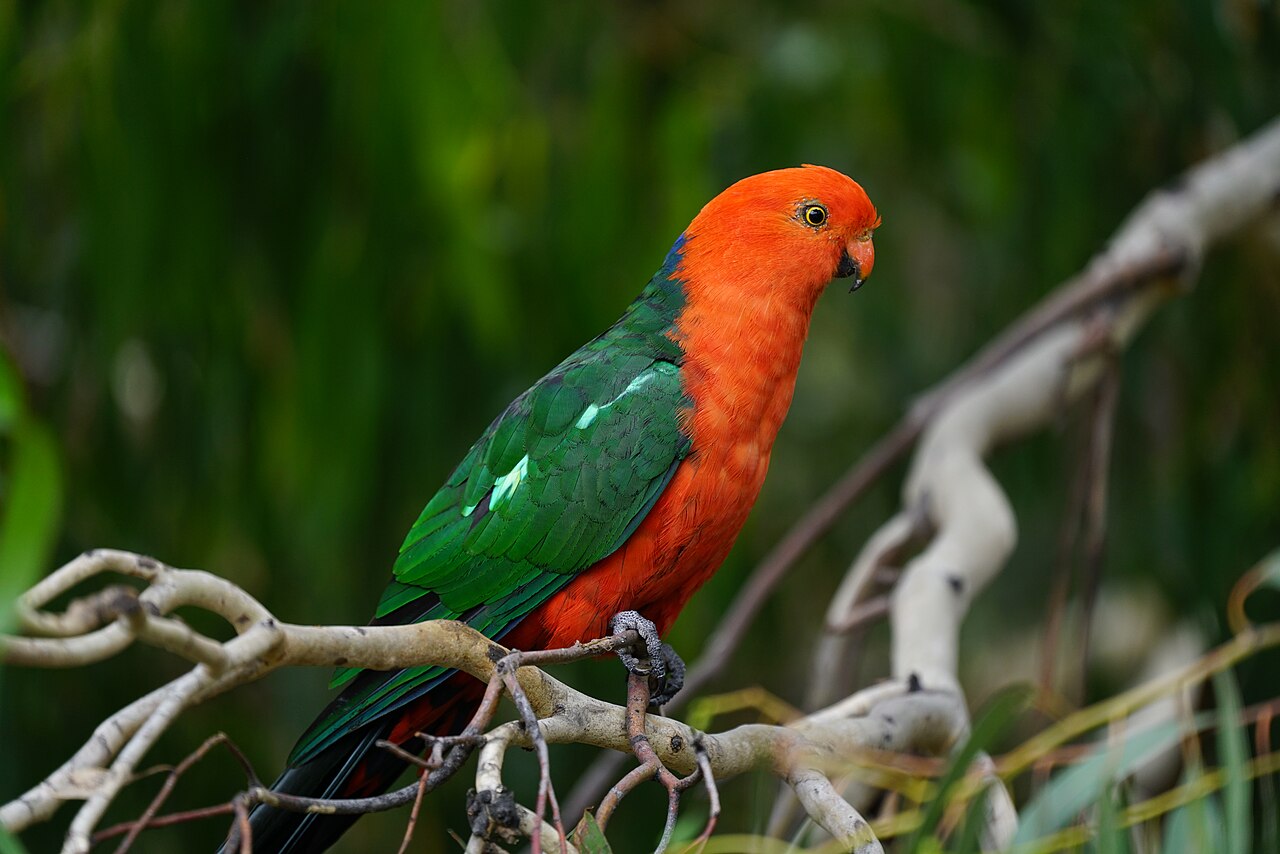
The Australian King Parrot is the large, long-tailed parrot of the moist eastern forest: the male has an entirely scarlet head and underparts against a green back, the female a green head and breast with a red belly. It flies with slow, deep beats low beneath the canopy, and gives itself away by its whistle rather than by its colour. In winter it comes into gardens and townships.
Voice
The contact call in flight is a hard two-syllable carr-ack, which announces a passing pair across a whole valley. Perched, it gives a series of high clear whistles that rise and fall slightly in pitch and sound far more musical than the screeching of rosellas and cockatoos. Disturbance brings a sharp, repeated screech. A group in a fruiting tree feeds largely in silence and betrays itself only by falling husks.
No freely licensed recording has been found for this species yet; what to listen for is described below.
Identification
A solid parrot with a long, broad tail and a heavy head. The male has head, neck and entire underparts scarlet, with a green back, green wings crossed by a pale green shoulder band, a blue rump and a long blackish blue tail; the upper mandible is orange-red tipped black. The female has head and breast green and only the belly and undertail coverts red, with a grey bill and a narrow blue edge on the nape. Young birds resemble the female, with a yellow-brown bill and a brown iris; the male gains the red head only after some years. In flight it stands out by the slow deep beat and the straight, low line taken just under the canopy.
Confusion species
Crimson Rosella (Platycercus elegans) shares the same forest and is also red in the male, but has blue cheeks, a black-scalloped back and a blue tail, and flies in short bounds rather than straight. Red-winged Parrot (Aprosmictus erythropterus) is green with a large red wing panel and, in the male, a black mantle, and belongs to drier forest in the north and inland. The female King Parrot separates from the female Red-winged Parrot by having no red in the wing and by the red of the belly cutting sharply against the green breast. Rainbow Lorikeets are smaller, far busier and much noisier.
Habitat
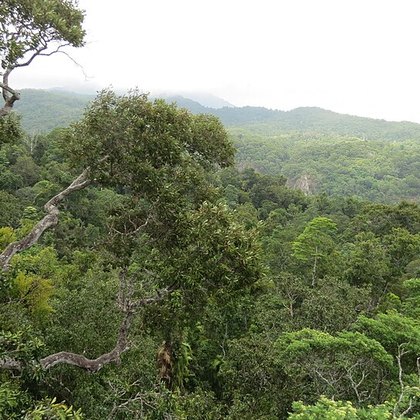
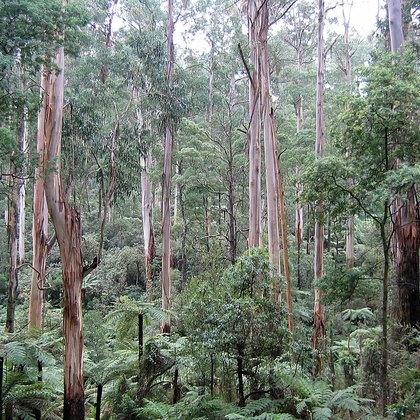
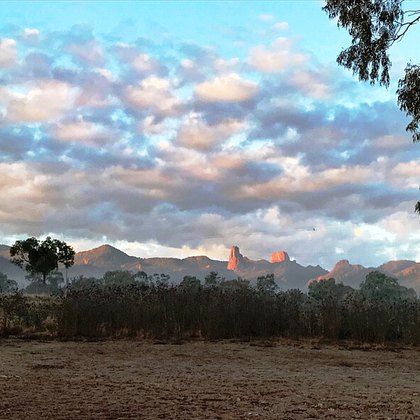
Rainforest and tall moist eucalypt forest in the ranges make up its summer quarters, with drier eucalypt forest, forest edges and riverine forest below them. In winter it comes lower and appears in orchards, parks, gardens and townships, where it feeds at tables and in fruiting trees. To breed it needs a deep hollow in a thick old tree, in which the eggs lie on a bed of rotten wood close to the ground while the entrance sits ten metres higher.
Where the bird is most often found, arranged by main group and formation.


Range and movements
Eastern Australia only, from Cooktown in northern Queensland along the coast and ranges to Port Campbell in Victoria. It occurs nowhere outside that belt, and is absent from Tasmania and from New Zealand. It does not migrate, but shifts with the season along the mountainside: high in the moist forest in summer, in the valleys and at the edge of settlement in winter. That winter shift has grown stronger over the past half century as front gardens and feeding tables have multiplied.
- Resident
- dark = core range, pale = thinly spread
Where and when to look
In winter, wait by a fruiting tree at the edge of a township in the ranges; the birds come in small parties and feed low and at length. Otherwise listen on a forest road for the carr-ack of a bird passing over, and look low rather than high: it cuts through just under the canopy. Do not feed it bread or seed mixes — parrots pick up beak and feather disease at tables of that kind.
Conservation
Not threatened (LC) and common throughout its range, including settled country. The constraint is the supply of large old trees with deep hollows, for which it competes with cockatoos, kookaburras and honeybees; young forest and plantation provide none. Beyond that, beak and feather disease plays a part and spreads readily around feeding tables, and birds are lost to traffic where they cross roads low through the forest.
Scientific name
Alisterus scapularis | (Lichtenstein, 1818)
Lichtenstein described the species in 1818 as Psittacus scapularis; because it was later moved to another genus, author and year stand in parentheses. The genus Alisterus was introduced by Mathews in 1911 and is named after his son Alister. The epithet scapularis means 'of the shoulder' and refers to the pale green band across the male's shoulder. The original description gives no locality; Mathews later fixed it as New South Wales.