All species › Parrots › Cockatoos › Carnaby's Black Cockatoo
Carnaby's Black Cockatoo | Zanda latirostris
Dunsnavelraafkaketoe | Cacatúa fúnebre piquicorta
Carnaby's Black Cockatoo is one of the two white-tailed black cockatoos of south-western Australia and is found nowhere else on earth. Grey-black with fine pale scalloping, a cream ear patch and two white panels in the tail — and with a short, broad, strongly arched bill with which it breaks open the woody fruits of banksias and hakeas.

Voice
The mark most observers settle on: a loud, wailing and far-carrying wy-lah, repeated in flight at intervals of about four tenths of a second, with a clear break between the two syllables. Beyond that come soft chuck notes between feeding birds, a whistling sequence from the female at the nest, and a harsh screech when disturbed. A flock crossing the suburbs of Perth announces itself for minutes on end.
No freely licensed recording has been found for this species yet; what to listen for is described below.
Identification
A large dark cockatoo of just over half a metre with a wingspan of about 110 cm, grey-black with narrow light grey feather margins that give the plumage a finely scaled look. A cream-white patch marks the ear coverts, and two broad white panels sit in the tail, visible only in flight or on the turn. The crest is short. The male has a dark grey to black bill and a pink eye-ring; the female a bone-white bill with a black tip, a grey eye-ring and a whiter, more conspicuous ear patch. The bill is short, broad and strongly arched — rounded in profile, not pointed.
Confusion species
Baudin's Black Cockatoo (Zanda baudinii) is the real problem: the same size, the same grey-black, the same white ear patch and the same white tail panels, and often inseparable in photographs. Look at the bill in side profile — broad, bulbous and short in this species, long, narrow and triangular in baudinii, whose upper mandible extends well below the lower. The call helps too: that of baudinii is shorter (about 0.47 against 0.64 seconds), shriller and sounds clipped, and it has a clucking note this species lacks. Behaviour gives it away as well: only Carnaby's regularly takes pine seed in plantations, and it tears marri fruit open roughly where baudinii leaves a neat hole. Yellow-tailed Black Cockatoo (Zanda funerea) has yellow rather than white tail panels and does not occur in the west. The Forest Red-tailed Black Cockatoo, the south-western subspecies of Calyptorhynchus banksii, shares the same forest but shows red tail panels, no pale ear patch and a harsh metallic call.
Habitat
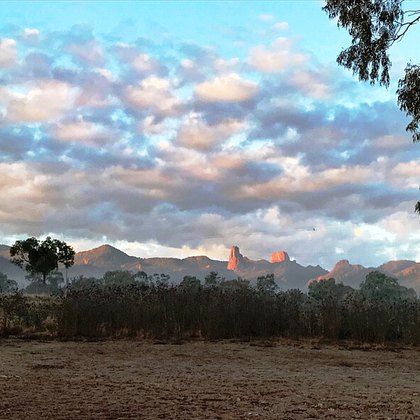
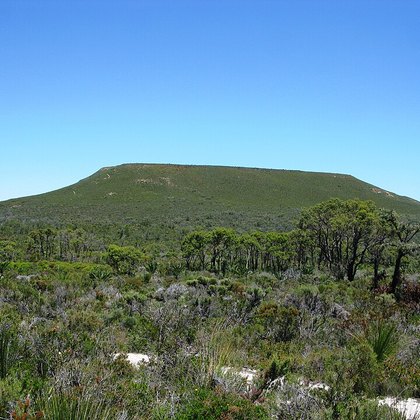
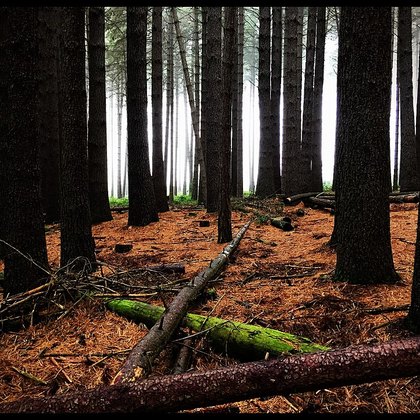
It breeds in old eucalypt woodland of wandoo and salmon gum, in large hollows in trees centuries old, and feeds in kwongan heath carrying banksias, hakeas and grevilleas, whose seed makes up most of the diet. Outside the breeding season it moves to the coast, using pine plantations, banksia woodland and the parks, streets and gardens of suburban Perth; roost trees are used year after year.
Where the bird is most often found, arranged by main group and formation.


Range and movements
Endemic to south-western Western Australia, chiefly in the wheatbelt within the 300 to 750 mm rainfall zone, from Kalbarri in the north to Cape Arid in the east and south. Birds breed inland from August to December and then move, roughly from December to July, to the Swan Coastal Plain around Perth and Bunbury. In the drier parts that movement is a genuine seasonal migration; in the wet south-west the birds stay all year. Outside this corner of Australia it occurs nowhere.
- Resident
- dark = core range, pale = thinly spread
Where and when to look
Go to a known roost on the Swan Coastal Plain at dusk in winter — a row of tall pines or gums in a suburb — and count the flocks coming in; that is exactly what the annual Great Cocky Count does. On every bird in the hand or in a photograph check the bill profile rather than the plumage, and try to record a call: the difference from Baudin's lies in the length and sharpness of the syllables.
Conservation
Endangered (EN), with an estimate of some forty thousand birds. The cause is at heart simple: more than half the original vegetation of the breeding range has been cleared since European settlement, removing both feeding shrubland and nest trees, and a suitable hollow in a wandoo or salmon gum takes a couple of centuries to form. On the coastal plain at Perth the Great Cocky Count recorded 10,919 birds in 2016, about half the 2010 figure; there the harvesting of the Gnangara pine plantations, urban growth, heatwaves and vehicle strikes all add up. Productivity is low — one or two eggs, usually one fledged young — so losses are made good only slowly.
Scientific name
Zanda latirostris | (Carnaby, 1948)
Ivan Carnaby described the bird in 1948 in The Western Australian Naturalist as Calyptorhynchus baudinii latirostris, that is, initially as a subspecies of Baudin's; author and year stand in parentheses because the species now sits in Zanda. That genus was introduced by Mathews in 1913 for the white- and yellow-tailed species and was taken back into use after recent genetic work; Mathews gave no explanation for the name Zanda itself. latirostris means broad-billed, from latus (broad) and rostrum (bill) — note that this looks the reverse of the Dutch guide name, which sets the bill against the much longer bill of baudinii, whereas the epithet and the Spanish piquicorta point at the short, broad shape. The English name honours the describer.