All species › Parrots › Cockatoos › Yellow-tailed Black Cockatoo
Yellow-tailed Black Cockatoo | Zanda funerea
Geeloograafkaketoe | Cacatúa fúnebre coliamarilla
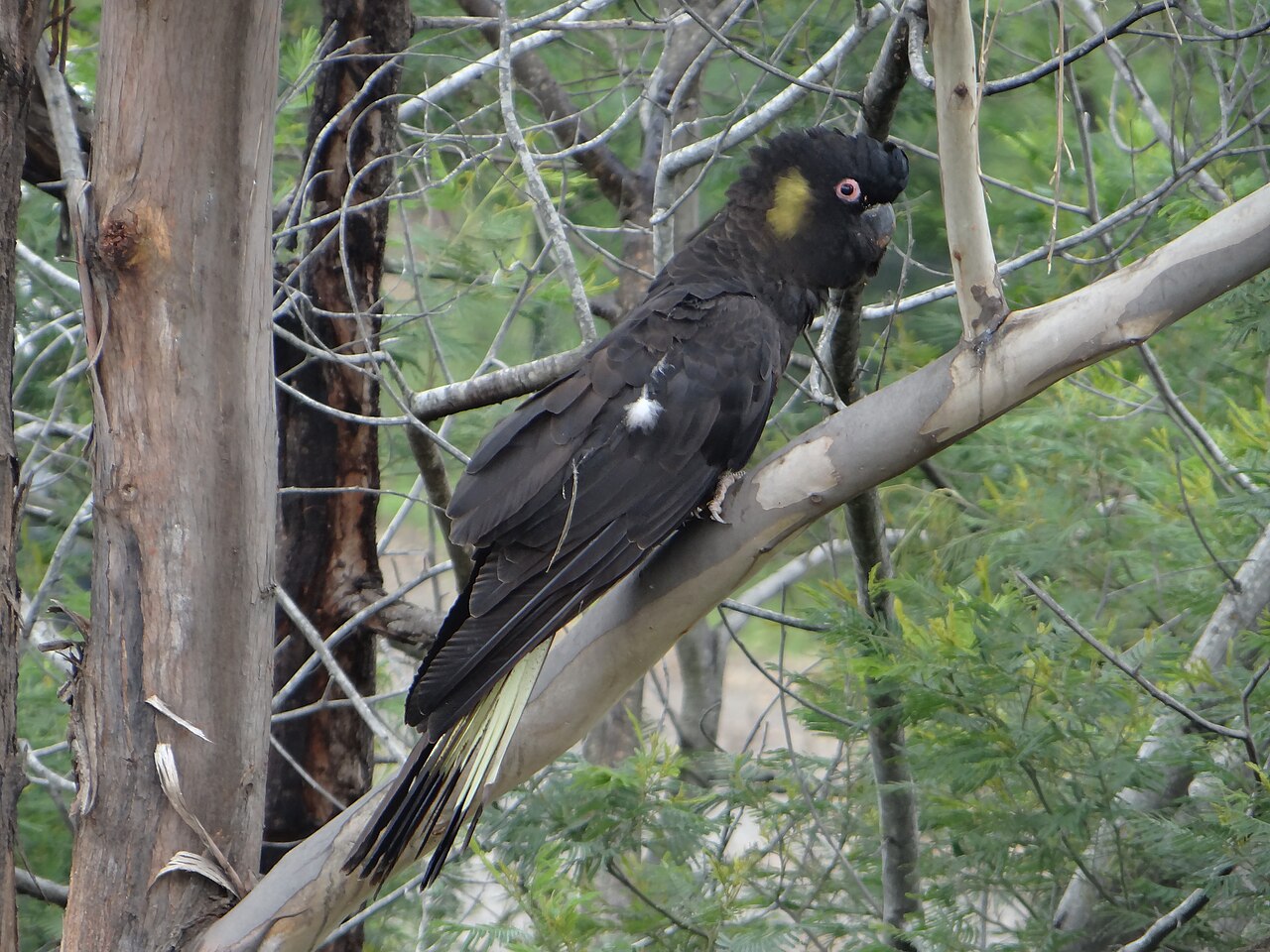
The Yellow-tailed Black Cockatoo is the black cockatoo of the south-east: a large, slow-flying bird with a yellow patch on the ear coverts and a broad yellow band in the long tail. It chisels wood-boring grubs out of trunks and branches, leaving a scatter of fresh wood chips that can be spotted from a distance.
Voice
A high, wailing and extremely far-carrying contact call, usually written as kee-ow ... kee-ow ... kee-ow, given at long intervals in flight or from the roost tree; on still mornings it travels kilometres. Beyond that a drawn-out, slightly mournful wee-la, soft throaty notes between partners and, while grubbing, the unmistakable crack of tearing wood.
No freely licensed recording has been found for this species yet; what to listen for is described below.
Identification
One of the largest cockatoos in Australia, up to sixty-five centimetres and seven hundred and fifty to nine hundred grams, brown-black with pale feather margins that make the plumage look scaled, and with a short mobile crest. The mark is the yellow patch over the ear coverts, backed up by the broad yellow band in the tail that lights up in flight and on landing. The male has a black bill and a pinkish-red eye-ring; the female a horn-coloured bill, a grey eye-ring and a larger, brighter yellow ear patch. Flight is slow and heavy, on deep beats, with the long tail clearly in view.
Confusion species
Within its range confusion is limited, because no other black cockatoo in the south-east has yellow tail panels. Glossy Black Cockatoo (Calyptorhynchus lathami) shares the same forest in New South Wales and Victoria but is considerably smaller and more compact, with red or orange-red tail panels, a thick bulbous pale bill and a much softer creaking voice; its female shows yellow on head and neck, but not as a single sharply defined ear patch. Red-tailed Black Cockatoo (Calyptorhynchus banksii) is glossier black with a tall helmet crest and red tail panels. The two white-tailed species of the west, Carnaby's (Zanda latirostris) and Baudin's (Zanda baudinii), are very like this bird but have white rather than yellow ear patch and tail panels, and there is no overlap at all: west and south-east do not meet.
Habitat
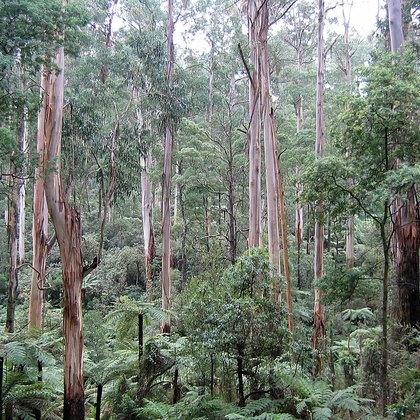
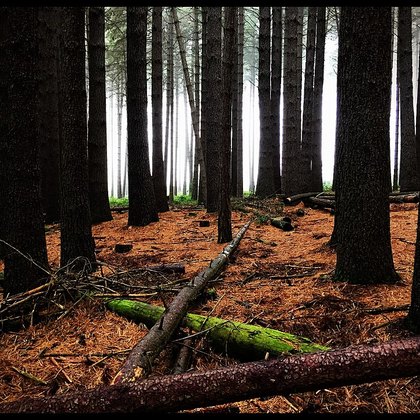
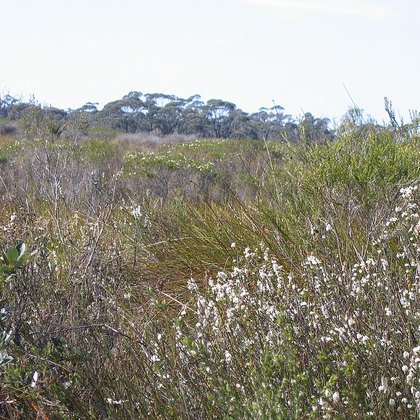
Wet and dry eucalypt forest, she-oak woodland, coastal heath with banksias and, readily, planted pine forest. It feeds on the seed of eucalypts, she-oaks, banksias and pines, and on the wood-boring larvae of cossid moths and beetles chiselled out of living and dead timber. It nests in large hollows high in very old eucalypts — trees of two centuries and more, in the south often mountain ash. Outside the breeding season flocks range through farmland and into the parks and streets of the big cities.
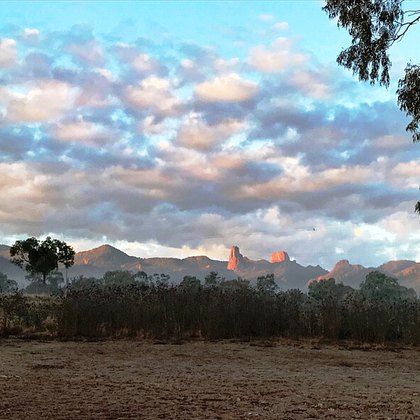
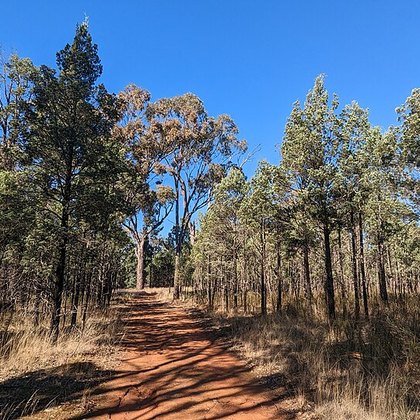
Where the bird is most often found, arranged by main group and formation.

Range and movements
South-eastern Australia: from south-eastern Queensland through New South Wales and Victoria into the south-east of South Australia, plus Tasmania and the Bass Strait islands. On Eyre Peninsula a tiny remnant of thirty to forty birds hangs on. The species is entirely absent from Western Australia, and does not occur in New Zealand.
- Resident
- dark = core range, pale = thinly spread
Where and when to look
Look for the work rather than the bird: fresh pale wood chips at the foot of a trunk or under a dead limb nearly always mean a Yellow-tailed has been chiselling grubs there, often the same day. In winter a pine plantation or a line of coastal banksias is the best bet; and listen early for the drawn-out kee-ow, which gives the flock away long before the slow silhouettes appear above the canopy.
Conservation
Not threatened (LC): the species remains widespread across its range and takes well to planted forest and to urban trees. The picture is not uniformly good, though. In Victoria and South Australia numbers are falling and the bird is treated as vulnerable at state level; the Eyre Peninsula group hangs by a thread. The key is always the same: nest hollows form only in eucalypts a few hundred years old, and where forest is thinned, fragmented or burnt those trees go faster than new hollows appear.
Scientific name
Zanda funerea | (Shaw, 1794)
Shaw described the species in 1794 as Psittacus funereus, funereus meaning literally 'belonging to a funeral': a reference to the sombre black plumage. The type locality reads New Holland and is understood as New South Wales. Author and year stand in parentheses because the bird now sits in Zanda, the genus Mathews introduced in 1913 and which recent genetic work has brought back into use; Mathews gave no explanation for the name Zanda. Note the difference between the names: English and Spanish point at the yellow tail, the Dutch guide name at the yellow patch on the ear coverts, just behind and below the eye.