All species › Parrots › Cockatoos › Baudin's Black Cockatoo
Baudin's Black Cockatoo | Zanda baudinii
Langsnavelraafkaketoe | Cacatúa fúnebre piquilarga
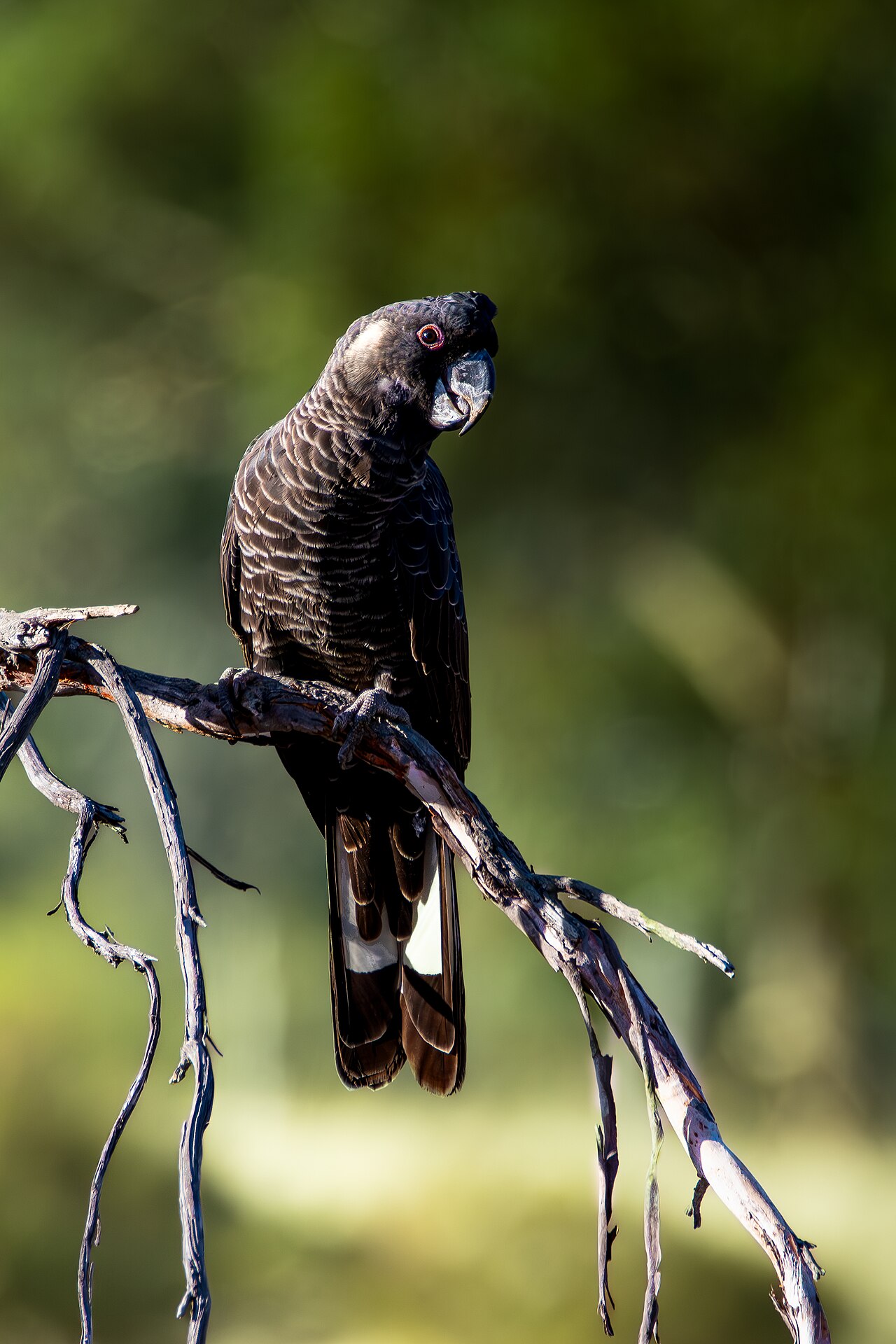
Baudin's Black Cockatoo is the rarest of Australia's five black cockatoos and lives only in the tall, moist forests between Perth and Albany. To look at it is almost a twin of Carnaby's; what gives it away is the bill: long, narrow and triangular, a forceps with which it picks the seed out of the hard fruits of marri without destroying the fruit.
Voice
A loud, whistling weeoo wee-oo, repeated in flight and at distance barely separable from Carnaby's. Measurement does show a difference: the call is shorter, about 0.47 seconds against 0.64 in the other species, sounds clipped and shriller in the first syllable, and the two syllables run together more (wheeor rather than whee-oor). It also has a clucking call that Carnaby's does not give.
No freely licensed recording has been found for this species yet; what to listen for is described below.
Identification
A large dark cockatoo of just over half a metre, brown-black with narrow cream-white feather margins that make the plumage look scaled, with a cream-white patch over the ear coverts and two white panels in the tail that show only in flight. The male has a black bill and a pink eye-ring; the female a bone-coloured bill and a grey-black eye-ring, and females usually show more pale fringing on breast and belly. The decisive mark is the bill profile: long, narrow and triangular, with the upper mandible extending well below the lower. Some observers also find the bird looks slightly browner and smaller than its counterpart in strong light.
Confusion species
Carnaby's Black Cockatoo (Zanda latirostris) is the whole story: the same size, the same plumage, the same white ear patch and white tail panels, and in the south-west the two ranges overlap. Only the bill profile is genuinely reliable — short, broad and bulbous in latirostris, long, narrow and pointed here. Where that fails, behaviour and place decide: this species keeps to heavy marri, karri and jarrah forest and hardly enters the wheatbelt, takes no pine seed in plantations, and leaves a neat little hole in a marri fruit where latirostris breaks the rim of the fruit away roughly. The Forest Red-tailed Black Cockatoo, the south-western subspecies of Calyptorhynchus banksii, shares the same forest but has red tail panels, no pale ear patch and a harsh metallic voice. Yellow-tailed Black Cockatoo (Zanda funerea) has yellow tail panels and does not occur in Western Australia.
Habitat
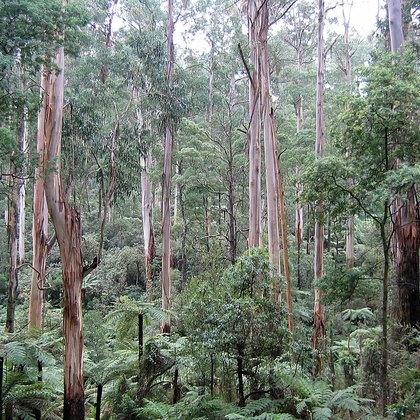
Moist, tall forest of marri, karri and jarrah is its world; marri seed is the core of the diet, with jarrah seed and wood-boring grubs alongside. It nests in very large hollows high in old karri and marri, which must be a couple of centuries old to offer one. Outside the breeding season it uses adjoining woodland and the apple and pear orchards around Donnybrook and Manjimup, and in winter also gardens and parks in towns along the forest edge.
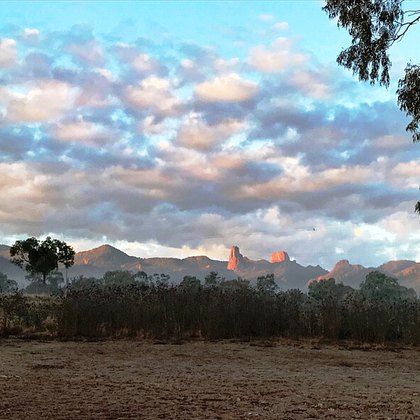
Where the bird is most often found, arranged by main group and formation.


Range and movements
Endemic to the far south-western corner of Western Australia and found nowhere else on earth: the forest belt between roughly Perth in the north and Albany in the south, centred on the tall marri and karri forests of the south-west. Eastward it barely reaches the drier wheatbelt, which is Carnaby's country. The entire range fits within a few hundred kilometres, and that is precisely the vulnerability of the species.
- Resident
- dark = core range, pale = thinly spread
Where and when to look
Search under a marri for fallen fruit: a fruit with one small, neat hole from which the seed has been taken is the work of this species, while a broken, ragged rim points to Carnaby's — that sign is often more reliable than a glimpse of a bird high in the canopy. If you do see the birds, wait until one sits side on and judge the bill in profile; and try to record a call, because the short, clipped character can be measured afterwards.
Conservation
Critically Endangered (CR) since the reassessment of 2021, the highest category short of extinct in the wild, with an estimate of ten to fifteen thousand birds left. The bottleneck is the nest hollow: only karri and marri of two centuries and more carry a cavity large enough, and those trees have been logged over wide areas or stand in fragmented remnants. On top of that the species breeds slowly, foxes and cats take young and sitting females, feral honeybees occupy the few hollows available, and the climate of the south-west has been drying for decades, which bears on marri fruiting. Historically, persecution in the orchards weighs as well: large numbers were shot under damage licences until the 1990s, and illegal shooting still occurs.
Scientific name
Zanda baudinii | (Lear, 1832)
Edward Lear figured and named the bird in 1832 in his Illustrations of the family of Psittacidae as Calyptorhynchus Baudinii, for the French explorer Nicolas Baudin, who charted the Australian coasts from 1800 to 1804 with the Géographe and the Naturaliste. Lear gave no type locality; Mathews later designated Albany in south-western Australia. Author and year stand in parentheses because the species now sits in Zanda, the genus Mathews introduced in 1913 and which recent genetic work has brought back into use; Mathews did not explain the name Zanda itself. The Dutch guide name and the Spanish piquilarga both point at the long, narrow bill.