All species › Parrots › Cockatoos › Palm Cockatoo
Palm Cockatoo | Probosciger aterrimus
Palmkaketoe | Cacatúa de las palmas
The Palm Cockatoo is the largest parrot in Australia and one of the strangest birds of Cape York: smoky black, with a tall crest of long loose feathers, a naked red cheek that changes colour when the bird is roused, and a monstrous hooked bill. Males drum with a self-made stick on a hollow bough — nothing else in the bird world does this.

Voice
A repertoire unusually rich for a parrot: thirty different syllables have been distinguished in the Iron Range population, among them a clear, almost human whistle and a low, plaintive heel-oo. Best known, however, is not a voice but the drumming: the male strikes a stick or seed pod up to fifteen centimetres long against a dead branch, in a rhythm that differs from bird to bird and carries up to a hundred metres.
No freely licensed recording has been found for this species yet; what to listen for is described below.
Identification
An enormous parrot of 55–60 cm and over a kilo, smoky black to slate-grey throughout, with a backward-sweeping crest of long, narrow, loose feathers that stands up like a comb. The face carries a large naked cheek patch, bright red at rest and changing colour with excitement or alarm. The bill is black and outsized, so heavy that upper and lower mandible do not meet. The tail is long for a cockatoo. The sexes are similar; the male has a heavier head and bill.
Confusion species
Within its range only Red-tailed Black Cockatoo (Calyptorhynchus banksii) is a serious candidate: also large and black, but with a closed, rounded crest, a feathered cheek without red, and a broad red (male) or yellow-barred (female) panel in the tail that lights up on take-off. The Palm Cockatoo has no colour panel in the tail at all and shows its colour on the head instead. Sulphur-crested Cockatoo (Cacatua galerita) is white and can only confuse in silhouette. In flight the Palm Cockatoo is known by the slow, deep beat, the loose crest laid back by the wind, and the heavy head that tips the bird forward.
Habitat
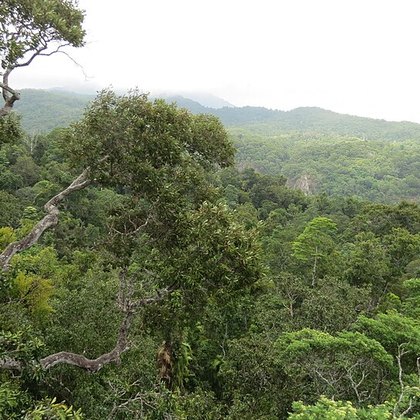
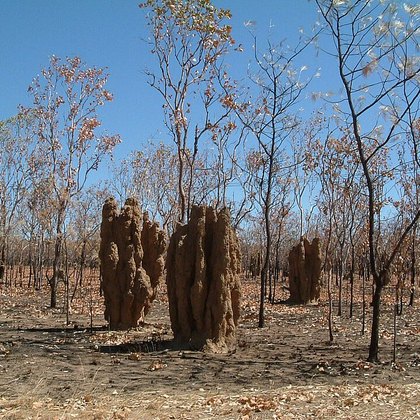
Tropical rainforest and its edges, monsoon forest and vine thicket, and above all the transition into open eucalypt savanna: it feeds in the forest and uses the savanna to nest and to drum. The nest is a hollow, upright trunk filled with a floor of shredded twigs. Food is mainly pandanus and kanari nuts, plus the fruits of Darwin stringybark, nonda, cocky apple and beach almond, and the seeds of the black bean tree.
Where the bird is most often found, arranged by main group and formation.

Range and movements
Within this map window only Cape York Peninsula in the far north of Queensland, roughly from the Jardine River and Weipa south to the Archer and Rocky Rivers; the best known site is the rainforest of Iron Range (Kutini-Payamu) and the adjoining McIlwraith Range. It occurs nowhere further south in Australia. Beyond the map window the range continues across New Guinea and the Aru Islands.
- Resident
- dark = core range, pale = thinly spread
Where and when to look
At Iron Range or near Weipa, go before sunrise to the edge between rainforest and savanna and listen for the drumming — it carries further than the call and places a displaying male exactly. Then search high in dead trees: it likes to sit on top of a bare branch and set its crested outline against the sky.
Conservation
Near Threatened (NT) globally, listed nationally as vulnerable in Australia since 2015, and on Appendix I of CITES. The species is extremely vulnerable through its breeding: a pair lays at most one egg every two years, and its breeding success is among the lowest recorded for any parrot, so losses are barely made good. The threats are bauxite mining around Weipa, which clears hollow-bearing and nest trees, altered fire regimes that damage the old savanna trees, hunting in the New Guinean part of the range, and a persistently high demand from the bird trade.
Scientific name
Probosciger aterrimus | (Gmelin, 1788)
Johann Friedrich Gmelin described the species in 1788 in his revised Systema Naturae as Psittacus aterrimus, from a 1764 description by George Edwards, so author and year stand in parentheses. Heinrich Kuhl introduced the genus Probosciger in 1820, built from Latin proboscis 'snout' and -ger 'bearing' — a reference to the outsized bill. aterrimus is Modern Latin for 'very black'. The type locality is the Aru Islands. The species is the only one in its genus.