All species › Parrots › Cockatoos › Cockatiel
Cockatiel | Nymphicus hollandicus
Valkparkiet | Cacatúa australiana ninfa
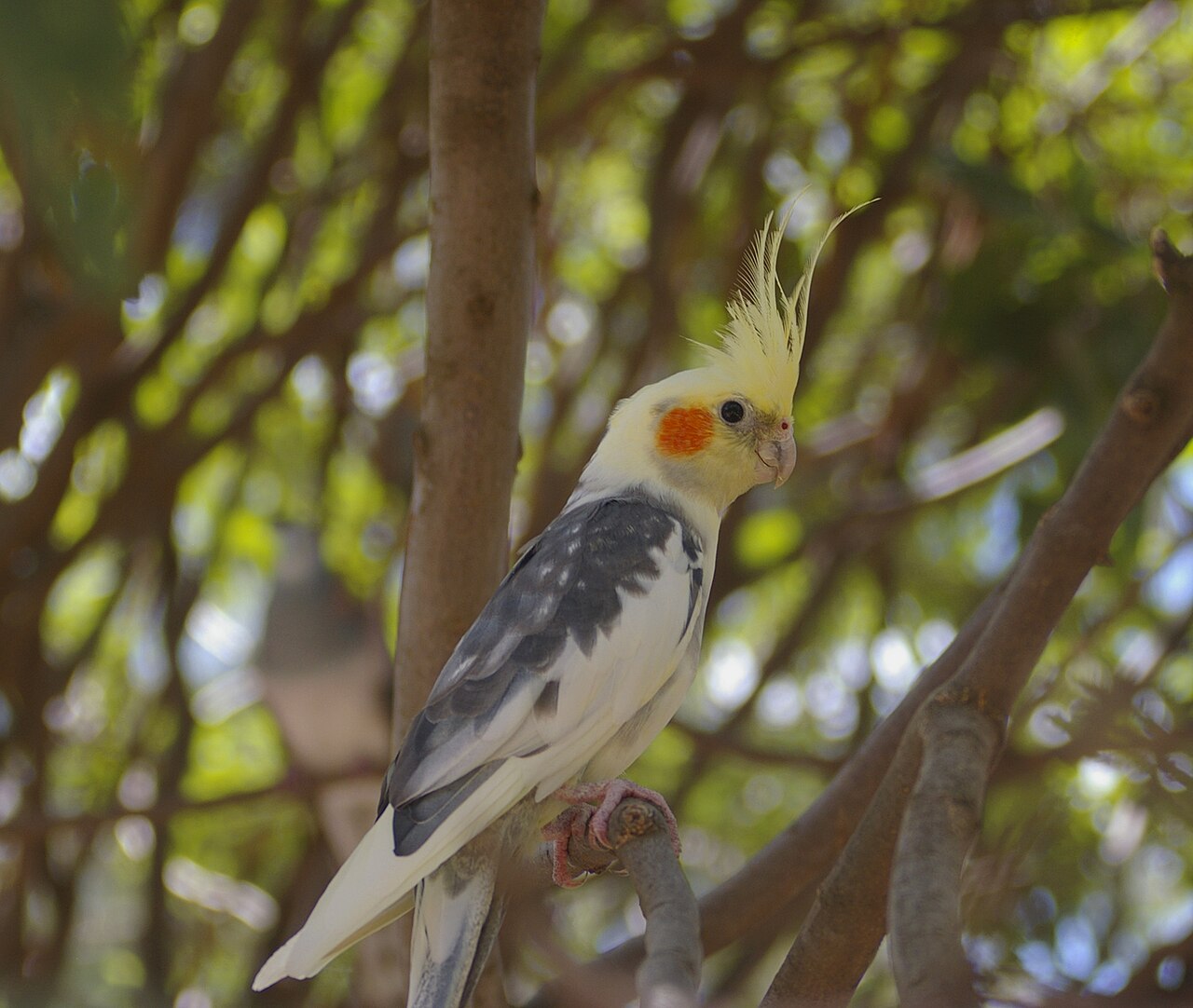
The Cockatiel is the smallest cockatoo in the world and the only one with a long pointed tail: a grey bird with a narrow erect crest, an orange cheek patch and a long white bar along the wing. In the dry interior it is one of the most familiar sights; outside Australia nearly everyone knows it as a cage bird.
Voice
The call is a clear, rolling, questioning queel-eel, stressed on the second syllable, usually repeated in flight and kept up continuously by a flock. There is also a soft squeaky chatter while feeding and a sharp alarm at a falcon. Males are the better singers: they string whistled phrases together and take up sounds from their surroundings.
No freely licensed recording has been found for this species yet; what to listen for is described below.
Identification
A slender cockatoo of 30–33 cm and under a hundred grams, of which the long pointed tail makes up more than half — no other cockatoo has that shape. The plumage is grey, with a broad white bar across the shoulder and wing coverts that shows in flight as a long stripe. The crest is narrow and erect and betrays the mood: vertical when startled, oblique at rest, flattened against the head in threat. The male has a yellow face and crest with a sharply defined orange ear patch; the female has a grey face with a duller orange patch, yellow spots on the underwing and a barred undertail. Young birds resemble the female.
Confusion species
In the field the shape is so distinctive that confusion mainly arises at range. Budgerigar (Melopsittacus undulatus) flies in the same flocks through the same dry interior and is also long-tailed, but is smaller, yellow and green, finely barred on head and back, and crestless. Mulga Parrot (Psephotellus varius) and Red-rumped Parrot (Psephotus haematonotus) are also long-tailed but largely green and without a crest. From the other cockatoos in this guide the Cockatiel is separated by its small size, the long tail and the narrow straight crest; in flight it suggests a small raptor sooner than a cockatoo — hence its Dutch name, which means 'falcon parakeet'.
Habitat
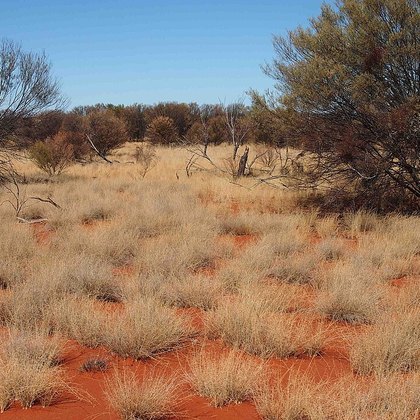
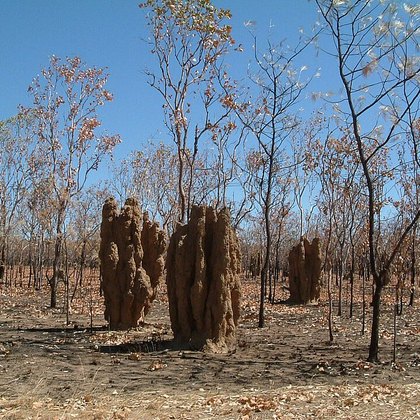
Dry and semi-arid open country, but always within reach of water: mulga and acacia scrub, spinifex plains with scattered trees, eucalypt savanna, the ribbons of creekside woodland that hold the nest hollows, and the crops and stubble that have pushed into the interior. It feeds mainly on seeds of acacia, grass, sorghum, wheat and sunflower, taken from the ground. Nests are in tree hollows close to fresh water.
Where the bird is most often found, arranged by main group and formation.



Range and movements
Nearly the whole Australian interior: western New South Wales and Queensland, the country around Alice Springs, the Kimberley and the north-western corner of Western Australia, and south into the dry parts of South Australia. It is absent from Cape York Peninsula, from the coastal belts of south-eastern and south-western Australia, and from Tasmania. Numbers are strongly nomadic: in a wet year it appears in force in districts where it has been absent for years.
- Resident
- dark = core range, pale = thinly spread
Where and when to look
In the interior, wait at a dam or stock trough at sunrise and towards sunset: Cockatiels come in to drink in small parties and settle in a dead tree close to the water, always lengthwise along the branch. In flight the white wing bar is the best mark; by voice you will have them before they come into view.
Conservation
Not threatened (LC) and by far the most numerous cockatoo in Australia. The provision of stock watering points and the spread of grain growing have opened the interior up further for the species, and numbers swing chiefly with rainfall. The millions of Cockatiels in captivity worldwide all descend from birds exported before the Australian export ban of 1960; the trade puts no pressure on the wild population today.
Scientific name
Nymphicus hollandicus | (Kerr, 1792)
Robert Kerr named the species in 1792 as Psittacus hollandicus; author and year stand in parentheses because Wagler placed it in the new genus Nymphicus in 1832. That genus refers to the nymphs of classical mythology — early European travellers thought the bird beautiful enough to name it after them. hollandicus refers to New Holland, the old name for Australia, and the type locality is accordingly simply New Holland. The Dutch guide name points to the flight silhouette, with the pointed wings and long tail of a small falcon. The species is the only one in its genus and belongs, despite its size, to the cockatoo family.