All species › Waders, gulls and terns › Skimmers, noddies, terns and gulls › Australian Tern
Australian Tern | Gelochelidon macrotarsa
Australische lachstern | Pagaza australiana
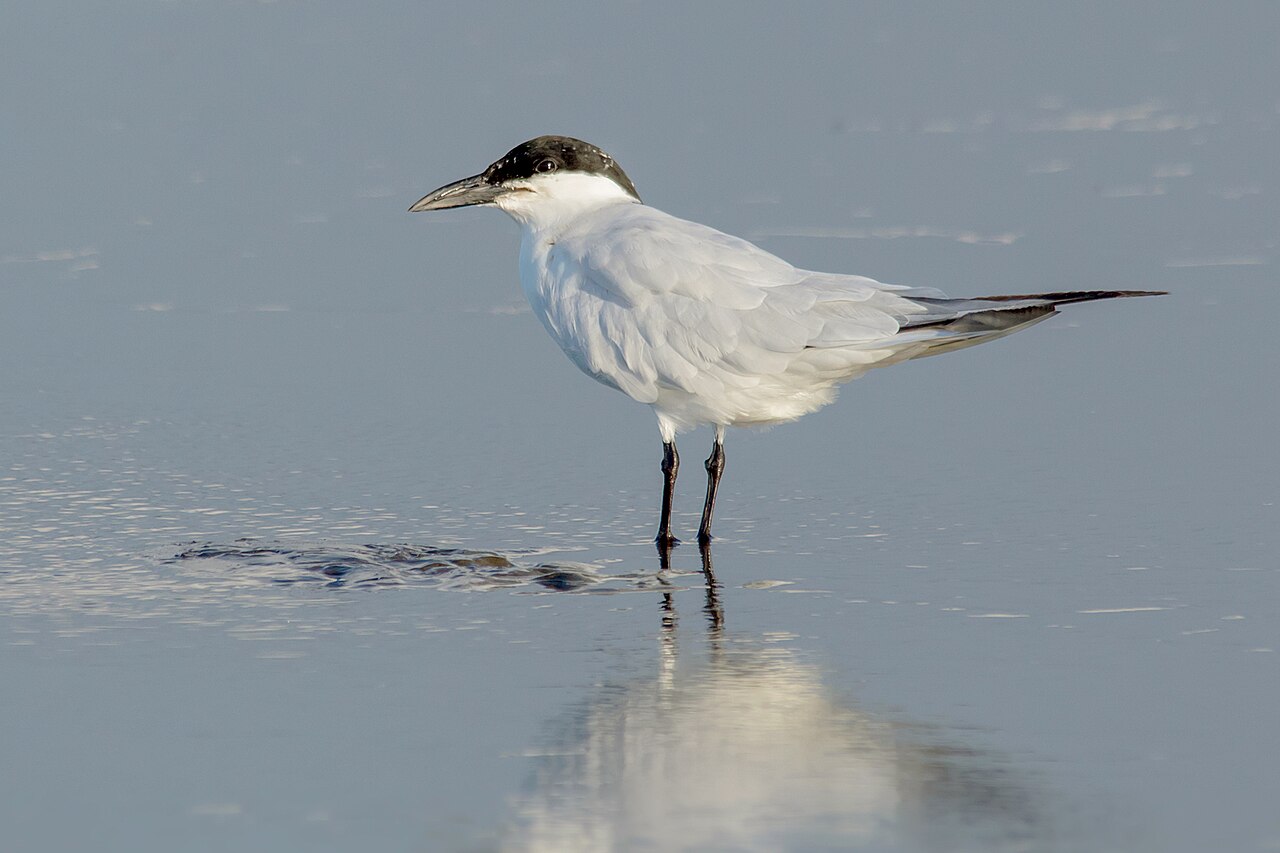
The Australian Tern is the tern that needs no sea: a pale, broad-winged bird with a short black bill and strikingly long black legs, hunting low over bare salt flats, claypans and paddocks for grasshoppers, lizards and mice. Until recently it passed as the Australian subspecies of the Gull-billed Tern; it now stands on the lists as a species of its own, and so as a bird that breeds nowhere else in the world.
Voice
A rasping, two-syllable ker-wik or kye-wik, low and dry, suggesting a frog or a bush-cricket rather than a tern. Over a colony or a hunting ground it becomes a short laughing series, kek-kek-kek, and on disturbance a hard, persistent yapping. Outside the breeding season it is often silent, so that flight rather than voice is what gives it away first.
No freely licensed recording has been found for this species yet; what to listen for is described below.
Identification
A medium-sized, heavily built tern with broad wings, a short and only moderately forked tail and long black legs it walks on easily — unusual for a tern. The bill is short, thick, straight and jet black, heavier than the Gull-billed Tern's but far from the bulk of a Caspian Tern's. In breeding plumage it wears a smooth black cap with no crest; in winter the head is white with a dark smudge behind the eye, which leaves the face bare and expressionless. The upperparts are very pale pearl-grey, the underparts white; the wingtips stay pale. It seldom dives into water: it hunts with a swerving flight over land and takes prey from the ground or the air, which makes it the one tern of this region regularly found over a bare paddock or a dry salt pan.
Confusion species
Gull-billed Tern (Gelochelidon nilotica), from which it was split only recently, is the whole problem: the same short thick black bill, the same black legs, the same pale plumage, the same way of hunting. The Australian bird averages larger, with a longer and heavier bill, longer legs and a longer, more deeply forked tail, but the differences are small and the ranges overlap; a lone winter-plumaged bird can rarely be named with certainty in the field. In practice context decides: a gull-billed type breeding or hunting inland in Australia is almost always this species, while Gull-billed Tern appears here only as an Asian visitor on the northern coast. Greater Crested Tern (Thalasseus bergii) and Lesser Crested Tern (Thalasseus bengalensis) have a long yellow or orange bill and a bristling crest. Caspian Tern (Hydroprogne caspia) is far larger with a thick coral-red bill — against that yardstick this bird's 'heavy' bill is modest. Common Tern (Sterna hirundo) and White-fronted Tern (Sterna striata) are slimmer, longer-billed and do plunge.
Habitat
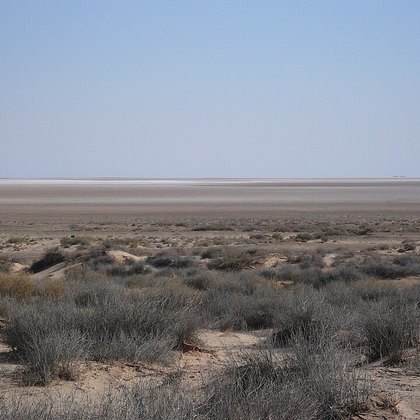
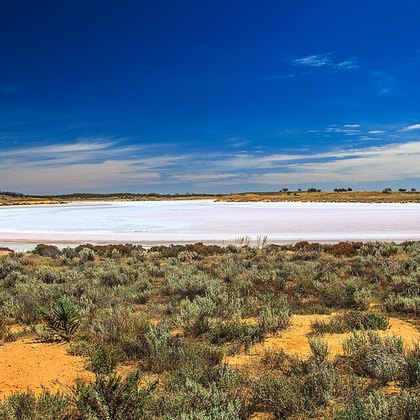
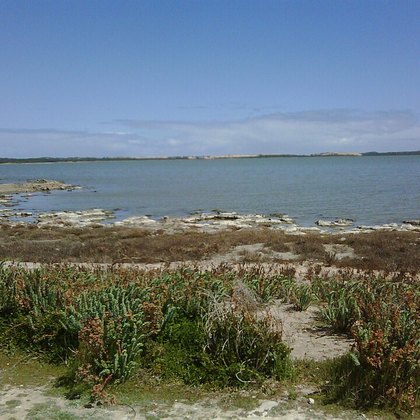
Open, low and usually saline or brackish country: inland claypans and ephemeral lakes, salt lakes and salt pans, samphire flats and coastal saltmarsh, tidal flats and estuaries, and besides those irrigated grassland and stock paddocks where the grasshoppers are. It nests on bare ground in small, loose colonies on salt flats, islets in inland lakes and bare coastal plains, and moves with the rain: where the interior floods, it comes to breed.
Where the bird is most often found, arranged by main group and formation.


Range and movements
Almost the whole of Australia, coast and interior, apart from the driest core of the desert; beyond the continent it reaches the south coast of New Guinea and Timor. After major inland flooding — the Lake Eyre basin, the Diamantina, Cooper Creek — it appears there in considerable numbers to breed, falling back to the coast in dry years. In New Zealand it is a rare vagrant. It is therefore the gull-billed type you will almost always be looking at in this map window, while true Gull-billed Tern is the exception here.
- Resident
- dark = core range, pale = thinly spread
Where and when to look
Look for this bird not over the water but over the land beside it: a pale tern hunting low and swerving over a ploughed field, a paddock or a dry salt pan, stooping again and again to the ground, is this species in Australia. Watch the legs as it lands — long and black, and it really does walk on them — and the profile of the short, blunt bill against the sky.
Conservation
Not threatened (LC). The species is spread over nearly the whole continent and gains from not being tied to the sea: irrigated grassland, rice fields and wastewater ponds provide hunting ground where there was none. The vulnerability lies in breeding: the colonies sit bare on the ground inland and then depend on high water lasting long enough, while foxes, cats and trampling stock reach the nests once the ground dries. Extraction of water from the inland river systems is therefore the chief indirect threat.
Scientific name
Gelochelidon macrotarsa | (Gould, 1837)
Gould described the bird in 1837 as Sterna macrotarsa; because the species now sits in Gelochelidon, author and year go in parentheses. The genus Gelochelidon is built from Greek gelan, 'to laugh', and khelidon, 'swallow'. The epithet macrotarsa means 'long-shanked', after exactly the character that separates it from the Gull-billed Tern. The type locality is Tasmania. Recognition as a full species is recent: the world lists this guide follows have only lately given it an English name of its own, and the Dutch and Spanish names used here both point straight at Australia.