All species › Waders, gulls and terns › Skimmers, noddies, terns and gulls › Gull-billed Tern
Gull-billed Tern | Gelochelidon nilotica
Lachstern | Charrán piquigrueso
The Gull-billed Tern is a pale, broad-winged tern with a short, jet-black bill more like a gull's than the fine spike of its relatives. It hardly ever plunges; instead it hunts low over saltmarsh, tidal flats and damp grassland, snatching insects from the air and picking crabs and lizards off the ground. In this map window it is the Asian half of a recently split species pair, and much scarcer than its Australian counterpart.

Voice
The call is a rasping, two-syllable ker-wik, likened to the noise of a bush-cricket and not at all tern-like. Over a group it becomes a hoarse, laughing series, kek-kek-kek — the source of its Dutch name. Away from the colony it is often silent, and in Australia almost always so: a bird heard here usually gives only that one short ker-wik.
No freely licensed recording has been found for this species yet; what to listen for is described below.
Identification
A medium-sized, solidly built tern with broad wings, a short and only shallowly forked tail and long black legs. The bill is the mark: short, thick, straight and wholly black, without red or yellow, its slightly curved upper edge giving a gull-like profile. In breeding plumage it wears a smooth black cap with no crest; in winter the head is white with only a dark patch behind and around the eye, which gives it a curiously bare face. The upperparts are pale grey, paler than in most terns, and the wingtips stay pale rather than standing out dark. In flight it looks slow and gull-like, with a characteristic swerving stoop to the ground instead of a dive into water.
Confusion species
The great difficulty is Australian Tern (Gelochelidon macrotarsa), until recently treated as a subspecies of this bird and only lately recognised as a species of its own. They share everything by which the Gull-billed Tern is known: the short thick black bill, the black legs, the pale plumage, the hunting over land. The Australian bird averages larger and heavier-built, with a longer and stouter bill, longer legs and a longer, more deeply forked tail, but those differences are small and overlapping, so a lone winter-plumaged bird often cannot be named in the field; range and breeding status do more in practice than appearance. Greater Crested Tern (Thalasseus bergii) and Lesser Crested Tern (Thalasseus bengalensis) have a long yellow or orange bill and a bristling crest. Caspian Tern (Hydroprogne caspia) is far bulkier with a thick coral-red bill — it is the yardstick against which the Gull-billed Tern's heavy bill in fact looks modest. Terns of the Common Tern (Sterna hirundo) and White-fronted Tern (Sterna striata) type are slimmer, with a longer and thinner bill, a more deeply forked tail, and they do plunge into the water.
Habitat
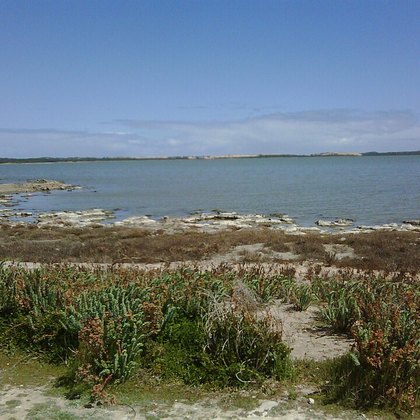
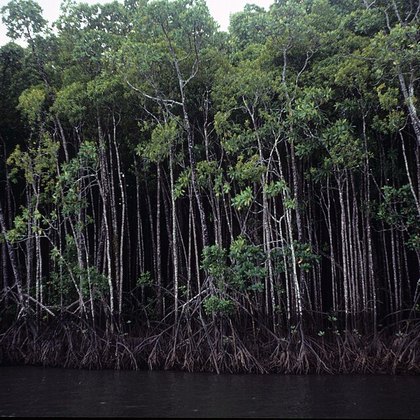
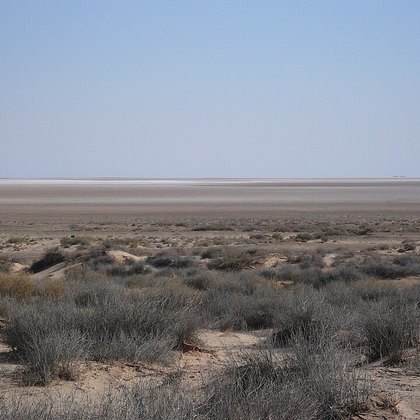
Shallow, open and often brackish or saline ground it can hunt over: drying tidal flats, saltmarsh and samphire plains, the edges of mangrove, flooded grassland and the shores of shallow inland lakes. The water itself matters little to it; what counts is a low, open plain to swerve above. It does not breed in this region — its colonies lie in Asia, on salt lakes and river plains.
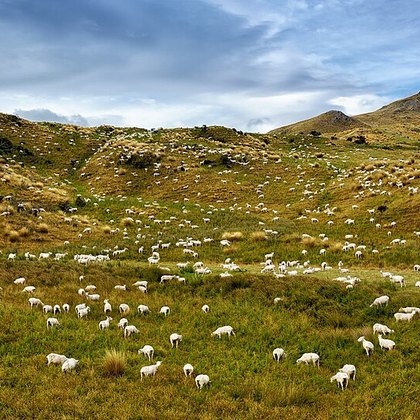
Where the bird is most often found, arranged by main group and formation.

Range and movements
In this map window a visitor from Asia: birds of the subspecies breeding in South and Southeast Asia reach the northern and northwestern coasts in the austral summer, from the Kimberley and the Top End to the Gulf of Carpentaria, with scattered records further south. How numerous it really is has become hard to say since Australian Tern was split off: many older Australian reports under the name Gull-billed Tern in fact concern the Australian species. In New Zealand it is extremely rare, with only a handful of records.
- Resident
- dark = core range, pale = thinly spread
Where and when to look
Do not look for it over the water but along it: scan a saltmarsh, a drying flat or a freshly flooded paddock for the bird that hunts low and swerving and repeatedly stoops to the ground without getting wet. When it settles, check the legs — long and black — and the bill profile against the sky: short, thick and blunt is Gull-billed, long and spiky is every other tern.
Conservation
Not threatened (LC) thanks to a very wide world range across four continents, though several regional populations are small and vulnerable. Its weak point is habitat: it depends on shallow, seasonal saline and marsh flats, and those are being reclaimed, drained or converted to aquaculture on a large scale, especially along the Asian flyway that brings the birds to Australia. In Europe the species has declined sharply as a result; in this region it is too scarce for a trend to be read.
Scientific name
Gelochelidon nilotica | (Gmelin, 1789)
Gmelin described the species in 1789 as Sterna nilotica; because it was later placed in another genus, author and year stand in parentheses. The genus Gelochelidon was introduced by Brehm in 1830 and is built from Greek gelan, 'to laugh', and khelidon, 'swallow': the laughing swallow, after the same call that gave it its Dutch name. nilotica means 'of the Nile', and the type locality is indeed Egypt, where the species breeds along the river and the delta lakes. The English and Spanish names are not about the voice but about the bill: both call it gull-thick.