All species › Waders, gulls and terns › Skimmers, noddies, terns and gulls › Blue-billed White Tern
Blue-billed White Tern | Gygis candida
Opaalstern | Charrán blanco
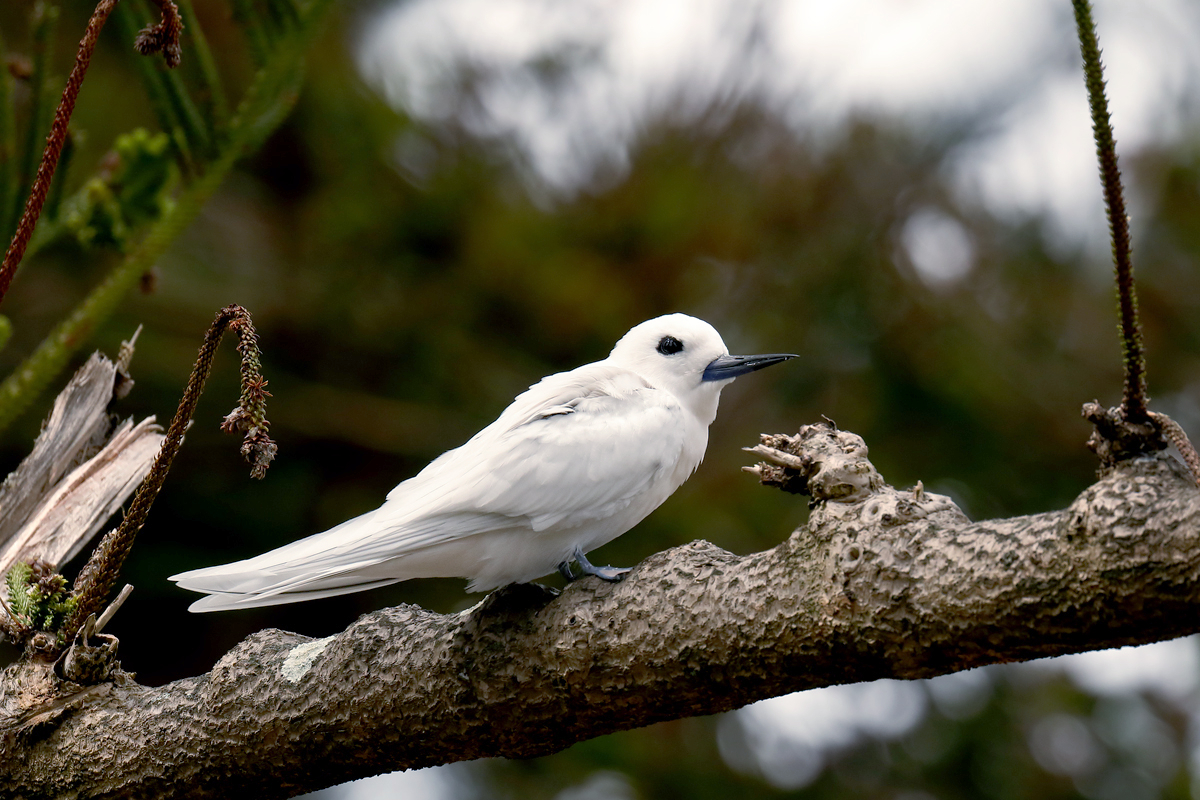
The Blue-billed White Tern is pure white, translucent against the light, and carries a black eye-ring that makes the eye look unnaturally large. It builds no nest: the single egg is laid in a slight hollow on a bare branch, a fork or a ledge, up to fifteen metres above the ground. In this region it is the bird of Norfolk and Lord Howe, where it breeds among the houses and in the pines.
Voice
The usual call is a short guttural heech heech, exchanged by birds over the breeding trees and sounding like a whispered rasp. When egg or chick is disturbed there is a wheezing, drawn-out squeal, and two birds disputing the same branch produce a whirring, twanging note. At sea it is almost always silent. In a colony what one mostly hears is the clatter of wings as birds turn close past each other.
No freely licensed recording has been found for this species yet; what to listen for is described below.
Identification
A medium-sized, entirely white tern of twenty-five to thirty-one centimetres, with long tapering wings that glow translucent when backlit. The bill is straight to slightly upturned, black with a blue base, and around the eye lies a black ring drawn out towards the bill, which makes the eye look large and dark. The legs are blue-grey with yellow webs and the tail is short and forked. Young birds have a dark patch behind the eye, a grey-brown scaled mantle and a duller bill. The sexes look alike.
Confusion species
There is barely any confusion: no other tern in this region is entirely white with a black bill and a black eye-ring. Grey Noddy (Anous albivitta) of the same islands is pale blue-grey rather than white and has a dark underwing. Black-naped Tern (Sterna sumatrana) is white with a black band across the nape and a longer, deeply forked tail. A bleached or partly white tern of another species can pass for this bird at range, but lacks the eye-ring and the upturned blue bill base. Under the taxonomy of this guide the Pacific bird is Gygis candida; Gygis alba is the Atlantic species and does not occur here.
Habitat
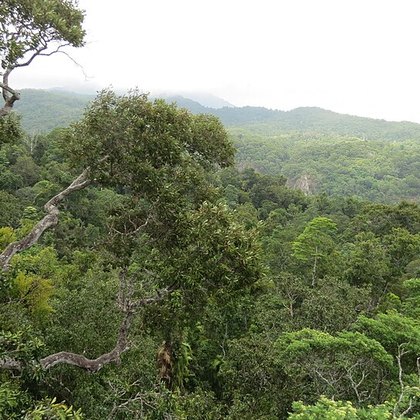
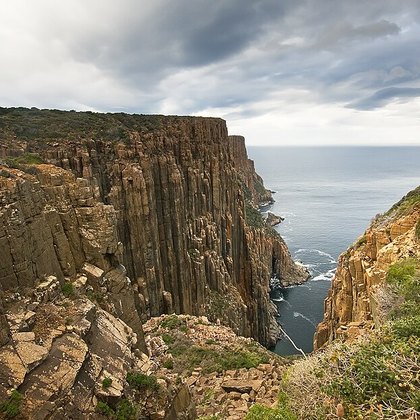
Warm, deep sea is its hunting ground: it fishes far offshore over deep water, taking small fish and squid from the surface and carrying several back crosswise in the bill. It breeds on oceanic islands, in trees along forest edges and in avenue trees, araucaria pines and garden trees in the middle of settlement. Rock ledges and cliffs also serve as a place for the egg, but the branch is preferred. It does not use mainland Australia or New Zealand.
Where the bird is most often found, arranged by main group and formation.


Range and movements
Within this region it breeds on Norfolk, where it is common and nests right into the township, on Lord Howe, where it established itself during the twentieth century and has increased since, and with a handful of pairs on Raoul in the Kermadecs. Outside the guide it is spread across the tropical Pacific and Indian oceans. On the east coast of Australia and along the New Zealand coast it turns up as a vagrant, usually after a cyclone, and then often exhausted or dead on the beach. On the New Zealand list the Kermadec breeding population counts as highly vulnerable, simply because there are so few pairs.
- Breeding (summer)
- dark = core range, pale = thinly spread
Where and when to look
On Norfolk there is no need to go offshore: walk through Kingston or along the avenue trees at Burnt Pine between September and March and look up into the forks of the branches, because that is where the egg or the chick sits, without a nest. Look not only for white against green but for white against cloud — backlit, the translucent wing is the most striking feature. Keep clear of the trunk: a disturbed parent flies up and the egg lies loose.
Conservation
Least Concern (LC), with a widely spread world population and a healthy occupancy on Norfolk and Lord Howe, growing on the latter. The danger lies in the island situation: rats, cats and feral animals can clear a colony from a small island within a few years, and the loose egg on the branch is equally vulnerable to storm and to disturbance. On Raoul the last predators were removed in 2002, but the colony there still counts only a handful of pairs.
Scientific name
Gygis candida | (Gmelin, 1789)
Gmelin described the bird in 1789 as Sterna Candida, among the terns; because it was later moved to another genus, author and year stand in parentheses. The genus Gygis was introduced by Wagler in 1832, after Greek guges, the name of an unidentified bird in classical writing. candida means 'shining white'. The type locality is Christmas Island in the Pacific, present-day Kiritimati; the islands of the same name in the Indian Ocean have nothing to do with it.