All species › Waders, gulls and terns › Skimmers, noddies, terns and gulls › Silver Gull
Silver Gull | Chroicocephalus novaehollandiae
Witkopmeeuw | Gaviota plateada
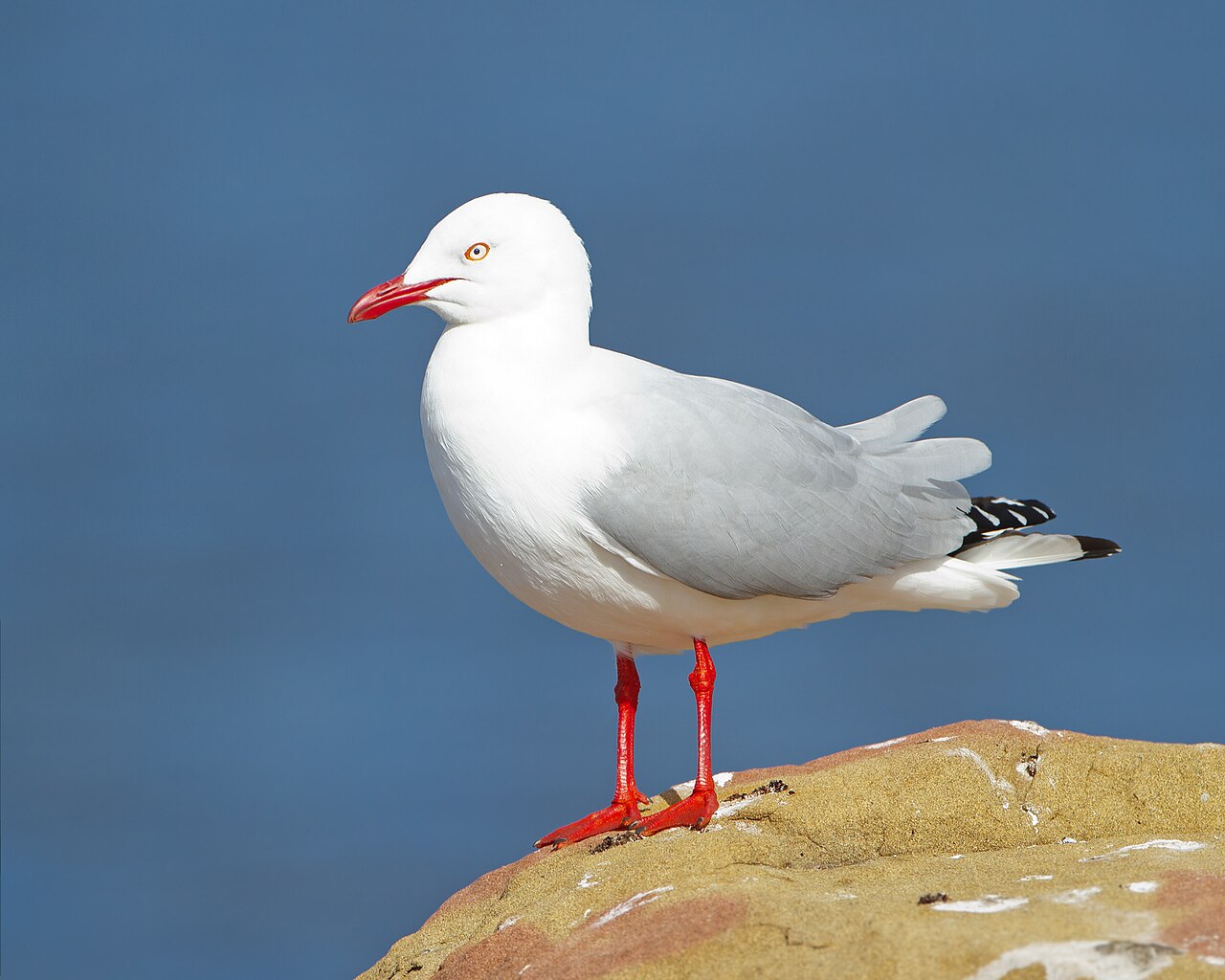
The Silver Gull is the small red-trimmed gull that stands at every harbour, beach and chip shop in Australia and New Zealand: white with a pale grey mantle, black wingtips with white mirrors, and bill, legs and eye-ring a hard orange-red. It is the gull everyone knows, and the only one that pushes inland as far as the salt lakes.
Voice
A harsh, scraping kwee-aarr is the usual call, often in series and thrown out with the head raised. Around a colony or a fishing wharf that runs together into a sustained squabbling scream with dozens of birds calling at once. In a scrap over food comes a short angry kek. Young birds beg with a thin whining whistle they keep up long after fledging.
No freely licensed recording has been found for this species yet; what to listen for is described below.
Identification
A small gull of just over forty centimetres, white on head, neck, underparts and tail, with a pale grey mantle and black wingtips carrying white mirrors. The adult has a bright red bill, red legs and a red eye-ring around a white iris; that combination rules out every other gull in the region. It never takes a hood, not even when breeding. First-year birds have brown shoulder feathers, a black tail band and a dark brown-black bill and legs; the red comes through during the second year.
Confusion species
Black-billed Gull (Chroicocephalus bulleri) of New Zealand is the hard one: paler grey on the mantle, with a long black bill and far more white in the primaries, and tied to the braided rivers of the South Island. Pacific Gull (Larus pacificus) and Kelp Gull (Larus dominicanus) are much larger and black-mantled. A young Silver Gull with a dark bill is regularly taken for a Black-billed Gull at range; go by the brown shoulder patches, which the Black-billed does not show so coarsely.
Habitat
Almost any water on or near land: estuaries and mudflats, beaches and harbours, lakes and reservoirs, sewage ponds and rubbish tips, and the lawns of every coastal park. It rarely goes far out to sea, though it follows fishing boats beyond sight of the coast. It breeds in dense colonies on predator-free islets, on sandbars, on breakwaters and now also on flat city roofs.
Where the bird is most often found, arranged by main group and formation.



Range and movements
Right around Australia, inland too wherever lakes and salt lakes lie, plus Tasmania, New Zealand with the Chathams and the subantarctic islands, New Caledonia and the Loyalty Islands. The New Zealand birds are the race scopulinus, known there as the Red-billed Gull and kept within this species by AviList. It does not migrate, but young birds wander far, and after inland rain parties follow the water to the filling salt lakes.
- Resident
- dark = core range, pale = thinly spread
Where and when to look
Any harbour or ferry produces it, but to see it properly walk past a breeding colony on an islet in an estuary between August and December. Watch the age classes there: first-years with brown shoulders and black bills stand beside adults, and the difference can be learnt at one glance. Do not feed it on the beach, because a party of Silver Gulls that has once learnt food is coming will not let you go.
Conservation
Least Concern (LC) and increased over nearly all of its range, because tips, fish waste, sewage ponds and city parks have handed it food the year round. The one real limit is nest sites: it needs predator-free islets, and where rats, cats or foxes arrive a colony empties. Locally it has become numerous enough to rob the nests of terns and small plovers, which sometimes makes control necessary around rare coastal breeders.
Scientific name
Chroicocephalus novaehollandiae | (Stephens, 1826)
Stephens described the species in 1826 as Larus novaehollandiae; because it was later moved to another genus, author and year stand in parentheses. The genus Chroicocephalus was introduced by Eyton in 1836 and is built from Greek khrōikos, 'coloured', and -kephalos, '-headed' — after the coloured hood of most of its members, which this species happens to lack. novaehollandiae means 'of New Holland', the old name for Australia, and the described bird came from that coast.